

Albanese’s ‘Australian Way’
Current Issue
- Events
- Book reviews
- Arts criticism
- Prizes & Fellowships
Sign Up For Our Newsletters
- Events
- Book reviews
- Arts criticism
- Prizes & Fellowships
Sign Up For Our Newsletters
Fierceland by Omar Musa
Omar Musa’s first novel, Here Come the Dogs (2014), is a rousing dramatisation of the combustible sense of displacement and dissatisfaction simmering at the underrepresented margins of Australian life. Its protagonists are singular and compelling: each is tender and violent, hopeful and despairing, pitiful and triumphant. They all possess a uniquely hybrid identity, and each is searching for something that is always out of reach.
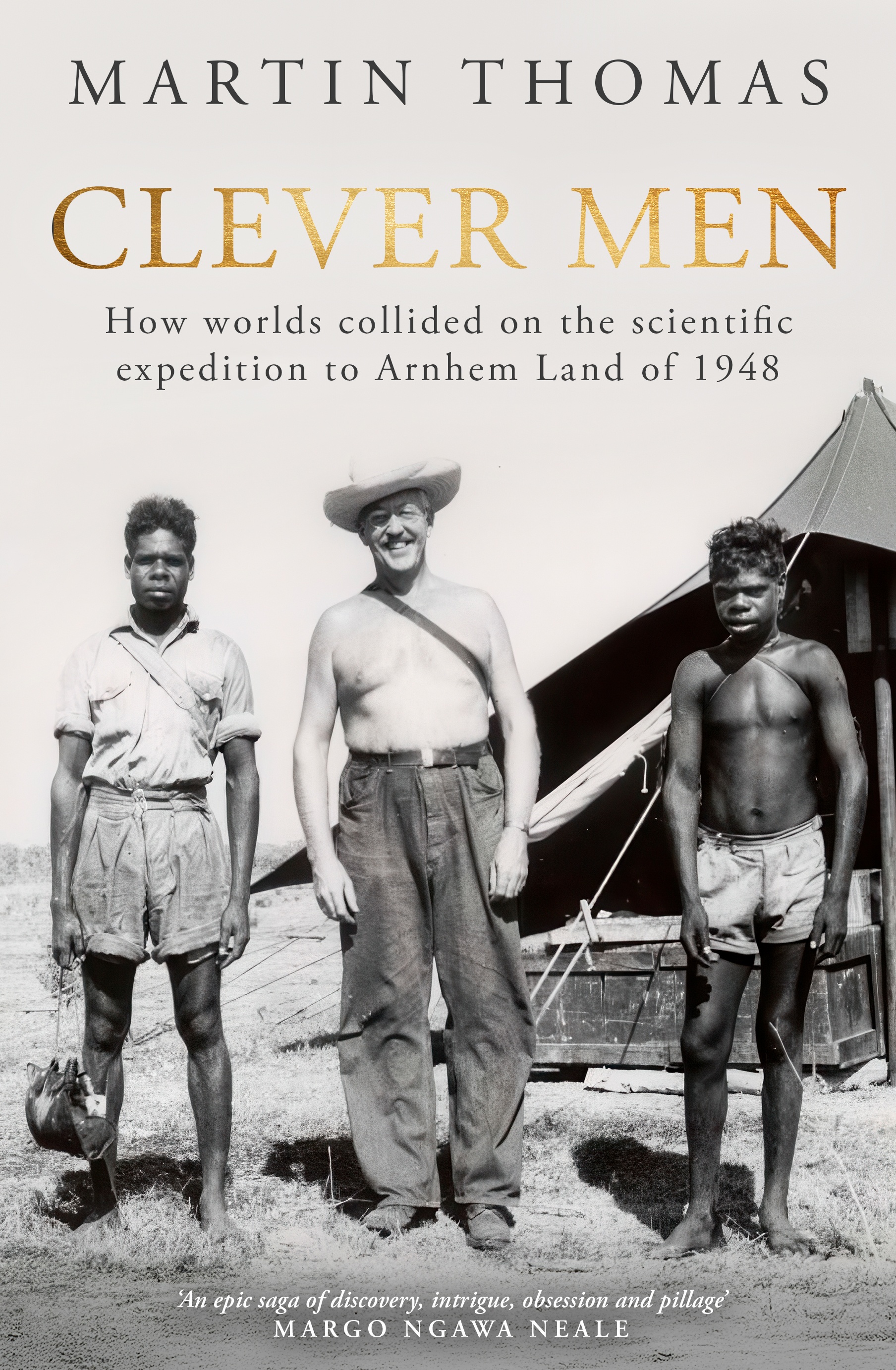
Clever Men: How worlds collided on the scientific expedition to Arnhem Land of 1948 by Martin Thomas
Soon after the conclusion of the 1948 Arnhem Land expedition, its leader, Charles Pearcy Mountford, an ethnologist and filmmaker, was celebrated by the National Geographic Society, a key sponsor of the expedition, along with the Smithsonian Institution in Washington DC and the Commonwealth Department of Information. In presenting Mountford with the Franklin L. Burr Prize and praising his ‘outstanding leadership’, the Society effectively honoured his success in presenting himself as the leader of a team of scientists working together in pursuit of new frontiers of knowledge. But this presentation is best read as theatre. The expedition’s scientific achievements were middling at best and, behind the scenes, the turmoil and disagreement that had characterised the expedition continued to rage.
Poet of the Month with Ellen van Neerven
Ellen van Neerven is a writer and editor of Mununjali and Dutch heritage. Their books include Heat and Light (2014), Comfort Food (2016), Throat (2020), and Personal Score (2023). Ellen’s first book, Heat and Light, was the recipient of the David Unaipon Award, the Dobbie Literary Award, and the NSW Premier’s Literary Awards Indigenous Writers’ Prize. Ellen’s second book, Comfort Food, was shortlisted for the NSW Premier’s Literary Awards Kenneth Slessor Prize and highly commended in the 2016 Wesley Michel Wright Prize. They live and write on unceded Yagera and Turrbal dhagun.
‘Land rights interrupted?: How Whitlam’s dismissal changed the history of First Nations land repossession’
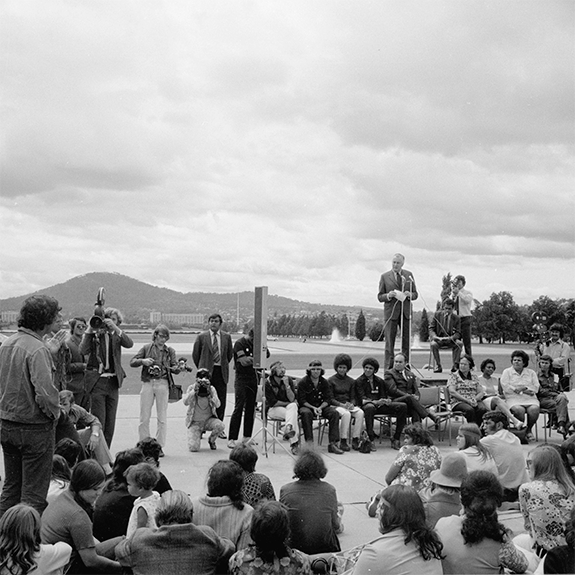
On the steps of Federal Parliament, a scrum assembled. Reporters jostled for position, enraged members of the public shouted over one another, advisers stood with faces drained of composure – even a comedian was caught in the fray. At the centre stood the tall and imposing figure of Prime Minister Gough Whitlam, listening as the governor-general’s official secretary read the proclamation dissolving Parliament. The moment, instantly mythic, would be remembered as ‘the dismissal’ – the most audacious constitutional rupture in Australian history, one that continues to haunt democratic life half a century on.
‘Alternate Names for Blak Mothers’
1. worlds inside brown eyes
2. a figure in a bed
3. stars in summer
4. women of clay
Walking Sydney: Fifteen walks with a city’s writers by Belinda Castles
During the walk she takes with Michelle de Kretser along the Cooks River, the bit that snakes between Hurlstone Park and Tempe, Belinda Castles, the author of Walking Sydney, muses on the impact of Sydney’s geography. ‘On the footpath-climb to skirt the golf course,’ she writes, ‘the village-like nature of Sydney makes itself felt, the way suburbs are enclosed and cut off by ridges and valleys, cliffs and rivers, the tentacles of the harbour. A city’s form has an effect on thinking and ways of being.’
On the Calculation of Volume: Book I by Solvej Balle, translated from Danish by Barbara J. Haveland & On the Calculation of Volume: Book II by Solvej Balle, translated from Danish by Barbara J. Haveland
In a famous thought experiment based on the notion of ‘eternal return’, German philosopher Friedrich Nietzsche asked what it would be like to live the same life over and over again, for eternity. Nietzsche’s intention was to set a kind of test that encourages us to consider whether we are living our best life, the life that makes us happiest.
Prove It: A scientific guide for the post-truth era by Elizabeth Finkel
Living alongside the world’s only native black swans, Australians should be more alive to the provisional nature of truth than most. For thousands of years of European history, the ‘fact’ that ‘all swans are white’ was backed up with an overwhelming data set that only the delusional – or a philosopher – would debate. But as Scottish Enlightenment philosopher David Hume pointed out, the difficulty with inductive reasoning is that it can seem incontrovertible all the way up until it is not. But if the truth is always shifting, where do we find solid ground when our lives depend on it? And to what absolutes and experts can we refer in an era of wilful misinformation, institutional mistrust, and anti-expert populism?
Letters – October 2025
My career began at Australian Book Review, and as such I’ve been prompted to reflect on the importance of publications such as ABR to ensuring a robust critical culture in Australia in the wake of Meanjin’s closure. The decision was announced on September 4 that Meanjin, one of Australia’s longest-running literary journals, would cease to be published by its custodian, Melbourne University Publishing, and that the editor and I would be made redundant.
ABR Arts
Bruckner and Strauss: A thoughtful performance of works by two Romantic masters
Letter from Santa Fe: 'Marriage of Figaro' and Wagner’s 'Die Walküre' at the Opera House
‘Waiting for Godot: Keanu Reeves and Alex Winter reunite for Beckett’s classic’
Book of the Week
Clever Men: How worlds collided on the scientific expedition to Arnhem Land of 1948 by Martin Thomas
Soon after the conclusion of the 1948 Arnhem Land expedition, its leader, Charles Pearcy Mountford, an ethnologist and filmmaker, was celebrated by the National Geographic Society, a key sponsor of the expedition, along with the Smithsonian Institution in Washington DC and the Commonwealth Department of Information. In presenting Mountford with the Franklin L. Burr Prize and praising his ‘outstanding leadership’, the Society effectively honoured his success in presenting himself as the leader of a team of scientists working together in pursuit of new frontiers of knowledge. But this presentation is best read as theatre. The expedition’s scientific achievements were middling at best and, behind the scenes, the turmoil and disagreement that had characterised the expedition continued to rage.
From the Archive
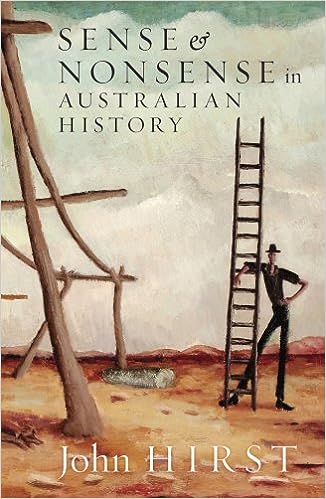
Sense and Nonsense in Australian History by John Hirst
John Hirst is a throwback. I don’t mean in his political views, but in his sense of his duty as an historian. He belongs to a tradition which, in this country, goes back to the 1870s and 1880s, when the Australian colonies began to feel the influence of German ideas about the right relationship between the humanities and the state. Today it is a tradition increasingly hard to maintain. Under this rubric, both historians and public servants are meant to offer critical and constructive argument about present events and the destiny of the nation. Henry Parkes was an historian of sorts, and he was happy to spend government money on the underpinnings of historical scholarship in Australia. The Historical Records of New South Wales was one obvious result, and that effort, in itself, involved close cooperation between bureaucrats and scholars. Alfred Deakin was likewise a man of considerable scholarship (and more sophisticated than Parkes), whose reading shaped his ideas about national destiny, and who nourished a similar outlook at the bureaucratic level.