


- Free Article: Yes
- Contents Category: Theatre
- Review Article: Yes
- Article Title: Light Shining in Buckinghamshire
- Article Subtitle: Paradise delayed
- Online Only: No
- Custom Highlight Text:
Caryl Churchill’s Light Shining in Buckinghamshire, first performed in 1976, is a dense and difficult play set during the English Civil War. The period may be distant in time but Churchill, working in a broadly Marxist tradition, sees it as an era when fundamental questions of governance were tested by a mass of ordinary people. From whom does the state derive authority, and is a person bound to obey laws they find unjust? Does the existence of private property – those enclosed lands cultivated for the profit of a few – offend against the common good? Do the rich offend God? ‘For a short time when the king had been defeated anything seemed possible,’ Churchill wrote in a 1978 introductory note. The possibilities included, for some, Christ’s return and with it the instigation of an earthly Paradise.
- Article Hero Image (920px wide):
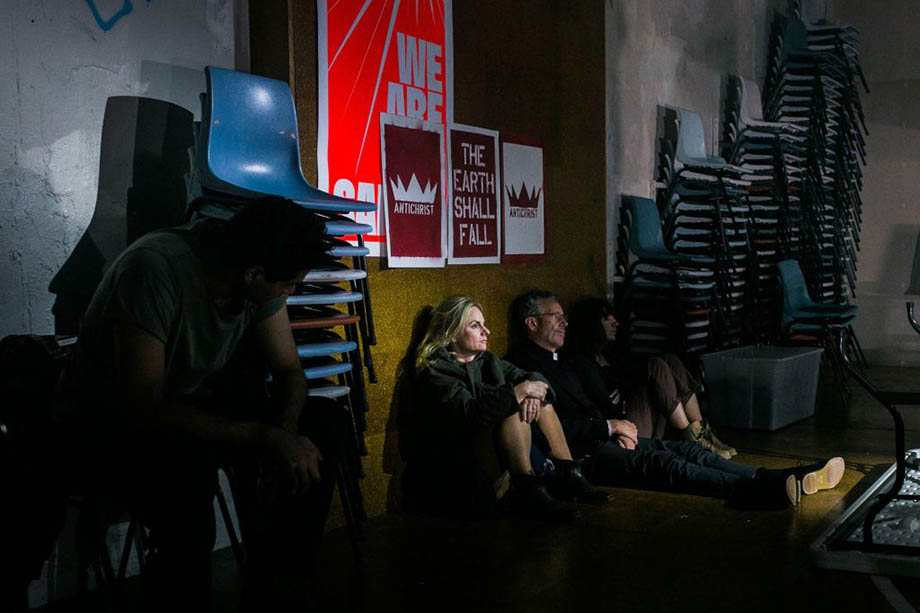
- Article Hero Image Caption: Production image from <em>Light Shining in Buckinghamshire </em> (Teniola Komolafe/Belvoir St Theatre)
- Alt Tag (Article Hero Image): Production image from Light Shining in Buckinghamshire (Teniola Komolafe/Belvoir St Theatre)
- Production Company: Belvoir St Theatre
Though set during a bloody conflict this is a play driven by ideas rather than action, interspersing didactic vignettes – a parson lecturing his parishioners, a starving peasant who abandons her baby – with long, wordy scenes of theological and political argument. It requires each cast member to act multiple roles, none of them characters in a rounded sense, and to get their tongues around large chunks of seventeenth-century English taken from the historical record (letters, pamphlets, parliamentary debates), not to mention the millenarian cadences of assorted Levellers, Diggers, Ranters, and Anabaptists. It is, in short, a challenge, and not one that this production meets, or which its co-directors, Eamon Flack and Hannah Goodwin, even appear to want to meet.
Let me begin at the end and work backwards. After all, this is a play about the power of eschatological thinking. In the script’s penultimate speech, a commoner named Briggs (Arkia Ashraf) describes an act of self-martyrdom. It is 1649 or thereabouts: the Republic has been declared, Oliver Cromwell is on the verge of invading Ireland, and the Civil War’s most radical dissenters, including the Diggers, led by Gerard Winstanley, have been suppressed. Enclosures of the commons continue, and the price of staple crops has risen. As a counteraction, Briggs starves himself: ‘A few people eat far too much. So if a few people ate far too little that might balance.’ He lives on grass, wild berries, and dandelions. The owner of the field in which he forages treats him as a public entertainment.
It is a bleak denouement, in which a man continues to pursue his principles in lonely uselessness. The emptiness of Michael Hankin’s set design at Belvoir Street made sense in this concluding moment: a bare wooden floor, spartan school chairs, a flickering theatre billboard that advertises ‘CHRIST ON EARTH’ as the last, best show in town. Ashraf, to his credit, performed Briggs’s speech as tragedy, which it is, but the opening night audience understood it as comedy. That mismatch was not the actor’s fault.
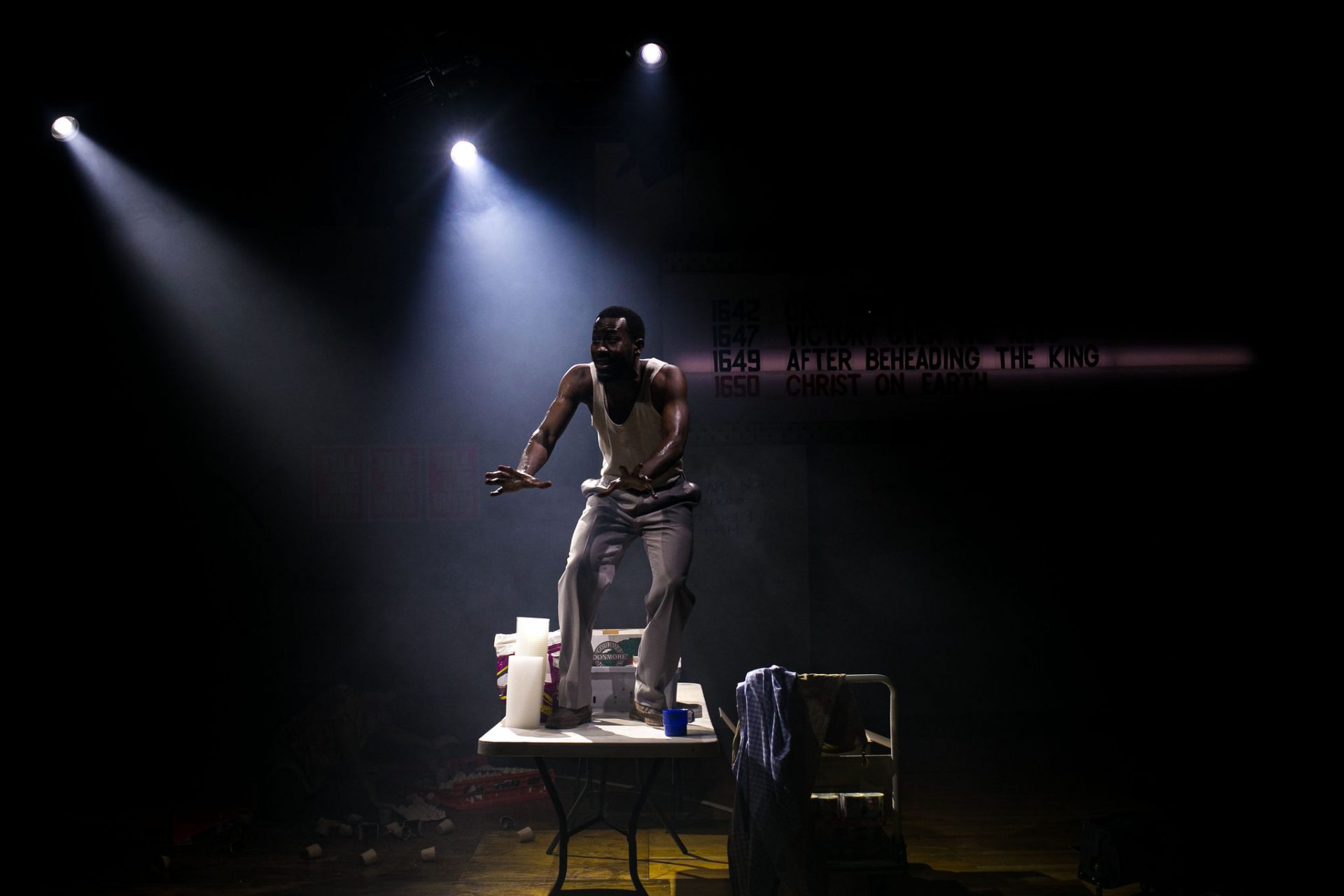 Production image from Light Shining in Buckinghamshire (Teniola Komolafe/Belvoir St Theatre)
Right from the start, decisions made by Flack and Goodwin scupper any pathos in the radicals’ betrayal by Cromwell. Their most damaging is to encourage us to laugh at these people, to regard them as crazy, even as they also strain to signal to us contemporary reference points, as if we can’t deduce these for ourselves. What’s the fear – that taking seventeenth-century Protestant radicals seriously, on their own terms, would mean something was at stake beyond the superficial (and predictable) recreation of present-day protest aesthetics, the placards and posters and graffiti? That an audience might resist the source material unless it’s dressed down as comedy? I’m all for moments of levity, even or especially amid the Last Days, but the approach here trivialises history. (A weak Covid joke, for instance: let it go.) Passionate debate, life-and-death, damnation-or-salvation stuff, is reduced either to slick politicking or wild-eyed tirade, while outmoded social mores, such as the prohibiting of women’s public speech, become invitations for the audience to congratulate ourselves on our better attitudes. ‘Their voices are surprisingly close to us,’ Churchill wrote of the dissenters who populate her play, but in this staging their voices only grow more distant and obtuse.
Audience members who arrive at this production without a working knowledge of the doctrinal and political differences between various seventeenth-century groupings – between the Calvinists’ belief in predetermination and the Ranters’ heretical antinomianism, or between the Levellers’ support for popular sovereignty and the Diggers’ agrarian Christian communism, all of which are covered, and some at length, in Churchill’s script – will go away just as unenlightened. This is partly a hazard of the play, which is short on exposition, but the Belvoir house style of contemporary dress and casual Australian diction does little to help distinguish, in speech, bearing, or appearance, between Puritan and Parliamentarian, peasant, parson, or landlord. A long, textually complicated scene, based on transcripts of the 1647 Putney Debates where Oliver Cromwell and his Grandees opposed the radicals’ arguments for universal (male) suffrage, would be a test for a stronger – and better directed – cast than this. Here, with both Cromwell (Marco Chiappi) and his son-in-law Henry Ireton (Brandon McClelland) played as smooth-talking politicians gesturing over stacks of laminated folders, the issues at hand – the relationship of property to citizenship, of citizen to state, of state to law, of law to anarchy, and so on – are diminished. We might as well be watching a squabble at the local ALP branch meeting, and for that kind of entertainment I’d rather revisit Rats in the Ranks.
On opening night there was a high percentage of misspoken lines and fudged cues. Even taking nerves into consideration, and the fact that every actor is rusty after two years without live performance, the cast’s struggle to stay on top of the text suggested a deeper problem with inhabiting the play. Most of the time they didn’t even seem to be in the same play, with the majority of the actors aiming for laughs while a handful, including Ashraf and Rashidi Edward as Claxton the Ranter (among other roles), took it seriously. Sandy Greenwood tried a distinctive and poignant sketch of a peasant-slash-disenfranchised Aboriginal woman, but the soft-spoken anxiety of her characterisation affected the audibility of her lines. Only during a few musical numbers did the cast gel: simple but effective choral settings of texts from Isaiah, Ecclesiastes, and Walt Whitman, by musicians Alyx Dennison and Marcus Whale, brought the actors together as speech did not. Here at least was dignity, beauty, and communion – all of those things that the radicals’ tracts spoke of.
It must be said Flack and Goodwin – the former Belvoir’s artistic director, the latter making her main stage directorial début – have set themselves and their cast an extra hurdle by staging Churchill’s play in repertory with Alana Valentine’s Wayside Bride, about the Wayside Chapel in Kings Cross and its progressive founding Methodist minister, Ted Noffs. This is the first time that Belvoir Street Theatre has done repertory work. In theory, the pairing makes sense: two playwrights concerned with social justice; two plays that both draw upon written and oral histories, with shared themes of religious dissent and democracy in practice. But in practice, what we get with is one interesting script – Churchill’s – poorly staged, and one weak script – Valentine’s – performed just as weakly. (The faults of that production would take a separate review.) Combined, that’s four-and-a-half hours of mediocre theatre.
‘How long till we win?’ the commoner Briggs asks the merchant Star, early in Churchill’s play. Too long by half. This production drags, and Paradise is yet delayed.
Light Shining in Buckinghamshire by Caryl Churchill is running at Belvoir Street Theatre until May 28, in a repertory program alternating with Wayside Bride by Alana Valentine. Performances attended: April 14 (Churchill) and April 16 (Valentine).