


- Free Article: No
- Contents Category: Film
- Review Article: Yes
- Article Title: The Godfather
- Article Subtitle: Revisiting Francis Ford Coppola’s classic fifty years on
- Online Only: No
- Custom Highlight Text:
The Godfather, the first instalment of Francis Ford Coppola’s three-part mafioso epic, premièred fifty years ago last month. Released in March 1972, The Godfather became a huge commercial success. By year’s end it was the highest-ever grossing film. And despite its brutal and salacious content, and its pulpy source material – which may help explain its attraction to moviegoers – it was a critical success. Pauline Kael, writing in the New Yorker, described it as ‘a great example of how the best popular movies come out of a merger of commerce and art’.
- Article Hero Image (920px wide):
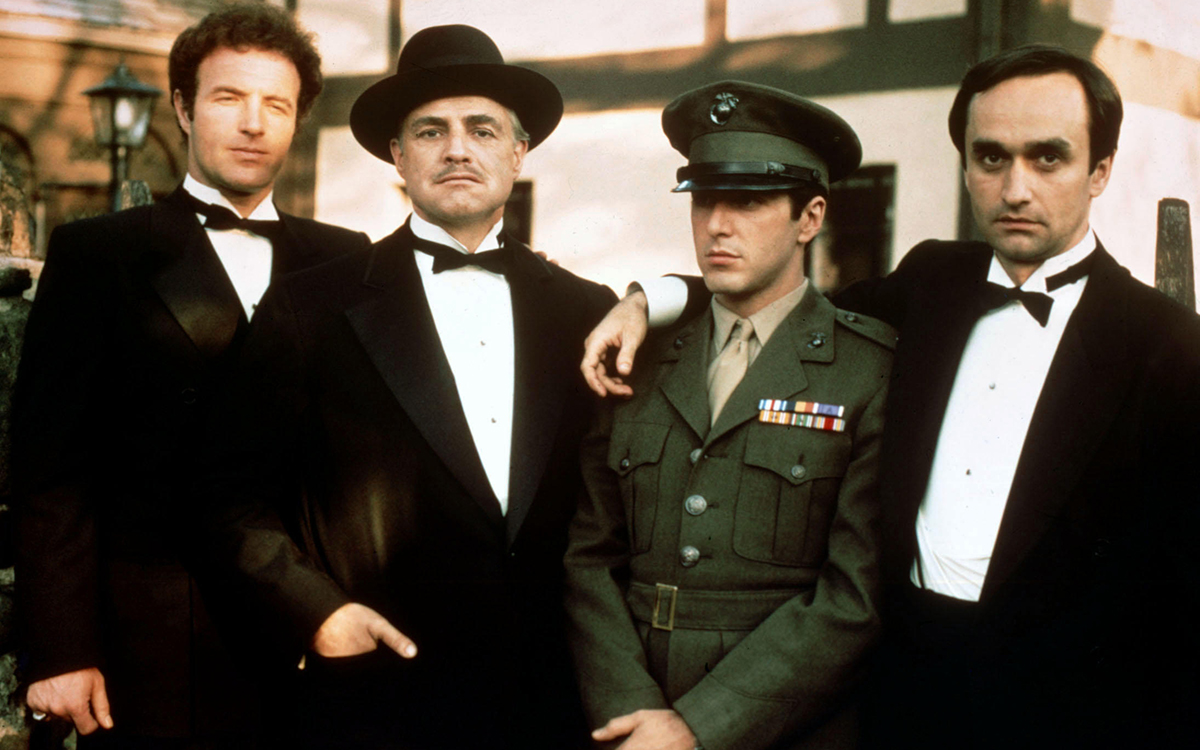
- Article Hero Image Caption: James Caan as Sonny Corleone, Marlon Brando as Vito Corleone, Al Pacino as Michael Corleone, and John Cazale as Fredo Corleone in The Godfather. (image courtesy of Alamy)
- Alt Tag (Article Hero Image): James Caan as Sonny Corleone, Marlon Brando as Vito Corleone, Al Pacino as Michael Corleone, and John Cazale as Fredo Corleone in The Godfather. (image courtesy of Alamy)
This bifold critical and public popularity has not wavered. There was no notable critical dissent in 1972, and no significant critical reappraisals have appeared since. If anything, critics of The Godfather have become less discerning. Commentary was reverential in the wake of the film’s anniversary – it was ‘masterful’, ‘magnificent’. ‘the greatest’. Most filmgoers generally agree.
The reverence for The Godfather is understandable. It is a beautiful film; the colours are sumptuous, the deep brown shadows giving the characters the firelit appearance of Rembrandt portraits. Gordon Willis’s cinematography is similarly masterful. Violent murders and the tableaux of family dinners are viewed from a shoulder-height perspective. Viewers observe proceedings from the same level, guaranteeing a certain camaraderie or complicity. Though the filmmaking is not as inventive as Coppola’s Apocalypse Now (1979), it elegantly serves its purpose.
Marlon Brando’s performance as the aging Don Corleone remains convincing – notwithstanding his odd wheeze and puffy face. Despite the violence the audience knows him to be capable of, we believe that the Godfather is in his heart a wise and gentle soul, a true Solomon of the Italian diaspora. As for Al Pacino as Michael, Brando’s ambivalent heir, not once throughout the film is he surprised in the act of acting.
And yet, technical quality alone does not guarantee lasting popularity. Quality films are made all the time. Perhaps it is The Godfather’s stable of memorable images that has ensured its durability – that poor horse, for example, or the gunshot that is potted through Moe Greene’s spectacles. These shocking images lend themselves to reproduction in popular culture, enabling it to live on in references from The Simpsons to The Sopranos.
It is arguable that high on the list of The Godfather’s most enduring qualities is the timelessly seductive political order of the mob. The Corleones idealise loyalty, discipline, sacrifice, and fealty to family. They attract the audience’s id, playing upon subtle and perhaps base desires for a simpler, more virtuous time in which family and community are central. The Sicily that Michael is exiled following his murder of two underworld figures to serves as an idealised Old World, which the family (and perhaps the audience) longs to recreate. The better life offered by the United States is only material, whereas the motherland provides a moral purpose. Sicily – depicted here in the only scenes in full daylight – is a bucolic Eden in which tradition still reigns. Life is simple: archaic but uncomplicated by America’s futile attempts at justice. At least the rule of violence is predictable.
Although these values suggest a prima facie conservative worldview, longing for a more honourable or predictable time is politically neutral. Leaders across our political spectrum appear to be fundamentally unprincipled; the Corleone’s politically non-specific code of valour accepts all comers. Viewers may relish the Corleones’ violent victories over McClusky, a violent cop, and Jack Woltz, a predatory, debased member of the media ‘élite’. In political discourse, the manipulation of such nostalgia has been a mainstay of the fifty years since The Godfather’s release.
What may shock many viewers out of this fantasy of virtuosity, however, is the complete passivity and objectification of The Godfather’s women (to give just one example). Women’s absence from the film’s action is so obvious that it is almost redundant to address it. It is tempting to side with the men of the Godfather and write their treatment off as simply the ‘way things were’. Their purpose is limited to serving as passive catalysts for male action - they may only be wedded, rejected, beaten, or killed. Only silent, demure Appolonia, Michael’s Sicilian love, is even granted any kindness. The Corleones’ misogyny foregrounds their hypocritical brutality, exposing the fundamental weakness of their principles. It will turn much of the audience against the Corleones. For others, perhaps, it is part of the film’s allure.
It is in this way that the women of The Godfather serve a key narrative purpose. They can observe the mob as outsiders, even as they live (and cook and clean) within their inner sanctum. The viewer shares Kay’s position as an insider–outsider, a semi-participant in their brotherhood but nevertheless anchored to an outsider’s sense of moral context. For example, in the film’s final scene, Kay (played by a then unknown Diane Keaton) observes Michael at a distance, framed by the doorway of the Godfather’s study and his men-at-arms. She, and therefore the audience, sees him not as he sees himself – as respected and feared. From her perspective, he is isolated and vulnerable.
Herein lies the sophistication of Coppola’s direction. He entices the audience into the mob with promises of principles, justice, and order, just as Don Corleone does to the guests at his daughter’s wedding. However, the audience is not permitted to indulge in the fantasy; we – insider–outsiders too – may see that maintaining the mob’s code of conduct is a fundamentally corrupted pursuit, unachievable without hypocrisy, brutality, and misogyny. How this differs from other mafia films lies in is its deftness, and its refusal to moralise. Where the protagonists of Goodfellas and Scarface seek redemption or get their righteous comeuppance, the Corleones’ doom is revealed in smaller, more human moments. As Tom Hagan, effectively the fourth Corleone brother, is ousted from Michael’s inner circle in the film’s denouement, the camera lingers on his hurt face. Even the mournful ‘Godfather Waltz’, heard before the film opens, subtly warns the audience of the looming tragedy of the Corleones. Waltzes are cyclical in structure; even the score implies that the end of the family’s Old World and its accompanying values is inevitable.
It is not simply the technical quality and pop-culture cool of The Godfather Part I that have garnered it fifty years of kudos and popularity. The Corleones’ nostalgia for a forgotten age of principles and justice is broadly appealing to an audience accustomed to increasing political instability and absurdity. And yet because of Coppola’s directorial subtlety, the audience may decide whether to side with the mob or to remain outsiders – whether they choose to view the Corleones as bastions of old-world virtue or hypocritical butchers. The film therefore works as both a straightforward mob-thriller, and as a searing exploration of patriarchal power.
It is this political and ideological ambiguity that has ensured The Godfather’s lasting success. Coppola produced a film that reflects back to the audience its own impulses, both righteous and unflattering.