


- Free Article: No
- Contents Category: Film
- Review Article: Yes
- Article Title: Memoria
- Article Subtitle: Apichatpong Weerasethakul’s eerie resonances
- Online Only: No
- Custom Highlight Text:
In the middle of Bogotá’s Parque de la Independencia is a statue of Nicolaus Copernicus. Designed by the Polish sculptor Tadeusz Lodziana, it was gifted by the People’s Republic of Poland to the city of Bogotá in 1974, after the resumption of diplomatic relations between the two countries, which had been suspended from 1952 to 1964. This period overlapped with La Violencia in Colombia, a bloody civil war between conservative and left-wing forces, during which roughly 200,000 people were killed.
- Article Hero Image (920px wide):
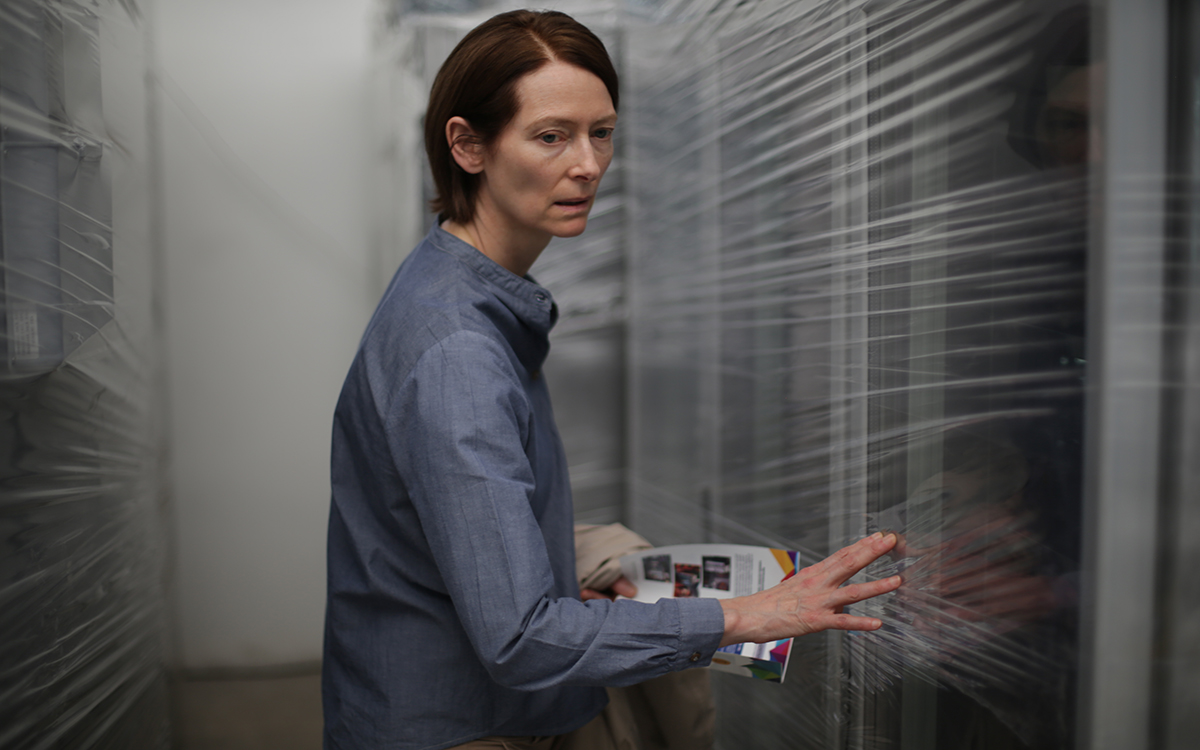
- Article Hero Image Caption: Still from <em>Memoria</em>, a film by Apichatpong Weerasethakul (photo by Sandro Kopp; © Kick the Machine Films, Burning, Anna Sanders Films, Match Factory Productions, ZDF-Arte and Piano)
- Alt Tag (Article Hero Image): Still from <em>Memoria</em>, a film by Apichatpong Weerasethakul (photo by Sandro Kopp; © Kick the Machine Films, Burning, Anna Sanders Films, Match Factory Productions, ZDF-Arte and Piano)
This statue of Copernicus appears early in Memoria, the tenth feature film by Apichatpong Weerasethakul. Jessica (Tilda Swinton), a Scottish market gardener living in Bogotá, sits at its base with Hernán (Juan Pablo Urrego), an audio engineer who is trying to help her understand a sound that only she – and we – can hear. Jessica has previously described the sound to Hérnan as something like ‘a big concrete ball that falls into a metal well surrounded by seawater’. Behind her, the stone astronomer holds a globe between his hands.
Terrestrial spheres and loops of time, beings displaced from where and when you might expect them to be, the Earth dislodged from the centre of our consciousness: all this and more is threaded through Memoria, which, as ever with the open-ended films of Weerasethakul, brims with strange, quiet hauntings. Or maybe not so quiet, in this case.
The film begins with the mysterious bang-whoomph that startles Jessica awake before dawn. The camera circles, slowly, in the darkness of her apartment. Outside, car alarms go off and yet the streets remain empty; some energy is unsettling this place, but its origins remain elusive. Weerasethakul’s approach in Memoria is consistent with his previous films, even if this is his first to be made outside Thailand. Connections between cause and effect, or between characters, will tighten for a moment then go slack again, only to come together later (sometimes much later) in a viewer’s mind. If you come to Weerasethakul for explanation, or even for basic exposition, annoyance will be your only reward.
With little narrative to move along, the actors get to simply be, the camera observing them in long takes from a distance. (Cinematographer Sayombhu Mukdeeprom also shot Weerasethakul’s most celebrated film, Uncle Boonmee Who Can Recall His Past Lives, which won the 2010 Palme d’Or at Cannes, along with Luca Guadagnino’s sensual summer romance Call Me By Your Name.) This careful, unobtrusive quality suits Swinton, in particular, who can be much like a statue in her own right. Her bearing is precise, and she keeps her own counsel.
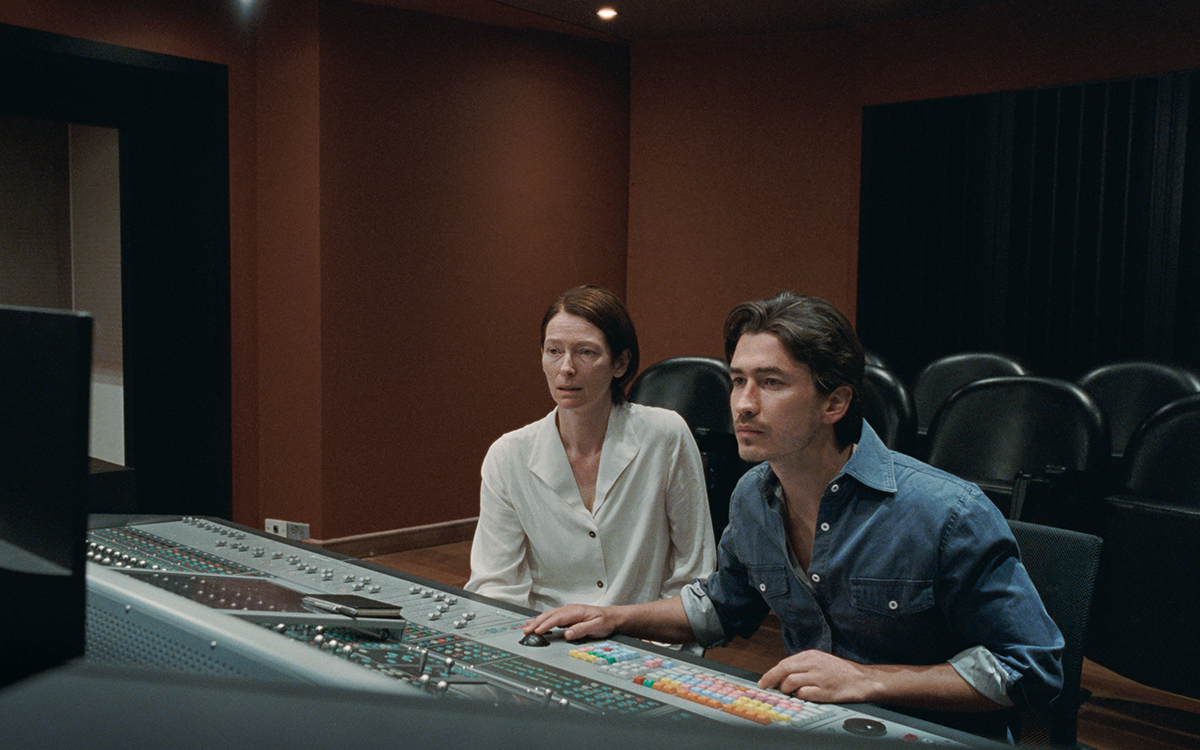 Tilda Swinton as Jessica and Juan Pablo Urrego as Hernán in Memoria (© Kick the Machine Films, Burning, Anna Sanders Films, Match Factory Productions, ZDF-Arte and Piano, 2021)
Jessica visits a relative in hospital, eats out with friends, researches rare botanical specimens at a city library, and all the while is repeatedly startled by the sound that woke her at the film’s beginning. She visits Hernán at his studio, and he attempts to recreate the sound she hears using a library of sound effects. As the two characters work together, Jessica calibrating and recalibrating her description, Hernán tweaking audio samples, we come to realise that we are watching a meditation on the sleight of hand involved in filmmaking itself, the necessary artificiality of the medium, which is no less transporting for being so.
The most notable stylistic departure here for Weerasethakul is that Memoria is muted in its colours, with nothing of the gorgeous neons that distinguished Cemetery of Splendour (2015) or the deep, jungle greens of Uncle Boonmee or Tropical Malady (2004). This holds true even when the action, such as it is, moves from Bogotá to the countryside, graveyard of the civil war dead. Memoria’s subdued palette suggests the ambiguous, elusive nature of memory itself as a kind of an afterlife-in-life, while some cleverly matched shots draw our attention to the fact that here, in Colombia, traces of pre-colonial, Spanish colonial and modern eras overlay each other in the strata of the earth and in the mind. Some characters in this film seem to exist in two places or times simultaneously; others forget each other between encounters. Memories may not belong to an individual but travel, like a sound wave, between people.
Resonance is Memoria’s organising logic: the endurance of deep sound across deep time. Only at the film’s conclusion does Weerasethakul suggest an origin for that sound, with a fantastical, last-minute leap into full-scale movie-making magic that is funny, surprising, and that risks being ridiculous. But cinema, Weerasethakul suggests in his work, is a place where the unbelievable can be made to happen. Ghosts walk, time slips, the very air is torn, and is any of it more unlikely, in the end, than our all-too-real and bloody histories?
Memoria (Madman Films), 136 mins, in cinemas April 7.