


- Free Article: No
- Contents Category: Art
- Review Article: Yes
- Article Title: Queer
- Article Subtitle: Reappraising the NGV’s heteronormative assumptions
- Online Only: No
- Custom Highlight Text:
We all know that emancipatory drives in the late twentieth century dislodged the hegemonic politics of social normativity through the movements of second wave feminism, civil rights, and gay activism, but it’s worth remembering that some rights took longer than others. Homosexuality was only fully decriminalised in Australia in 1997 (Tasmania being the last state to do so); same-sex marriages were not legalised until 2017.
- Article Hero Image (920px wide):
.jpg)
- Article Hero Image Caption: Installation view of <em>QUEER: Stories from the NGV Collection</em> on display from 10 March–21 August 2022 at NGV International, Melbourne (photograph by Sean Fennessy)
- Alt Tag (Article Hero Image): Installation view of <em>QUEER: Stories from the NGV Collection</em> on display from 10 March–21 August 2022 at NGV International, Melbourne (photograph by Sean Fennessy)
Featuring almost 400 works from the NGV’s permanent collection, Queer presents works spanning over two thousand years from 540 BCE to 2021, with a breadth of media including photography, painting, printmaking, video, sculpture, fashion, decorative arts, and installation, producing an overall effect of multi-textured queer-tinted abundance. What makes the exhibition absorbing, however, is the curatorial premise: to ‘queer’ the permanent collection. In historian Helen Langa’s words, to ‘look queerly’ is to interpret works of art from a ‘queerly curious’ perspective beyond settled iconographies, drawing out their non-heteronormative dimensions. This means that ‘queer’ oscillates between noun and verb as a badge of affiliation and an interpretative lens.
On the one hand, Queer predictably presents a parade of overtly camp works by self-identifying LGBTIQ+ artists such as David McDiarmid’s mirror mosaic bang-ready buttocks in Body language (1990) or Paul Yore’s orgiastic collaged textile The Evacuation of Mallacoota (2021). It also displays a selection of elegantly epicene works, both familiar – Peter Behrens’s The kiss (1898); a Jugendstil woodblock print of two lovers’ faces encircled by entangled tresses, and surprising – Aesthetic teapot (1882); a delicate figurine manufactured by the Worcester Royal Porcelain Co. of a double-sided foppish androgyne whose poncey hand gesture forms the teapot’s spout.
Aesthetic teapot (1882), Worcester Royal Porcelain Co., Worcester (manufacturer), porcelain (photograph courtesy of National Gallery of Victoria)
The exhibition also offers a handful of portraits of famous queers from cultural history, such as Queen Christina of Sweden, as well as figures of ambiguous sexual orientation like Leonardo and Shakespeare. Loïe Fuller, the nineteenth-century lesbian dancer renowned for her choreography of swirling silk, is captured in a sliver of looped film footage as well as rendered as a bronze figural lamp by François-Raoul Larche, the object’s metallic gleam delineating her arabesques of movement.
Effort has clearly been made to feature queer Indigenous art such as the Blak-queer pop romanticism of Dylan Mooney’s digital portraits Stuck on you and Our moment (both 2020). But stereotypical imaging of camp theatricality slips away in the delicate drawing of an Aboriginal male nude by Kuku Imidiji man Arone Raymond Meeks, who during his lifetime advocated for Aboriginal and Torres Strait Islanders living with HIV, as well as working as an artist.
The curatorial agenda to reappraise the NGV Collection’s heteronormative assumptions is mostly achieved through savvy juxtapositions. Jean Paul Gaultier’s Shirt (1996), whose silk surface reproduces in halftone a man’s bare chest, perches next to a first-century BCE Italian/Greek marble torso of an athlete, the equivalence in their hyper-defined male muscularity implying homoeroticism across millennia. A 1932 black-and-white photo by Brassaï of Le Monocle – a queer bar in Paris in the interwar years – is installed next to a 1970s woman’s smoking suit designed by Yves Saint Laurent, which adapts the tailoring of a man’s suit for a woman’s body. Janet Burchill and Jennifer McCamley’s Eat Cake (Lavender) (2003), hung next to Robert Indiana’s screenprint Love (1965), draws out semantic layers beneath the works’ visual correspondence. The angled tilt of the ‘O’ in Indiana’s taut arrangement of the four letters echoes the sloping line of Burchill and McCamley’s adjacent emblem, but ‘Eat Cake’ linguistically and graphically puns on corporate capitalism’s iconic soft drink logo, and the wordplay shimmies over to Indiana’s work to imply more oblique forms of love.
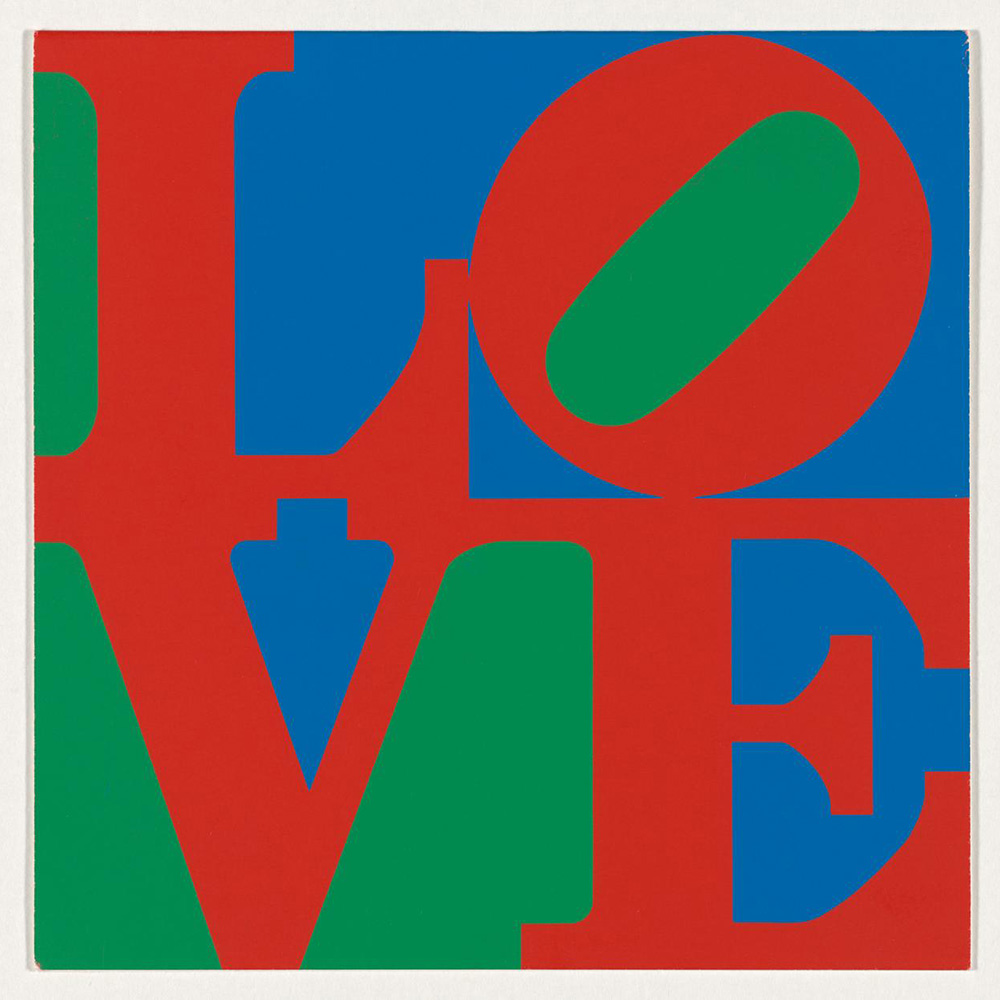 Love (1965), Robert Indiana, colour screenprint on card (image courtesy of the National Gallery of Victoria)
Yet the issue of ‘queering’ the collection begs the question: What kind of gaze does the exhibition solicit? While the naked bodies in many of the historical works seek a non-sexually specific voyeuristic gaze, reaching a point of exaggerated titillation in St George Hare’s nineteenth-century academic painting The victory of faith (c.1890–91) – an Orientalist fantasia of nubile female flesh – several works deflect the gaze through the conceit of staring back. The ancient Greek poet Sappho is portrayed in Robert Strange’s eighteenth-century engraving as a composed young woman in voluptuous dress whose resolute gaze calmly meets the viewer’s own. Christian Thompson’s photo-portrait Othering the ethnologist, Augustus Pitt Rivers (2015) shows him clasping a placard of the famous English ethnologist’s visage, masking Thompson’s own – but holes cut into the photo of Rivers’ face reveal Thompson’s eyes staring back in an uncanny appropriation of the colonialist gaze.
.jpg) Installation view of QUEER: Stories from the NGV Collection on display from 10 March–21 August 2022 at NGV International, Melbourne (photograph by Sean Fennessy)
Installation view of QUEER: Stories from the NGV Collection on display from 10 March–21 August 2022 at NGV International, Melbourne (photograph by Sean Fennessy)
The provocation at the heart of Queer is a call not just to acknowledge the fact that queers have always been around, but that the canon of art testifies to their presence in varied and intricate ways. Fundamentally, the exhibition poses an argument for queerness as a longue durée – historian Fernand Braudel’s term for the temporal span of long duration in contrast to episodic history. Queerness, in all its multiplicity, swirls and unfurls across the epochs, like the ceaseless flows of Loïe Fuller’s cascading robes.
Queer: Stories from the NGV Collection (NGV International) continues until 21 August 202. The catalogue of the same name is available from the NGV ($99.95 hb).
This article is supported by the Copyright Agency’s Cultural Fund.