


- Free Article: No
- Contents Category: Theatre
- Review Article: Yes
- Article Title: Heroes of the Fourth Turning
- Article Subtitle: Religious conservatism’s sorrow and solitude
- Online Only: No
- Custom Highlight Text:
Not long into Will Arbery’s Heroes of the Fourth Turning a character brings out an acoustic guitar and is asked to play a song. He chooses Townes Van Zandt’s ‘Nothin’’, a melancholy ballad pulled from the annals of American folk music. When it was released in 1971, many assumed it represented Van Zandt’s struggle with drug addiction. In fact, as he explained two years before his death, the song was inspired by Nikos Kazantzakis’s The Last Temptation of Christ, a novel banned by the Catholic Church in 1955 for representing a Christ figure prone to human fallibilities.
- Article Hero Image (920px wide):
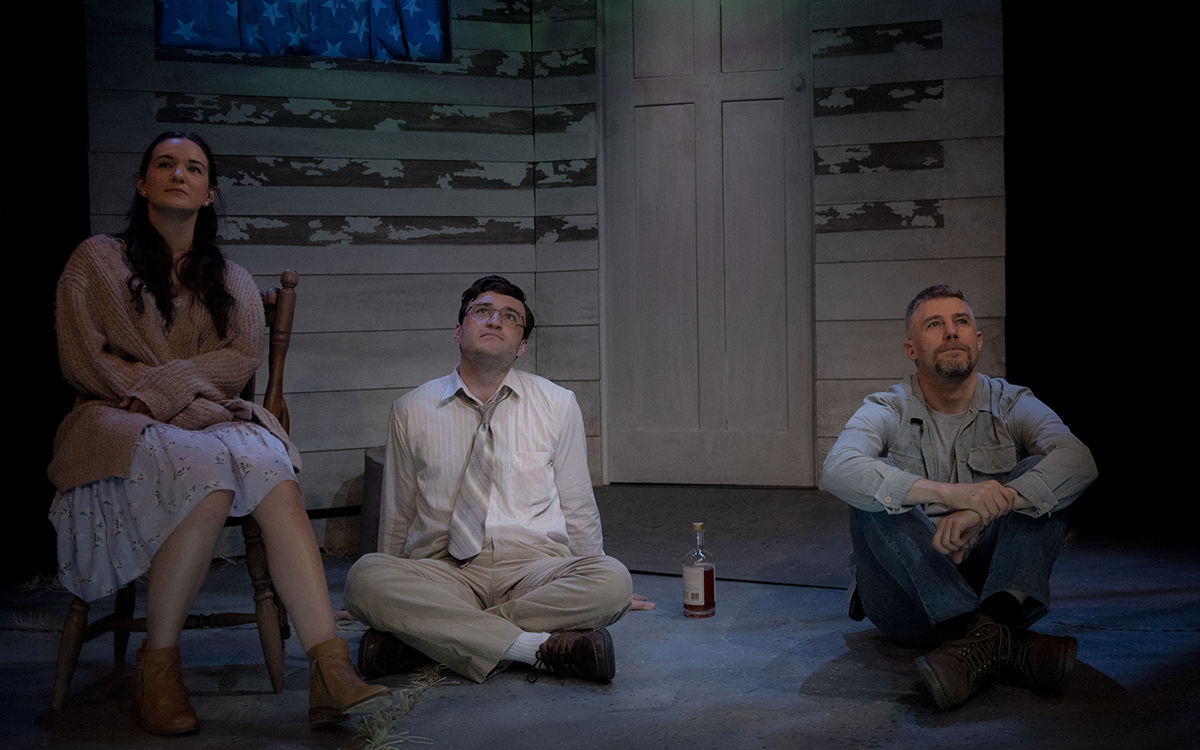
- Article Hero Image Caption: Mollie Mooney, Darcy Kent, and Charlie Cousins in <em>Heroes of the Fourth Turning</em> (photograph by Jodie Hutchinson)
- Alt Tag (Article Hero Image): Mollie Mooney, Darcy Kent, and Charlie Cousins in <em>Heroes of the Fourth Turning</em> (photograph by Jodie Hutchinson)
When Van Zandt’s song appears in Will Arbery’s Pulitzer Prize-nominated play, it creates a sermonic tableau; it is sung on a cold porch in Wyoming for a group of conservative Catholics gathering in reverential celebration. Those who have grown up in the church will instantly recognise this image. But the seemingly blasphemous inspiration for Van Zandt’s lyrics lends a certain irony to its inclusion in this scene. Do these characters know of the song’s complex origins? Would their Catholic beliefs take issue with it being sung if they did? No matter, the song goes on: ‘Sorrow and solitude / These are the precious things / And the only words / That are worth rememberin’’.
When Heroes of the Fourth Turning first premièred in 2019 at Playwrights Horizons, it was considered a radically honest representation of conservatism in the United States – a ‘red-state unicorn’, according to New York Times’s Jesse Green, that looked on Catholic values and their political repercussions with honesty, if not necessarily approval. Three years on, and it appears well-equipped to illuminate the Pentecostal bent of Australian conservatism in a week that saw the resignation of prominent church figure, Brian Houston. Head of Hillsong Church and mentor to Prime Minister Scott Morrison, Houston resigned this week amid allegations of sexual harassment, and a criminal trial bringing to light accusations of child abuse committed by Houston’s father. No wonder that Red Stitch’s staging of the play is but the first of two productions to come (the second, at the Seymour Centre, will première before the end of the month). Directed by Emily O’Brien-Brown, this production is powerfully attuned to the emotional and contextual stakes of its subject matter, though marred by choices that oversimplify Arbery’s text.
It is a week after the Charlottesville riots in 2017, and four friends have come together to celebrate the appointment of Gina (Margaret Mills) as the new president of their alma mater, Transfiguration College of Wyoming. The perfect conservative institution, Transfiguration has banned sex and cellphones, refused federal funding, and instilled in its students a high standard of education informed by Catholic theology. Yet over time, the brand of conservatism it has sought to affirm has changed to suit each character’s individual neuroses and a political context they believe threatens them. Theresa (Annie Shapero), the right-wing blogger, represents the antagonistic brand of conservative associated with Steve Bannon. Emily (Mollie Mooney) is the earnest counterpoint to Theresa who upholds a conservatism led by empathy. While Justin (Charlie Cousins) believes they must return to a pastoral, even feudal, simplicity, responding to the ‘parasitic’ Liberal agenda by fortifying political and geographical insularity. And for Kevin (Darcy Kent) – the self-described ‘holy fool’– issues of contemporary conservatism are less important than his inability to find a girlfriend. Though linked by a shared faith and a shared history, these characters must contend with the ways in which their beliefs have diverged along lines of personal and political interest. Exposing this divergence creates tension and, for many of them, emphasises their loneliness.
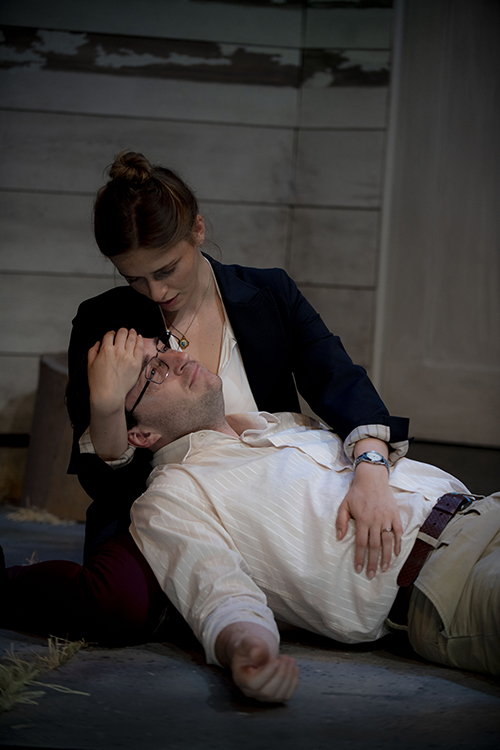 Annie Shapero and Darcy Kent in Heroes of the Fourth Turning (photograph by Jodie Hutchinson)
These are difficult characters defined by their fallibility and the cast assembled here render them with aplomb. As Kevin, Darcy Kent is particularly affecting, using humour expertly to toy with the dramatic stakes behind his character’s near constant garrulity. Annie Shapero’s Theresa is similarly arresting. A challenge for the most seasoned actor, Theresa’s sharp-witted bravado masks a litany of personal fears that Shapero reflects in her body language. As an ensemble, the cast work together beautifully.
Catholicism is the bedrock upon which the relationship between these characters has been formed. The intertextual references, historical figures or theoretical paradigms that may at times overload Arbery’s writing are emblematic of a shared vocabulary. Pat Buchanan, Flannery O’Connor, Bojack Horseman and Hannah Arendt exist alongside debates about pronouns, LGBTQIA+ rights and the sanctity of the Virgin Mary. The longer the scenes stretch the more these references accumulate, as does the range of topics. This accumulation – amounting to an occasional bombardment – makes it difficult to attribute value to or judge the often problematic and contradictory viewpoints exposed. This is central to Arbery’s intent: namely, to ask audiences ‘to sit with [his] character’s ideas’ in a ‘fugue’ state, rather than render the play didactic by allowing us to simply accept or oppose them.
It is surprising, then, that Red Stitch’s production has chosen to break up the two-hour play with a twenty-minute intermission. This choice compromises the cumulative quality intended by Arbery’s writing, allowing an audience time to note a character’s contradictions rather than ‘sit with’ them. The play’s ending – which features a surreal twist some may find contentious – offers a climactic denouement that seems intended to release the tension of a two-hour run built on these increasing contradictions.
The play’s characteristically long scenes also appear to have compromised Justin Gardam’s ominous sound design. While successful in creating tension, Gardam’s ambient compositions are often overused to the point of dilution. This is both an understandable result of a play wherein scenes rarely, if ever, end quickly and a disappointment considering the effectiveness of the other acoustic elements – a broken generator, a Wyoming night – that work so well within the confines of the Red Stitch Theatre.
In contrast, Emily O’Brien-Brown’s direction seems constrained by the small performance space. While scenes that required the entire ensemble were well-blocked, there were some staging choices that confused sight lines and so compromised the emotive resonance of particular scenes. It should be said, too, that a front-facing wall painted with a pale American flag, paired with a crucifix illumined in a doorway, teeters on the edge of force feeding an audience symbolism. If the latter is saved by Efterpi Soropos’s arresting light design, the former is too simple a pairing for the complexity of Arbery’s writing.
Despite these faults, Heroes of the Fourth Turning has its fingers on the pulse of a Christian conservatism that continues to inform US and Australian politics. To ‘sit with these characters’, as Arbery instructs, is to reckon with this influence, and so understand the deep loneliness and complex contradictions that come with sharing a system of belief – no matter what that system may be – with others. ‘Sorrow and solitude’, echo Townes Van Zandt’s lyrics, ‘These are the precious things’. When asked about the arrest of his former friend and mentor, Brian Houston, Scott Morrison responded by insisting that he ‘had not been to Hillsong in fifteen years’. At Hillsong Conference in 2019, he would pray, side by side with Houston and in front of thousands of devotees, for ‘more love and less judgement’.
Heroes of the Fourth Turning is running at Red Stitch Theatre from 15 March to 20 April. Performance attended: 19th March.
This article is supported by the Copyright Agency’s Cultural Fund.