


- Free Article: No
- Contents Category: Film
- Review Article: Yes
- Article Title: Loveland
- Article Subtitle: Ivan Sen’s audacious experiment in science fiction
- Online Only: No
- Custom Highlight Text:
After a decade spent redefining Australian outback noir with Mystery Road (2013), Goldstone (2016), and their ABC TV offshoots, writer–director Ivan Sen turns his attention to a semi-futuristic Asian metropolis in Loveland, retaining his lean directorial focus while delving into even headier philosophical territory. His new film is a strange beast indeed – daring, beautiful, frequently confounding. Those expecting breakneck cyberpunk action will likely head home disappointed – the genre worlds Sen’s characters inhabit are usually more prison than playground – but those with the patience to indulge this alluring and moody experiment should find much to admire.
- Article Hero Image (920px wide):
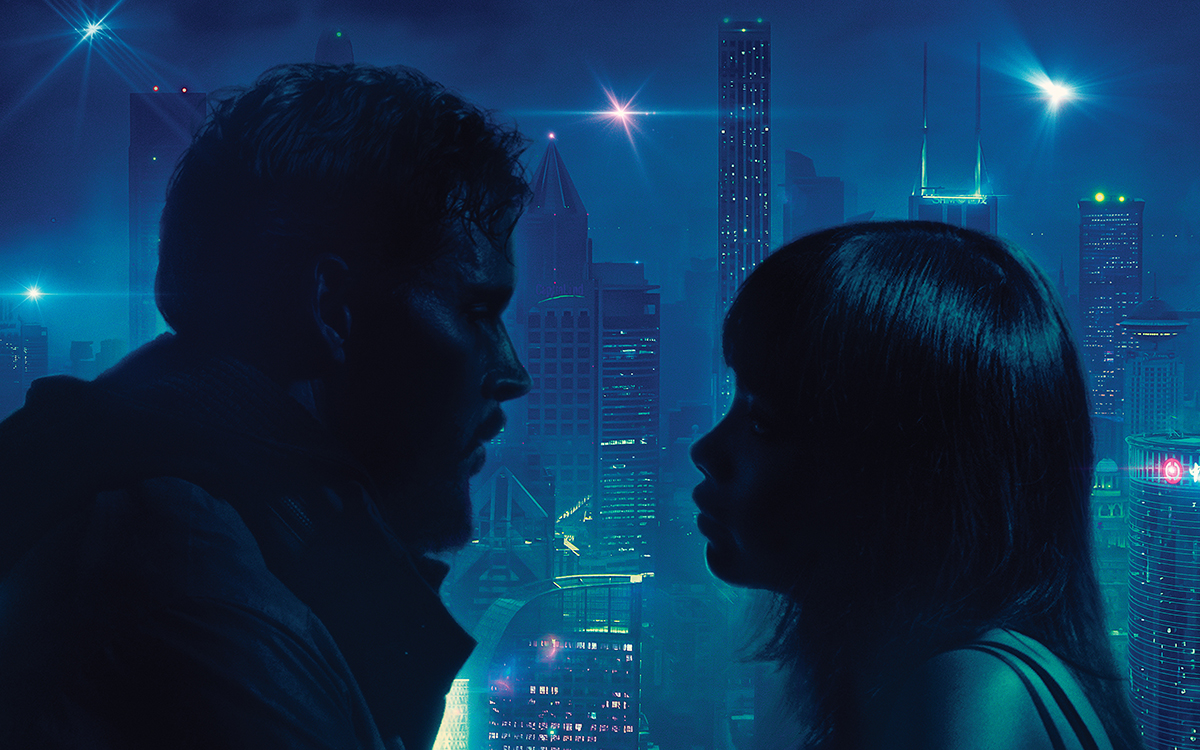
- Article Hero Image Caption: Ryan Kwanten and Jillian Nguyen in <em>Loveland</em>
- Alt Tag (Article Hero Image): Ryan Kwanten and Jillian Nguyen in <em>Loveland</em>
I say semi-futuristic, because the world of Loveland is not quite so far-flung as other science fictions. This is not a galaxy far, far away, but an Earth still a lot like our own. Shooting in Hong Kong, Sen capitalises on the city’s natural, neon-soaked modernity and augments it as necessary, cleverly marrying guerrilla-style street footage of his characters with foggy aerial cityscapes and the colourful, contrast-heavy interiors of karaoke lounges and all-night eateries. More clever world-building hints at winter typhoons, acid rain, a moon obscured entirely by pollution, genetic experimentation, and automatons roaming the streets.
It is on these streets that we meet Jack (Ryan Kwanten), a solitary hitman who takes his assignments from a crooked policeman and hunts his human prey through the city’s labyrinthine back alleys. One day he encounters April (Jillian Nguyen), a nightclub singer. Like so many emotionally stunted, lovestruck lugs before him, Jack begins stalking her. Once they do finally meet and form a relationship, Jack is stricken with a mysterious affliction that no doctor seems able to diagnose, leading him to seek out Dr Bergman (Hugo Weaving), a reclusive ‘life extension specialist’, who may hold the key to Jack’s illness as well as to his mysterious past.
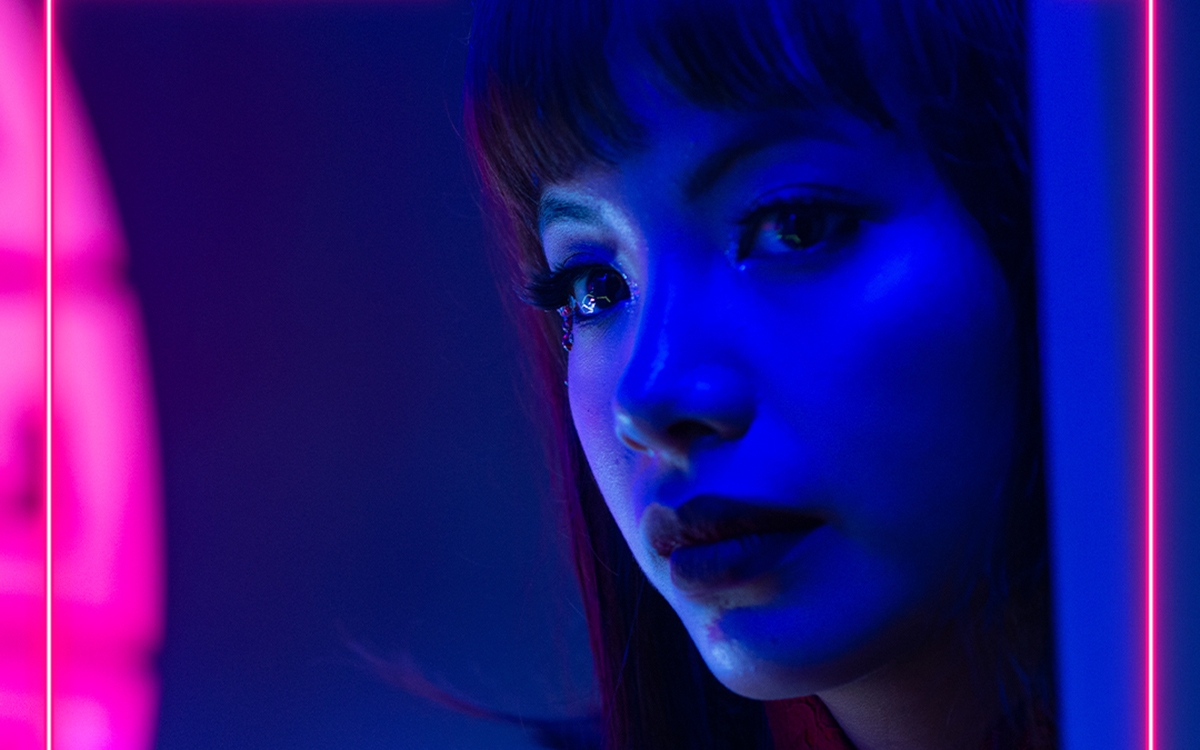 Jillian Nguyen as April in Loveland (image courtesy of Bunya Productions)
Kwanten, perhaps best known for his evergreen boyish charms in the likes of Red Hill and True Blood, makes for a compelling lead here, by turns gruff, haunted, and desperate. Nguyen (SBS’s Hungry Ghosts) is excellent as April, conveying as much with a flick of her eyelashes as she does with a gently whispered aphorism. Weaving revels in his role as the bearded geneticist, nursing his own dark secrets while delivering the lion’s share of pseudo-scientific exposition with gravel-voiced aplomb.
But while Kwanten and Nguyen are both very good in their own right, their relationship – the eponymous love in Loveland – remains somewhat thinly drawn. It’s easy to imagine what attracts Jack to April; she’s young and beautiful, and he senses in her a brokenness somewhat similar to his own. Less clear is what she sees in him, a perpetually sweaty, monosyllabic cipher who apparently only owns the one hoodie. These are characters drawn together by fate and plot more than by any organic chemistry, and their scenes rely too much on hushed, cryptic banter, questions answered with more questions.
This extends to the film’s liberal use of not one, not two, but three separate voice-overs (only inviting further comparisons to Blade Runner, an iconic sci-fi noir with its own patchy legacy of gratuitous narration). While jarring at times, these voice-overs also make Loveland’s agenda wholly clear: this is not an action-mystery but a tone poem, a sensory composite of three lonely, overlapping lives. The film grapples with some big ideas, refusing to distract itself with needless action or melodrama – though with such good and game performers, one wishes we could see them stretch beyond the film’s reverential melancholy, even just once.
Remarkably, Sen is not merely writer and director, but editor, composer, and cinematographer as well. If Loveland’s drama feels at times a bit staid, its visuals are nothing short of extraordinary. Sen uses stark natural light, rainbows of neon, rain-mottled glass, lens flares, lasers, one-way mirrors, deep focus, and foreboding shadows to meticulously sculpt every shot, drawing from the neon-noir playbook (see Tokyo Drifter, Akira, Only God Forgives) while deploying plenty of his own unique ideas and compositions as well. The crammed beige streets of Hong Kong during the day serve as a refreshing counterpoint to the neon-drenched nights – and Dr Bergman’s brown-and-green apartment, decked in wood and filled with dazed insects, feels like a plaintive portal to the past. This is one of those films where you could pause on any given frame and find a wealth of detail to appreciate, and the sumptuous cinematography comfortably carries it through its more uneven moments. Ivan Sen’s Loveland may be the most visually striking Australian film you will see this year, an audacious outing from one of our finest filmmakers.
Loveland (Dark Matter Distribution), 102 mins, is in cinemas now.