


- Free Article: No
- Contents Category: Opera
- Review Article: Yes
- Article Title: Jonny spielt auf
- Article Subtitle: Ernst Krenek’s timeless opera in Munich
- Online Only: No
- Custom Highlight Text:
Despite being one of the most successful and influential operas of all time, Ernst Krenek’s Jonny spielt auf (1926) is now something of a stage novelty. We are inclined to assume, perhaps, that the operatic genre it spawned, the Zeitoper, contained the seeds of its own obsolescence. As a new production at the Gärtnerplatztheater in Munich demonstrates, however, the work retains a capacity to shock and inform, as well as to entertain.
- Article Hero Image (920px wide):
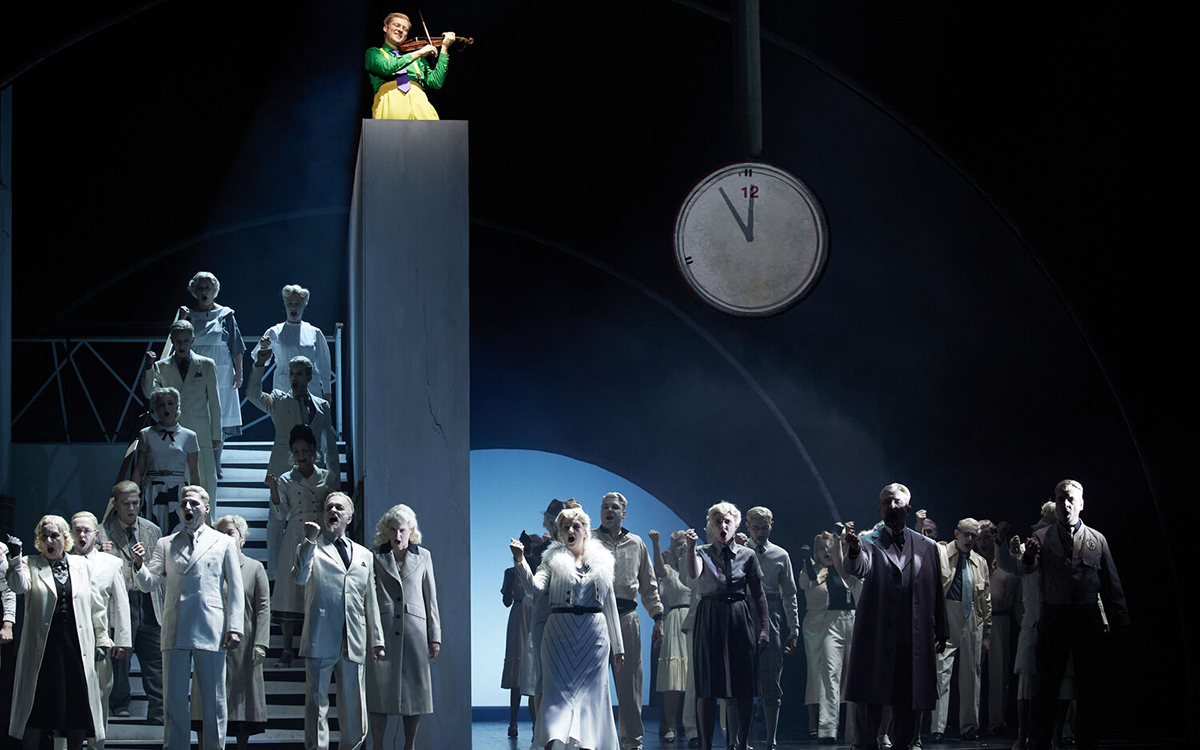
- Article Hero Image Caption: Ludwig Mittelhammer as Jonny and Chor des Staatstheaters am Gärtnerplatz in <em>Jonny spielt auf</em> (photo by Christian Pogo Zach)
- Alt Tag (Article Hero Image): Ludwig Mittelhammer as Jonny and Chor des Staatstheaters am Gärtnerplatz in <em>Jonny spielt auf</em> (photo by Christian Pogo Zach)
What exercised the Nazi thugs was the fact that title role of the opera was the composer’s imagining of an African American jazz musician. Moreover, this Jonny was fully, and unproblematically, incorporated into the composer’s novel representation of modern city life. His racial identity is simply not an issue for the characters on stage, with the exception of one character, the violin virtuoso Daniello.
In any event, Krenek’s thinly veiled autobiographical plot centres on an introspective classical composer, Max, and the tangle of romantic intrigues that erupt when he has an affair with Anita, the lead soprano in his latest opera (a character inspired by Krenek’s brief relationship with the Australian violinist Alma Moodie). For most of the opera, Jonny is a tangential character. His presence is only elevated (literally and figuratively) at the work’s conclusion where he launches into a New World jazz number (played on a violin he has stolen from Daniello) while representatives of Old World Europe dance at his feet.
In essence, Jonny spielt auf is really an opera about the shock of the new. Jonny emerges as a kind of Pied Piper who leads the other characters towards a heady world of novel freedoms (sexual and cultural not least) that were embodied in the composer’s imagination of the modern American metropolis.
The vexed issue of racial representation overshadows much of Peter Lund and designer Jürgen Franz Kirner’s approach to the work. Jonny, sung by baritone Ludwig Mittelhammer, first appears as part of a tableau of both white and multi-ethnic stage performers, but he then makes himself up in blackface (to their pointed disgust).
Soon thereafter the chorus also makes a non-scripted appearance to express their horror at the appearance in their midst of what they now presumably take to be an actual African American musician. Their reaction is reinforced by projections above the set of contemporary cartoons drawn from the so-called ‘Schwarze Schande’, a politically exploited moral panic that erupted in parts of Germany when the French Army garrisoned Senegalese and other African soldiers in the occupied Rhine region of Germany between 1918 and 1930.
Krenek’s own model for Jonny drew neither on this iconography nor the irredeemably racist and demeaning American blackface tradition. Rather, Jonny was inspired by his encounter with jazz pianist Sam Wooding and his band in 1925. Wooding, in turn, later recalled how positive his reception in Germany had been, pointedly observing that this ‘would never have happened back here in the States. Here they looked on jazz as something that belonged in the gin mills and sporting houses.’
The production’s attempt to align Krenek’s Jonny with American blackface culture was, to my mind at least, an awkward and unnecessary complication. Nevertheless, there was still much to admire in this slick, generally well-cast, and coherent production. The set, which must be able to deliver quick changes of place and scale, was both ingenious and beautifully constructed. Daria Kornysheva’s costumes were top-notch, and Raphael Kurig and Meike Ebert’s video projections were clever and judiciously applied, never distracting from the stage action (as is so often the case today). Despite some balance issues between stage and pit, and a muffled-sounding stage ensemble, the orchestral playing was fully committed and characterful. Conductor Michael Brandstätter kept a fast pace, driving the action on stage admirably.
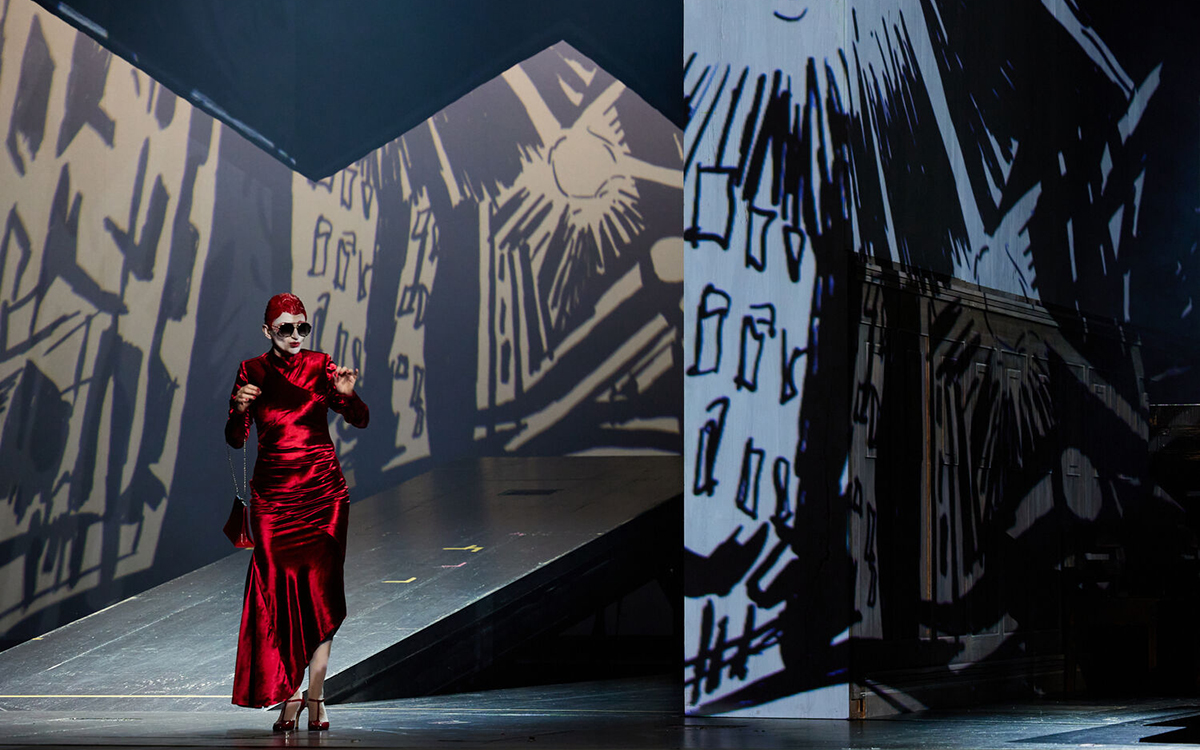 Mária Celeng as Anita in Jonny spielt auf (photo by Christian Pogo Zach)
Amid a generally strong ensemble cast, Mária Celeng (Anita) was the standout; her powerful soprano voice rang out clearly. Tenor Alexandros Tsilogiannis (Max) struggled to be heard above the orchestra. The role is undoubtedly technically challenging; more suited, I suspect, to a Heldentenor than a lighter lyric voice like his. Several minutes of the lengthy soliloquy that opens Act II had also been cut, which further sapped the character’s dramatic impact. Gaining some sympathy for his plight is central to a good deal of the opera’s dramatic propulsion.
Strong supporting performances from Judith Spießer (Yvonne), Holger Ohlmann (Manager), Juan Carlos Falcón (Hotel Director/Station Master), and Caspar Krieger, David Špaňhel, and Martin Hausberg, as a trio of comic policemen ensured that this was not a ruinous weakness.
Today, the siren call to the ‘land of freedom’ that Jonny unleashes at the work’s conclusion, and the alarm bells that Krenek scores to accompany it, sound as an uncannily prescient warning of the social and political catastrophe that followed Hitler’s accession to power in 1933. If a reminder of the relevance of that warning were needed, the performance I attended was undertaken for the benefit for the charity ‘Aktion Deutschland Hilft’ in support of its work for Ukranian refugees. The audience were implored to open their homes, as many in Germany are already doing, to those fleeing the conflict in the Ukraine.
Jonny spielt auf is playing at the Gärtnerplatztheater in Munich until 29 May 2022. Performance attended: 11 March. An audio recording of the opening night performance is available for all of March at www.br-klassik.de/programm/radio/ausstrahlung-2749920.html