


- Free Article: No
- Contents Category: Opera
- Review Article: Yes
- Article Title: Watershed: The Death of Dr Duncan
- Article Subtitle: A major new Australian oratorio
- Online Only: No
- Custom Highlight Text:
Neil Armfield’s production of Watershed – a new oratorio by composer Joe Twist and co-librettists Alana Valentine and Christos Tsolkias about the murder of Ian Duncan by police in Adelaide in 1972 and the subsequent cover-up and campaign for homosexual legal reform – is an angry, brave, beautiful, emotionally shattering, and unexpectedly uplifting work.
- Article Hero Image (920px wide):
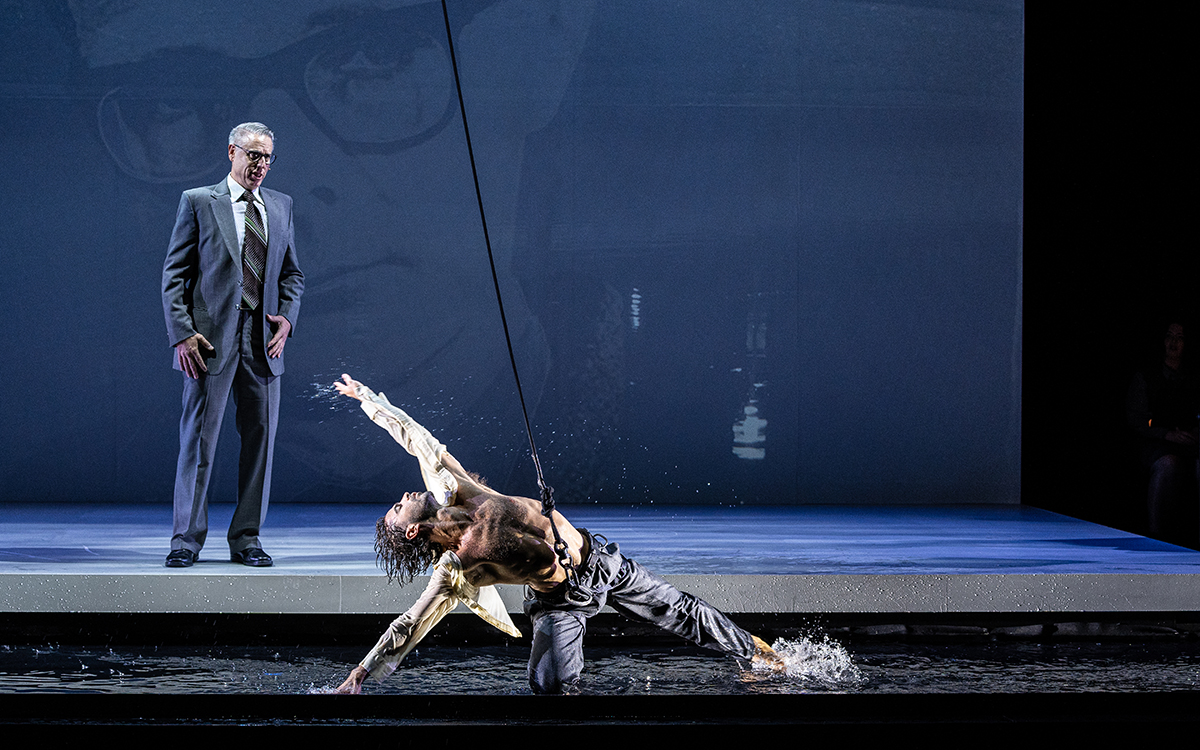
- Article Hero Image Caption: Mark Oates and Mason Kelly in <em>Watershed</em> (photo by Andrew Beveridge)
- Alt Tag (Article Hero Image): Mark Oates and Mason Kelly in <em>Watershed</em> (photo by Andrew Beveridge)
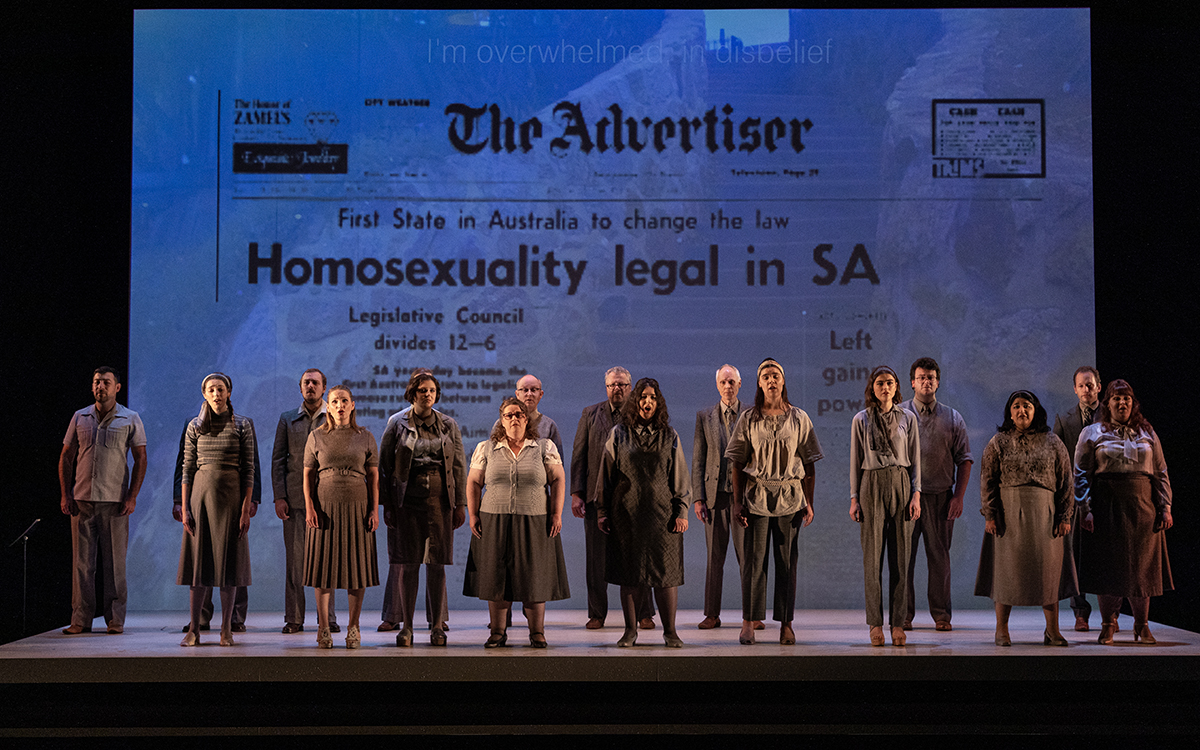
Valentine and Tsiolkas’s libretto is a poetic distillation of the story that invites us to see ourselves reflected in all its messy and enduring ramifications. The work begins provocatively with the evocation of an anonymous gay hook-up in a men’s urinal by an appropriately nameless young contemporary narrator called ‘The Lost Boy’ (actor–singer Ainsley Melham), whose role is similar to that of the Evangelist in an oratorio by Bach. In fact, the whole work invokes a Bach Passion (or Michael Tippett’s A Child of Our Time) by positioning Duncan (tenor Mark Oates) as a kind of Christ-figure (like Tippett’s Jewish refugee) and juxtaposing his voice with those of others in the story, including one of the police officers involved (bass-baritone Pelham Andrews), as well as lawyers, politicians, and members of the community, variously sung by Oates, Andrews, and members of the Adelaide Chamber Singers.
A key addition is the presence of dancer Mason Kelly as a kind of physical double of Oates/Duncan and perhaps more generally a representation of gay-hate crime victims everywhere. Importantly, Kelly also appears as a drag queen in a section celebrating gay liberation (the movement sequences are thoughtfully choreographed by Lewis Major). This forms part of a classic Armfield coup de théâtre, which has Kelly slowly lowered from the flies in a harness at the start of the work above a narrow ‘river’ of shallow water in front of a raised bare stage, around which the chorus and singers are arranged and which they use to ‘enact’ certain scenes (elegantly minimal set and period costume design by Ailsa Paterson). Kelly eventually rests in the water like a dead Christ and is lovingly cradled by the Boy (both equally lovingly side-lit by lighting designer Nigel Levings), before being untethered to move freely throughout the rest of the performance, and reascending at the end after a final kiss (a heart-stopping moment that reminded me of the drowning of Fish Lamb at the end of Armfield’s Cloudstreet).
The invocation of religious music, language, and iconography (Duncan was also a practising Anglo-Catholic) is another provocative aspect of the work which does not shy away from notions of faith – including faith in art, community, and progress, despite ongoing injustice. This also provides a bridge of inclusiveness and solidarity between different but overlapping communities: queer and straight, non-believers and believers (of different faiths), even progressives and conservatives. The unifying motif is love in all its forms, from eros to agape.
 (photo by Andrew Beveridge)
Joe Twist’s emotional and accessible score likewise embraces a variety of idioms (much like Bach’s use of Lutheran hymns or Tippett’s use of African-American spirituals). I heard echoes of Benjamin Britten and Peter Sculthorpe; Broadway composers like Leonard Bernstein and Stephen Sondheim; and (appropriately) 1970s rock musicals and operas, as well as Bach chorales. This was all sensitively realised by an eclectic orchestra (including guitar, bass, and drums, alongside a fine string section) conducted by Christie Anderson. Melham’s clear, heartfelt musical-theatre tenor and deeply personalised acting were complemented by full-voiced and three-dimensional performances from Oates and Andrews (especially in the key roles of Duncan and policeman-turned-whistleblower Mick O’Shea), as well as robust work from the Adelaide Singers, especially when they took on anonymous community character roles, or joined Kelly and the soloists in the gay pride dance.

Inevitably, I had a few minor reservations. There were moments when the score sounded a touch sentimental; one or two of Melham’s spoken monologues felt expository; and the video backdrop (including surveillance-style footage of the riverbank at night and the superimposed faces of actual protagonists) seemed a tad redundant (and occasionally distracted me from the faces of the performers or the evocative potential of the music and words). However, these are minor quibbles that didn’t detract from what was, for me, an overwhelmingly moving experience, and a hugely important work.
Watershed: The Death of Dr Duncan is being performed at the Dunstan Playhouse from 2 March to 8 March 2022 as part of the Adelaide Festival 2022. Performance attended: 6 March.