


- Free Article: No
- Contents Category: Theatre
- Custom Article Title: Girls & Boys
- Review Article: Yes
- Article Title: Girls & Boys
- Article Subtitle: Speechifying violence in Dennis Kelly’s one-woman show
- Online Only: No
- Custom Highlight Text:
I’ve never cared much for first-person direct address monologues in the theatre. Too often, one feels talked at rather than implicated in the action, the interpersonal dynamics of multi-actor drama shorn away in favour of a kind of speechifying.
British playwright Dennis Kelly’s Girls & Boys – the ampersand seems to be official – is one such monologue. ‘Woman’ (Kelly doesn’t give her a name) is the narrator, a middle-aged PA in the documentary film industry who, having got a ‘drinky, druggy, slaggy phase’ out of her system, marries a handsome antiques dealer she meets at Naples Airport.
- Article Hero Image (920px wide):
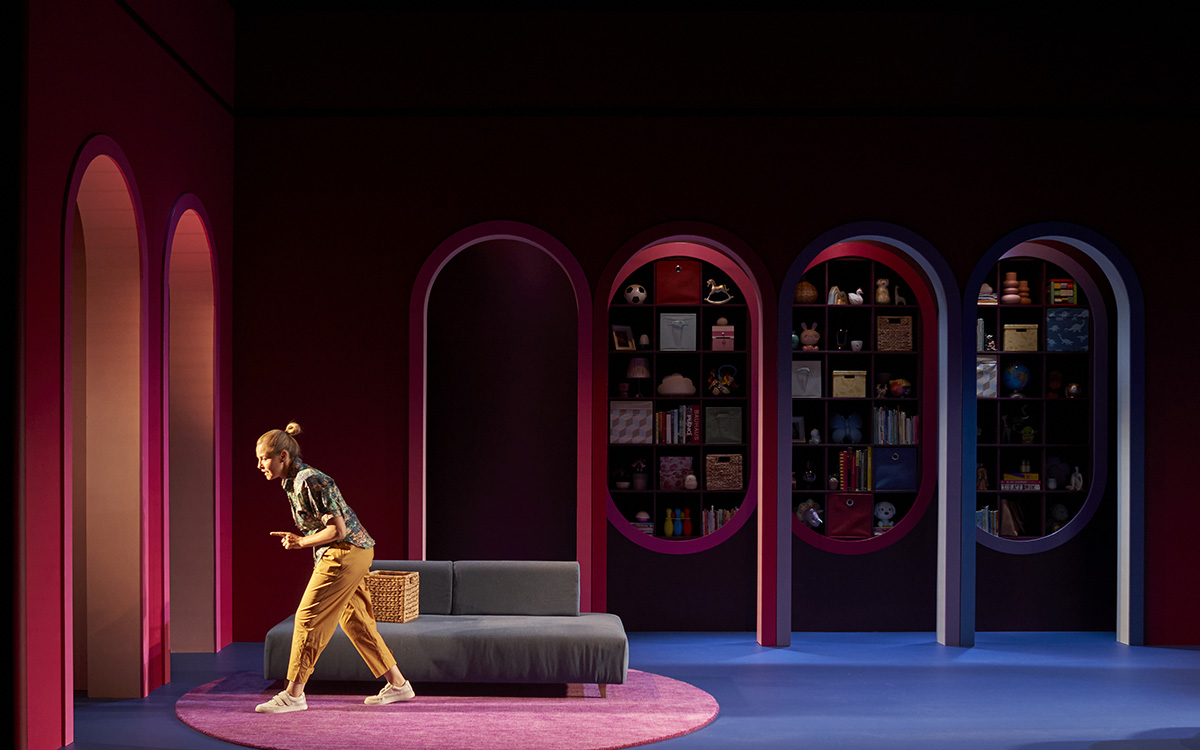
- Article Hero Image Caption: Justine Clarke in <em>Girls & Boys</em> (photograph by Sam Roberts)
- Alt Tag (Article Hero Image): Justine Clarke in <em>Girls & Boys</em> (photograph by Sam Roberts)
The couple seem well matched at first: the sex is great, apparently, and he’s supportive of her career ambitions. As in some ideal nuclear family, they produce a girl and then a boy. For a moment, the narrator herself appears to embody another quixotic archetype, that of the woman who ‘has it all’. It comes as little surprise, however, when Kelly begins to undercut the play’s early, almost ribald humour with dark hints that this domestic idyll may be more mirage than reality. ‘Belief,’ the woman observes, ‘is an incredible thing’.
Performed by a much-lauded Carey Mulligan in its 2018 Royal Court début and in the subsequent off-Broadway run at New York’s Minetta Lane, the Woman is portrayed in this Australian première by Justine Clarke. Known for her regular appearances on Play School and her own eponymous television show for young audiences, Clarke is a revelation in a role that could hardly place more different demands on an actor. I understand she knew virtually every word on the first day of rehearsal, and it shows in her absolute command of the text.
Adopting a convincing Essex accent, she fully inhabits Kelly’s spiky, intensely rhythmic words both vocally and physically, her blonde hair tightly pulled back from an endlessly expressive face. In alternating scenes of domestic banality, Clarke deftly conjures the children Leanne and Danny through gesture alone, her gaze unswerving as she plays with them, scolds them, and lets them fall asleep on her. In these moments one can feel, too, the guiding but unobtrusive hand of director Mitchell Butel, an actor himself and one with an evident appreciation of the way a single body can, by turns, dominate and open up a space.
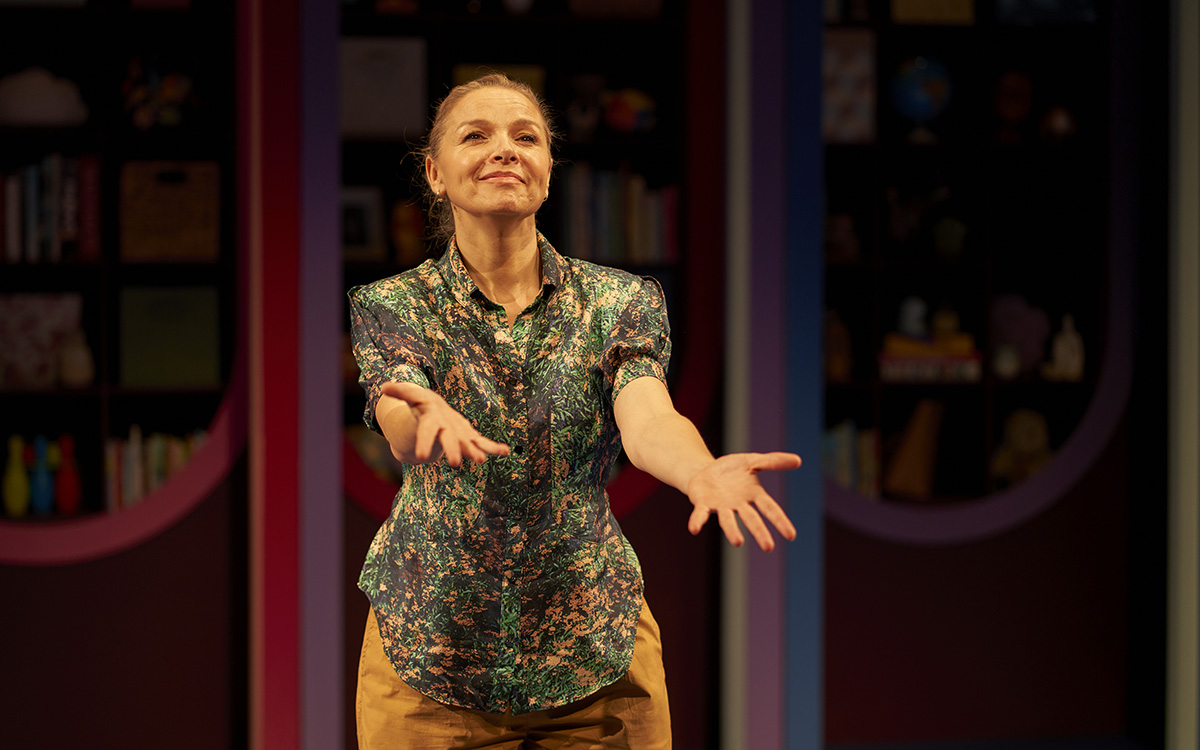 Justine Clarke in Girls & Boys (photograph by Sam Roberts)
As in Kelly’s previous plays – I was reminded particularly of the twisty two-hander After the End, set in a nuclear fallout shelter – Girls & Boys is preoccupied with the gendered nature of violence, the roots of which are shown to be deep and intractable. In one scene, Danny insists on a game in which he destroys the skyscraper Leanne has built from stools. In another, the potential subject of one of the Woman’s documentaries, an elderly academic known for his radical critiques of systemic male power and privilege, makes unwanted sexual overtures to both her and her teenaged assistant.
‘I think a lot about violence,’ the Woman says at one point, which may as well be Kelly talking. The genuinely harrowing eruption of bloodshed on which the play ends up hinging – it would be giving away too much to say more – is presaged by an argument between the Woman and her husband sparked by news of a mass shooting, and a discussion about ‘war, murder and torture in other parts of the planet happening right now’ that cannot but, for Festival audiences, recall Russia’s appalling invasion of Ukraine. As the Woman’s marriage drifts into indifference and acrimony, truth becomes ‘a dissected animal’, arguments akin to ‘warfare’ and even ‘genocide’. What accrues is a bleak portrait not only of marital dysfunction but also the dispositions of men in which difficult emotions fester, and the demented and dementing impulse to exert control over others thrives.
Unfortunately, Kelly ultimately abandons the drama he has carefully – if not exactly subtly – built over the previous ninety minutes or so for sociology, smuggling in something that sounds less like a play than a TED Talk. Maybe a documentary-maker would speak like this, using well-honed facts to prosecute a theory about society having being constructed so as to ‘stop’ men rather than benefit them, but it’s hard not to feel that this reasoning is the wrong way about – that Kelly’s choice of occupation for the Woman was to facilitate this kind of didacticism. Her forensic description of the play’s culminating butchery is equally problematic, risking a sort of pornography of violence without, it seems to me, real purpose.
Several times the Woman emphasises that we are only hearing her side of the story, but it’s a somewhat disingenuous claim on Kelly’s part: we are never told anything that leads us to believe her version of events is anything other than What Really Happened. Kelly seems to want us to view the Woman as some kind of unreliable narrator – perhaps in order to convince us his play is more nuanced than it actually is – but doesn’t give her anything particularly unreliable to say. She’s not a paragon, but the character lacks light and shade. The result is a play that feels a little overdetermined, and perhaps too invested in answering rather than asking questions of its audience (‘the purpose of art,’ James Baldwin asserted, ‘is to lay bare the questions that have been hidden by the answers’).
And yet, despite these failings, there is genuine alchemy in the meeting between Kelly’s text, Clarke’s performance, and Butel’s direction. As darkness descended on Ailsa Paterson’s chocolate box set, children’s nightlights glowing ethereally through the upstage archways, I found myself feeling both discomforted and moved. As I sat there, a ghastly realisation dawned on me for the first time: that, statistically speaking, the most dangerous person in my young son’s life is me.
That’s clearly the sort of ‘takeaway’ Kelly is hoping for, and I wasn’t alone in experiencing something like it. Afterwards, on the footpath outside the theatre, I was struck by the sight of two women about my age, their faces red from crying. Getting back into my car, something the Woman says came back to me: ‘What I do now is, I carry on’.
Girls & Boys, produced by the State Theatre Company of South Australia, is playing from 25 February to 12 March 2022 at the Odeon Theatre. Performance attended: 1 March.
This review is supported by the Copyright Agency’s Cultural Fund.