


- Free Article: No
- Contents Category: Art
- Review Article: Yes
- Article Title: HG60
- Article Subtitle: Hamilton Gallery’s sixtieth birthday
- Online Only: No
- Custom Highlight Text:
Australia’s regional galleries hold rich collections that demonstrate a powerful communal need to collect and display art. Victoria’s regional cities, in particular, are notably well endowed with public art collections and handsome buildings to house them. The gold rush towns were at the forefront in establishing public art galleries: the first, in Ballarat, was founded in 1884; Bendigo followed in 1887. There are now nineteen of them fairly evenly positioned across the state – between one and six hours’ drive from Melbourne – from Warrnambool (1886) in the south-west and Mildura (1956) in the north-west to Bairnsdale (1992) to the east.
- Article Hero Image (920px wide):
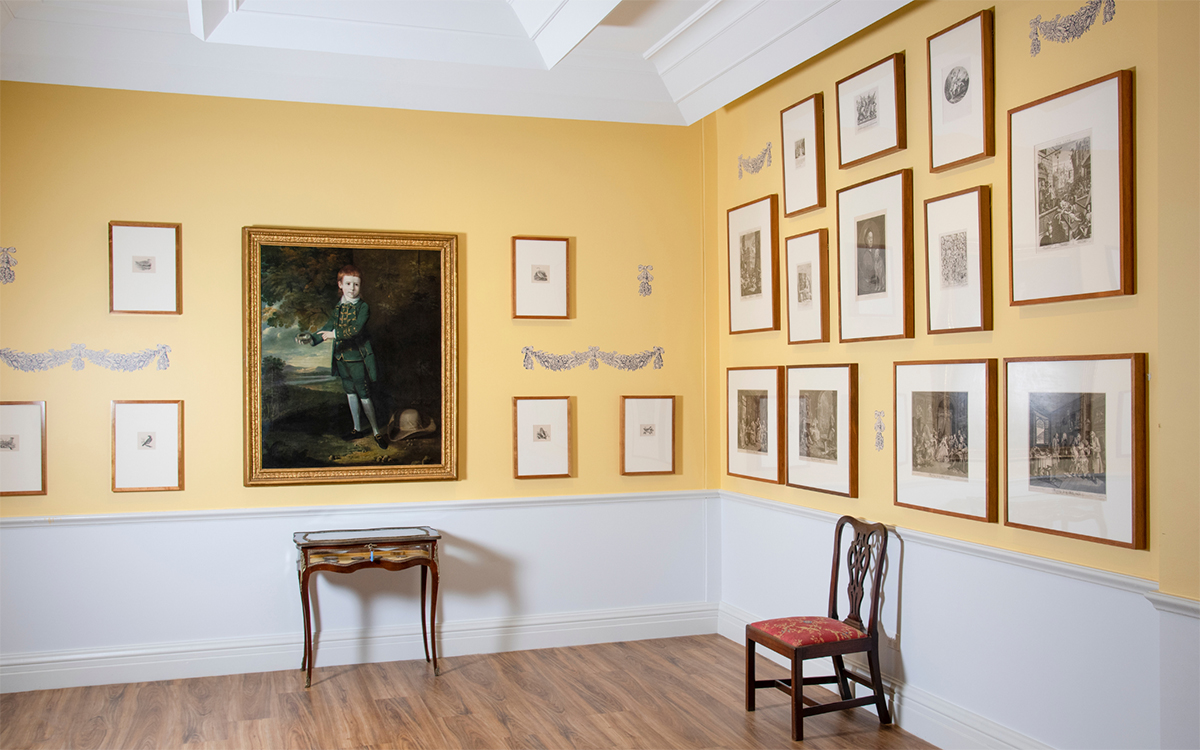
- Article Hero Image Caption: Installation photograph of ‘HG60’ at the Hamilton Gallery (photograph courtesy of Hamilton Gallery)
- Alt Tag (Article Hero Image): Installation photograph of ‘HG60’ at the Hamilton Gallery (photograph courtesy of Hamilton Gallery)
Ironically, a casting vote by the mayor of Hamilton in Victoria’s Western District was required for the formation of one of Australia’s finest regional art galleries. The Hamilton Gallery, now celebrating its sixtieth anniversary through an exhibition, book, and symposium (all inevitably delayed by Victoria’s lockdowns) was founded by the 1958 bequest of Western District residents Herbert and May Shaw. Their collection focused on the European and Asian decorative arts that form the core of the Hamilton collection, which now numbers more than 9,000 works.
Since its opening in 1961, and drawing on community support and benefactors from its wealthy hinterland and further afield, the Hamilton Gallery has amassed a collection of distinction, covering Australian, European, and Asian paintings, prints, sculptures, and decorative arts. The highlights, including some fine Australian paintings, splendid English watercolours by Paul Sandby, German baroque silver gilt objects, key examples of eighteenth-century European porcelain and Chinese and Japanese objects, are unmatched elsewhere in Australian public collections.
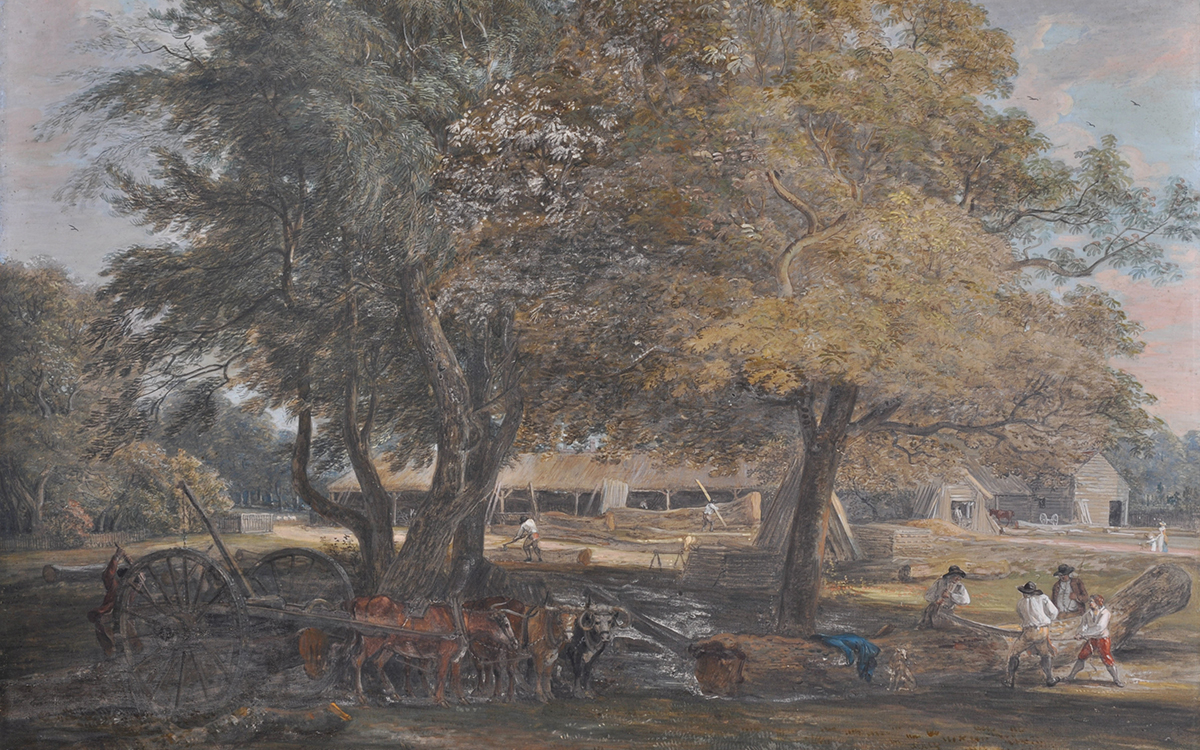 Paul Sandby, The Wood Yard in Windsor Great Park (1792), oil and gouache on canvas, purchased with the assistance of a special grant from the Government of Victoria in 1971 (photograph courtesy of Hamilton Gallery)
To celebrate the milestone, the gallery commissioned a book, HG60: Hamilton Gallery 60th Anniversary, and exhibition, jointly authored and curated by some of Australia’s leading art historians and scholars. The result is a fascinating and handsomely installed display that celebrates the breadth and quality of the holdings, and an eminently readable volume that examines the history of the collection and turns the spotlight on key works. The authors also presented in-focus papers on selected works at a symposium (‘60 Years in 16 Objects’) held in Hamilton in association with the exhibition opening and book launch.
The book covers the development of the Hamilton Gallery and highlights of the collection, in sections devoted to the holdings of European, Australian, and Asian art. David Hansen’s thoughtful introduction on the establishment and growth of Australian regional galleries gives context to the creation of these institutions, their collections and collection policies – where their strengths lie and why they differ. Lisa Beaven, Alison Inglis, and Vivien Gaston tackle European art in the collection. They take the reader through copies of baroque sculptures, a selection of portraits – including an exquisite late eighteenth-century pastel, Miss Sophia Vansittart (c.1791), by John Russell and two 1970s prints by Francis Bacon – and the remarkable group of almost thirty watercolours and 97 prints by English artist Paul Sandby (a Founder Member of London’s Royal Academy of Arts in 1768). European decorative arts – ceramics, metalwork, glass, tapestry – are covered by Matthew Martin and Peter McNeil. Jane Clark writes about the Australian works from colonial landscapes to the present day. Chinese and Japanese art are served, respectively, by Alex Burchmore and Mark K. Erdmann.
The stylish essays on the collection highlight impart interesting new information and research. Also covered in the volume are the collecting activities of benefactors, including those of founder–benefactors Herbert and May Shaw, who augmented their collection on international travels during the 1930s, from Melbourne dealers during the 1930s to 1950s such as Archie Meare (Connoisseurs’ Store) and Joshua McClelland, and at auctions of major Melbourne collections: A.J. Swan’s (1949) and Keith Murdoch’s (1953).
The Australian works featured include colonial landscapes of the Western District by Thomas Clark and Nicholas Chevalier, fascinating rarities such as photographs and the scorebook relating to the Aboriginal cricket team that toured England in 1868, and William Guilfoyle’s 1881 design for the Hamilton Botanic Gardens. Other Australian highlights include striking portraits – Mrs Archibald Currie (1911) by Rupert Bunny and Dedication (1941) by Nora Heysen (originally titled Murray Madonna) – a fine Crucifixion (1956) by Sidney Nolan, After the storm from Spring bank, study (1988) by William Robinson, My Country – bush seeds (after sandstorm) (2003) by Kathleen Petyarr, and a terrific modernist print, Birds following a plough (1933) by Ethel Spowers.
As Burchmore notes in his introduction to Chinese art, Hamilton holds one of the largest collections of Chinese material in an Australian regional gallery; it ranges from prehistory to the present. The core of the Chinese collection was from the original Shaw bequest, and the collection has grown ever since. The earliest work is now a splendid decorated Jar (2200–2000 BCE) and the most recent McDonald’s M (2007) by Li Lihong, the latter a wry take in blue and white decorated porcelain on the ubiquitous golden arches.
 Kajima Ikkoku II Mitsutaka, Pair of vases (c.1890), bronze, inlaid with engraved gold, chased applied decoration in gold, silver, oxidised silver and shibuichi, Japan (photograph courtesy of Hamilton Gallery)
Mark K. Erdmann, in his introduction to Japanese art, reminds us of the first Australian encounter with Japan, in 1830, when a ship hijacked by convicts in Van Diemen’s Land moored briefly off Shikoku, safe from the British. Japanese works entered the Hamilton collection at its inception and have been supplemented with a series of fine acquisitions ever since. It now includes ceramics, woodblock prints, works in bronze and ivory. Among the many notable Japanese works in the collection is a striking Pair of vases (c.1890), made of bronze and decorated with gold and silver, by Kajima Ikkoku II Mitsutaka.
Given the range and quality of the Hamilton collection, there is certainly something for all artistic tastes. The exhibition, HG60: Hamilton Gallery 60th Anniversary, is handsomely displayed by culture and period on level one of the gallery, and forms a model collection display. There is much to see and to engage with. It is well worth the three-and-a-half-hour drive from Melbourne.
This review is supported by the Copyright Agency’s Cultural Fund.