


- Free Article: No
- Contents Category: Commentary
- Review Article: Yes
- Article Title: The Grainger Trap
- Article Subtitle: At the altar of the curator’s moral superiority
- Online Only: No
- Custom Highlight Text:
Australians might be forgiven for thinking that the history of classical music – as an art form with origins in Europe – is something that happens elsewhere, that we are little more than observers (and listeners) of a tradition that is essentially the property of others. Melbourne-born Percy Grainger (1882–1961), however, presents us with an unambiguous claim to being a classical composer of lasting historical significance. And yet his music is also not performed, or celebrated, here with anything like the frequency and enthusiasm that it is overseas.
- Article Hero Image (920px wide):
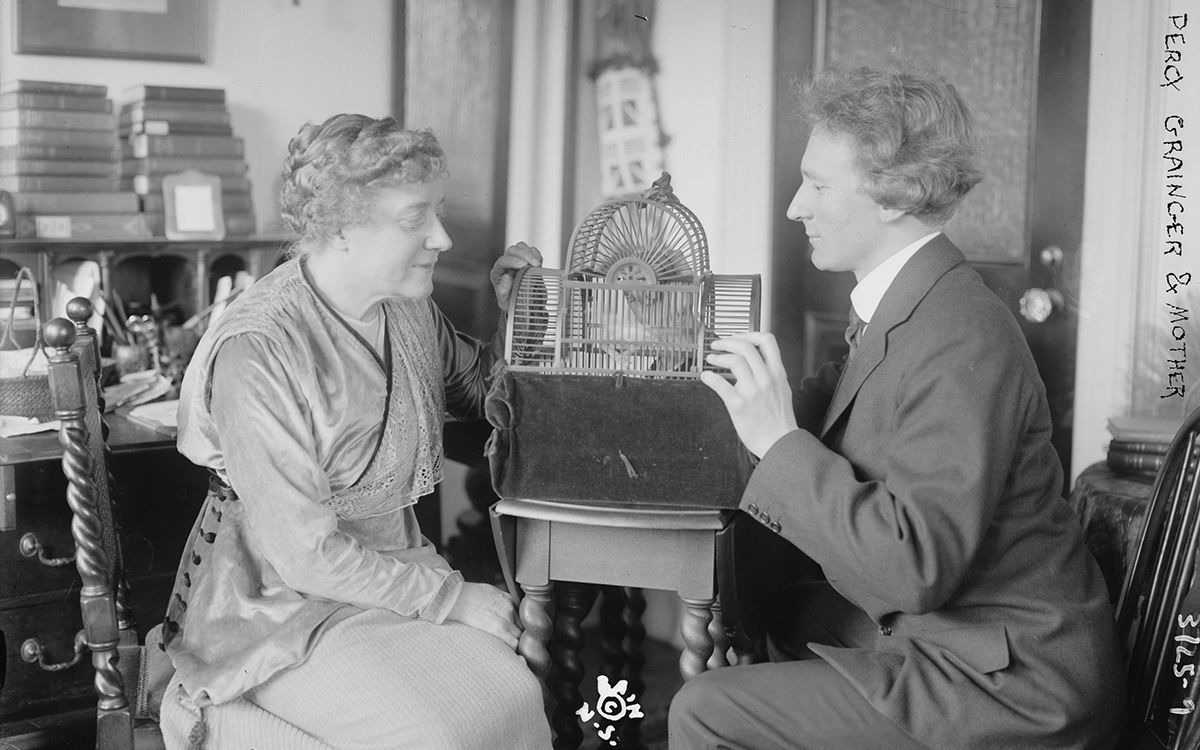
- Article Hero Image Caption: Percy Grainger and his mother, Rose (between ca. 1910 and ca. 1920) (photograph courtesy of the Library of Congress)
- Alt Tag (Article Hero Image): Percy Grainger and his mother, Rose (between ca. 1910 and ca. 1920) (photograph courtesy of the Library of Congress)
For this reason, he also bequeathed to the Museum publications, manuscripts, recordings, musical instruments, and other material that he hoped would encourage the study and performance of music from across the globe, including Southeast Asia and the South Pacific. This was a bold vision for any musician of his day, let alone an Australian musician, but it sparked little local interest. The limited public attention that the museum has attracted since has tended to focus instead on Grainger’s non-musical interests, such as his predilection for sadomasochism and his obsession with racial (especially Nordic) characteristics. Australian composer Peter Sculthorpe called this the ‘Grainger trap’; the fascination we have with Grainger’s eccentric personality has served to obscure, not elucidate, the global significance of his musical and musicological achievements.
Until recently, the museum’s location next to the University of Melbourne’s Conservatorium of Music in Parkville at least gently reminded passers-by that Grainger only remains of lasting value to us because of those achievements. With the relocation of the Conservatorium to new premises in Southbank some three years ago, that neighbourly prompt has gone. I wonder, as a result, if the Grainger trap is now only more liable to be sprung.
In any event, the University of Melbourne has recently been undertaking what it describes as ‘a radical re-thinking of the Grainger Museum and its collection’. On 15 February, its first public manifestation, David Sequeira’s #brownmaninawhitemuseum opened to the public. Currently Director of the Margaret Lawrence Gallery at the Victorian College of the Arts, Sequeira describes himself on the accompanying exhibition flyer as a ‘gay mid-50s, brown-skinned, Indian born, Australian artist/curator/academic’. In turn, Grainger is characterised as an ‘openly racist composer/musician who was committed to promoting his own genius’.
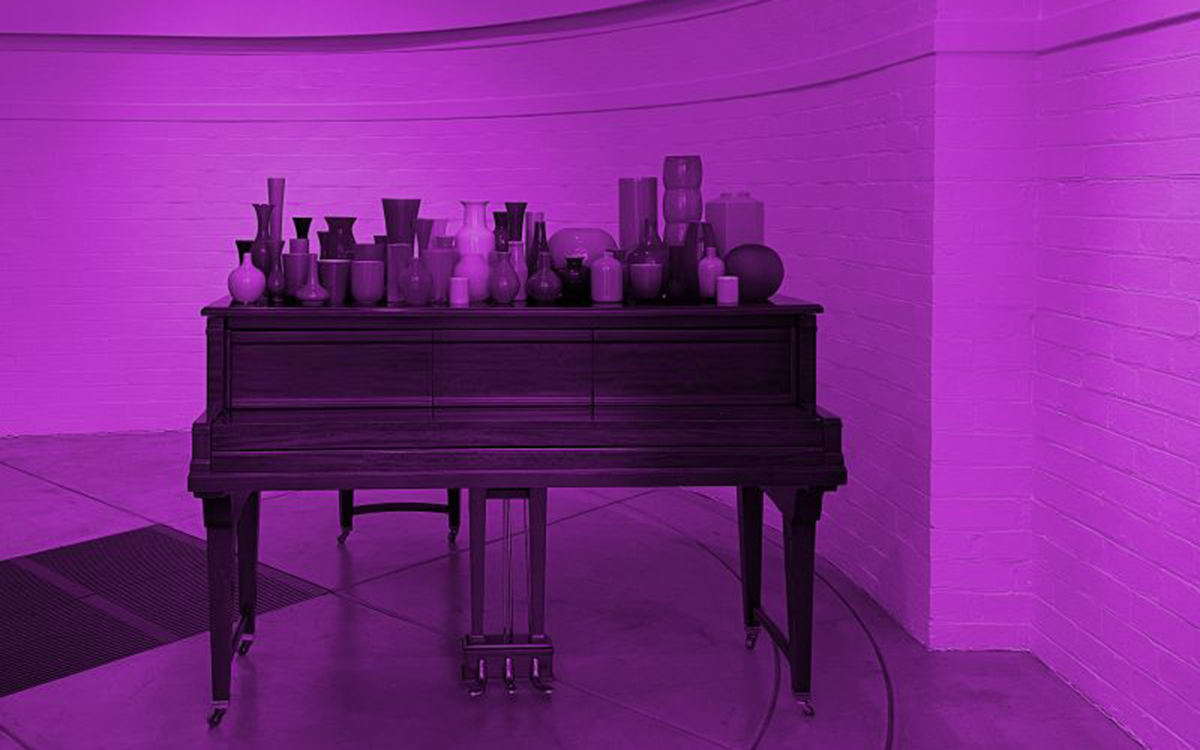 ‘Your piano is my plinth’ at #brownmaninawhitemuseum (photograph courtesy of the Grainger Museum, University of Melbourne)
Prior to the exhibition, the museum had been emptied of its collections and Sequeira takes advantage of this tabula rasa to introduce a series of ‘interventions’ that return just a few objects to display in ways that deliberately distort, rather than illuminate, their original context or purpose. Maybe, as suggested by works such as ‘Your piano is my plinth’, ‘Vase chord 1’ and ‘Vase chord 2’, which involve the artist placing his own coloured vases on top of Grainger’s piano and sheet music manuscript drawers, respectively, he intends to ‘colonise’ them. ‘Upside-down Felt music’, which consists of large pieces of brightly-coloured felt attached to music stands that are left hanging up-side-down from the museum’s ceiling conveys a similarly wary attitude towards Grainger, his art, and his museum. An overarching theme of curatorship as a proprietary act is not hard to discern.
These provocations are not without value. Museums are by nature not neutral in their preservation of the past, and it is not difficult to draw parallels between the nature of collecting and the nature of colonisation itself. Sequeira may also have drawn inspiration from American artist Fred Wilson’s influential ‘Mining the Museum’ exhibition for the Maryland Historical Society (1992–93) which similarly sought to prompt the viewer to reconsider the interpretative presumptions they brought with them.
The implicit danger in so doing, however, is that the opportunity to provide an enriched understanding of an object’s historical context, complexities, or contradictions can end up being sacrificed on the altar of the curator’s presumed moral superiority. The mere invocation of associated historical wrongs can instead foreclose any need for further interpretation. The curator’s reframing instead offers us a kind of moral absolute; we are not invited or encouraged to assess it in relation to a broader historical record.
To be sure, Sequeira is well justified in drawing attention to Grainger’s views on race. Those views are disturbing and unpleasant, more so over the course of his long life, as he drew on ideas inherited from his mother and found in books such as Madison Grant’s The Passing of the Great Race: Or, The Racial Basis of European History (1916). This particular aspect of Grainger’s creative and public life neither requires, nor deserves, special pleading.
But it is not the whole story. Alongside Grainger’s bombastic, often contradictory rhetoric on race can also be found a deep concern for much more subtle, sympathetic, and sophisticated understandings of modern social and sexual identity. Time and time again, he behaved in ways that are anything but the expected actions of an egomaniacal white supremacist, and he did so often at considerable personal cost. Among the founding principles of his museum we also find a desire to create ‘a centre for the preservation and study of native music in, or adjacent to, Australia’. His so-called ‘autobiographical’ museum was always so much more than just that.
Behind it all lies his music, which offers us what music historian Bob van der Linden has described as an ‘imperial counterculture’, an unmistakably cosmopolitan aesthetic that bears witness to experiences of estrangement, violence, and loss. As Grainger put it in a program note for a performance of his setting of Kipling’s The Widow’s Party (1939), he wished his music to speak to ‘the tragedy, not the splendours of imperialism’.
Sequeira’s interventions, and the critical foreclosures they imply, therefore raise a larger question as to what kind of relationship to historical truth (contested or not) a museum, especially a university museum, should have. I also worry that what Sequeira has done here, and his rationale for it, proffers an impoverished model of what research-led creative practice can, and should, be.
Perhaps Sequeira anticipated such criticisms when he declared in the exhibition flyer that the Grainger Museum was (until now, one presumes) ‘strikingly inconsistent with the University’s current values’. But here, too, some historical context would have been useful. There have been, sadly, very few periods in its history when the Grainger Museum (and the munificent gift by the composer that established it) has been well supported by the University – the most recent exception being during Philip Kent’s tenure as University Librarian. The dismissal of Grainger himself and his museum without a close scholarly engagement with the historical and material record seems less like a genuine reconception or reimagining than a continuation of what has been, in fact, a long-standing attitude of miscomprehension and disdain.
Above all … where is the music?
#brownmaninawhitemuseum is showing at the Grainger Museum, Parkville on 19, 24, and 26 February 2022.
This review is supported by the Copyright Agency’s Cultural Fund.