


- Free Article: No
- Contents Category: Opera
- Review Article: Yes
- Article Title: Otello
- Article Subtitle: A welcome revival of Harry Kupfer’s production
- Online Only: No
- Custom Highlight Text:
Devotees of Giuseppe Verdi often suggest that the composer’s version of Shakespeare’s Othello is ‘greater’ than the original; a fruitless assertion, but indicative of the esteem in which Verdi’s penultimate opera is held. After Aida (1871), Verdi was enjoying the life of a gentleman farmer. Italian opera of the 1870s and 1880s, however, was facing something of a crisis, threatened by the relentless tide of ‘Wagnerism’, whose theories on opera were embraced by many Italians. Verdi, when asked about his own theory of theatre, drily replied: ‘My theory is that the theatre should be full’.
- Article Hero Image (920px wide):
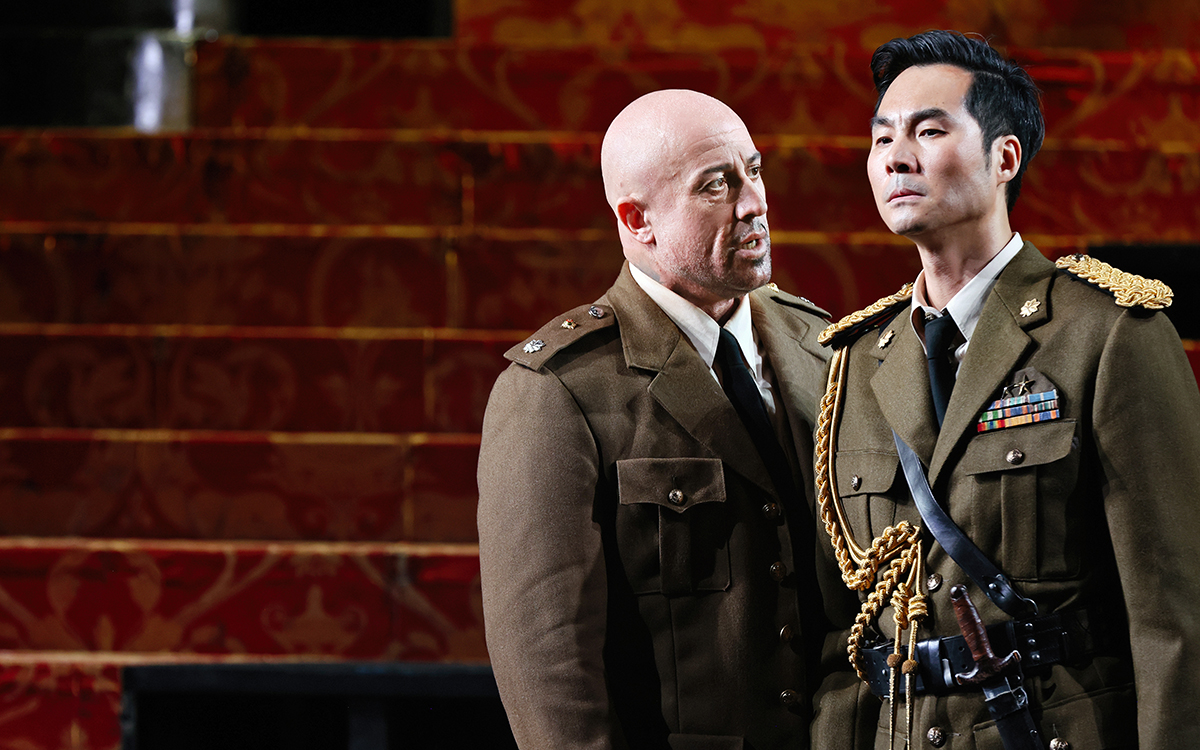
- Article Hero Image Caption: Marco Vratogna as Iago and Yonghoon Lee as Otello in Opera Australia’s 2022 production of <em>Otello</em> at the Sydney Opera House (photograph by Prudence Upton)
- Alt Tag (Article Hero Image): Marco Vratogna as Iago and Yonghoon Lee as Otello in Opera Australia’s 2022 production of <em>Otello</em> at the Sydney Opera House (photograph by Prudence Upton)
A plot was hatched by publisher Giulio Ricordi, librettist–composer Arrigo Boito, and conductor–composer Franco Faccio, to entice the ageing Verdi back to the stage; Boito had written the libretto for Faccio’s Amleto (1865). These three ‘conspirators’ belonged to a younger, more radical generation. Luckily, Verdi and Boito had settled previous awkward artistic differences, happily collaborating on revisions to the libretto of Simon Boccanegra while forging a strong, mutually admiring relationship.
The lure dangled in front of Verdi was Shakespeare. Anecdotal gossip suggests that there were two books on Verdi’s bedside table when he travelled: the Bible, and a collection of Shakespeare’s plays. There might be doubts regarding the Bible, judging by Verdi’s anti-clerical views, but not Shakespeare.
Verdi was determined not to revert to the highly effective but somewhat tired formulaic dramaturgy of Italian opera. There were to be no traditional arias and duets. He even questioned the need for a chorus. As a result, Otello (which had its première at La Scala in February 1887) almost completely subsumes form to the dramatic imperative. This is immediately apparent – with no sign of an introduction – in the cataclysmic choral opening of the opera, as we are plunged headlong into the storm. Traditional forms persist but they have been completely reimagined. Verdi transforms them with music of freshness and ravishing beauty; everything is dictated by the dramatic situation.
Boito’s contribution was crucial; Verdi asserted that the Otello libretto was the best he had ever seen. Boito jettisoned the play’s first act, thus forging a relentless dramatic arc. As he would do with Falstaff (La Scala, 1893), Boito did not feel constricted by the illustrious source, observing in a letter to Verdi:
A translator’s fidelity ought to be very scrupulous, but the fidelity of one who illustrates a work from another art with his own art … can be less scrupulous. He who translates has the duty not to change the letter; he who illustrates has the mission of interpreting the spirit. One is a slave, the other is free.
This production was first staged in 2003 for Opera Australia by the late, renowned German director Harry Kupfer (1935–2019) and here revived by Luke Joslin, with sets by Hans Schavernoch, costumes by Yan Tax, and lighting Toby Sewell. The opera is set in wartime in the mid-twentieth century. A single set comprises a massive, damaged black and red staircase, which serves as the main playing area. Starkly lit and highly effective in large-scale scenes, the set lacks the requisite claustrophobic, bedchamber intimacy necessary for the final act. Costumes, bedecked with jewels and other finery, are sumptuous, befitting a society celebrating its recent victory.
The celebrated opening of the opera was breathtaking. Down flood the chorus dressed as refugees as the action commences. And what a sound they make – chorus and orchestra are the firm bedrock upon which everything else rests. Conductor Andrea Battistoni expertly drew out the sheer force, momentum, and variety of Verdi’s brilliant orchestration, while highlighting the subtleties and nuances in this most mercurial of scores.
Otello, rightly regarded as the pinnacle of the tenor roles in the Italian opera repertoire, calls for a voice with great declamatory power allied to tonal subtlety and emotional commitment. Yonghoon Lee’s thundering opening utterance, ‘Esultate’, lasts less than half a minute – no standard leisurely entrance aria this – and must instantly stamp his authority. One immediately senses that his is a spinto voice capable of doing justice to his début in this role. The tone has a laser-like focus, with fullness and color throughout the range. His soft singing had body and substance, and while some of the textural nuances are not yet fully developed, he should soon take his place among the best contemporary exponents of the role.
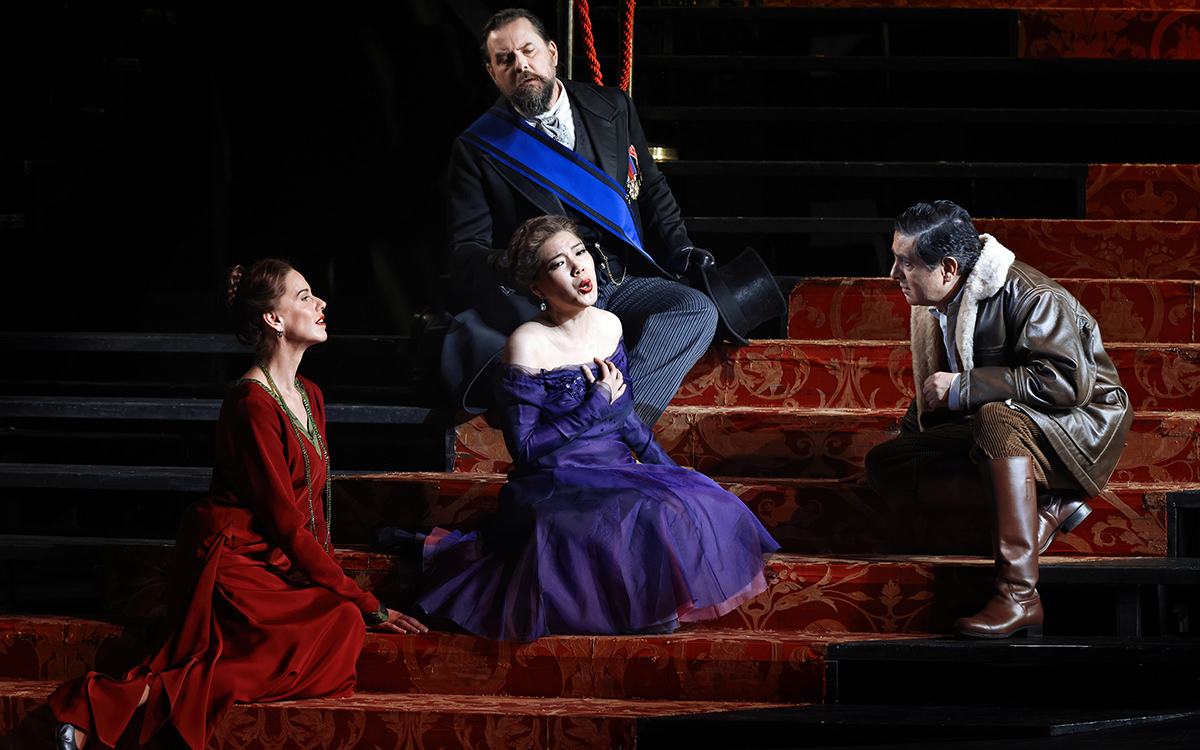 Sian Sharp as Emilia, Karah Son as Desdemona, Richard Anderson as Lodovico and Virgilio Marino as Cassio in Opera Australia’s 2022 production of Otello at the Sydney Opera House (photograph by Prudence Upton)
Karah Son as Desdemona has a beautiful, richly limpid voice combined with an attractive stage presence. Her tone sounded somewhat veiled in the first two acts, but her final moments were most affecting as the voice bloomed. The last act with its two arias was especially poignant, culminating in her cry to Emilia, full of foreboding: ‘Ah! Emilia, addio, Emilia, addio’, at the end of the ‘Willow Song’. This spine-tingling vocal outburst has been described as the last despairing cry of the glorious tradition of the Italian bel canto. The ‘Ave Maria’ that follows seems most appropriate in both deeply personal character terms as well as wider symbolic significance. It was a profoundly moving moment in her performance and in the opera.
And then there is Iago, expertly sung by Marco Vratogna, demonstrating his affinity with this repertoire. Iago is the pivotal figure (Verdi initially thought of naming the opera Iago). Whereas the music for Otello and Desdemona is distinctive, Iago is a vocal chameleon, able to adapt his vocal utterance to suit each situation, ranging from the seemingly forthright honest broker with Cassio, Roderigo, and Desdemona, to the insinuating manipulator with Otello, and revealing something of his true nature in his ‘Credo’, Boito’s brilliant addition to Shakespeare. Vratogna brought great tonal variety to the role: a voice of dark, incisive power with an insinuating stage presence. His manipulation of Otello was at all times frighteningly believable. His callous tossing away of the knife with which he and Otello have sworn vengeance is a brief but dramatic gesture revealing the heart, or lack thereof, of the character.
The smaller roles were consistently fine: Virgilio Marino (Cassio) and Sian Sharp (Emilia) brought sympathy, definition, and depth to these crucial characters, both demonstrating years of experience in their vocal and dramatic portrayals. Richard Anderson, Hubert Francis, Andrew Moran, and Andrew Williams all contributed well-rounded vocal performances and strong stage presences.
There was a palpable sense of occasion at the première: celebration of a fine performance tinged with relief at being back in the theatre under close to normal circumstances. Opera Australia has done Verdi, and opera, proud in the revival of this production which does full justice to one of the supreme achievements of the art form. Otello remains unsurpassed as a Shakespearean adaptation.
Otello (Opera Australia) continues at the Joan Sutherland Theatre, Sydney Opera House, until 19 March 2022. Performance attended: 19 February.