


- Free Article: No
- Contents Category: Film
- Review Article: Yes
- Article Title: Drive My Car
- Article Subtitle: Ryusuke Hamaguchi’s luminous new film
- Online Only: No
- Custom Highlight Text:
Director Ryusuke Hamaguchi’s latest feature, Drive My Car, ponders fidelity and sorrow, and the universal truth that people are mostly fucked up. It adapts Huraki Murakami’s short story of the same name from his collection Men Without Women (2014), about a widower recounting his deceased wife’s infidelities to his ‘homely’ female driver. Hamaguchi’s film gently teases out the many quirky strands of information glossed over in the master novelist’s short story, most notably the characters’ backstories. The result is a literary work, magnificent in scope, that unfurls over three entrancing hours.
- Article Hero Image (920px wide):
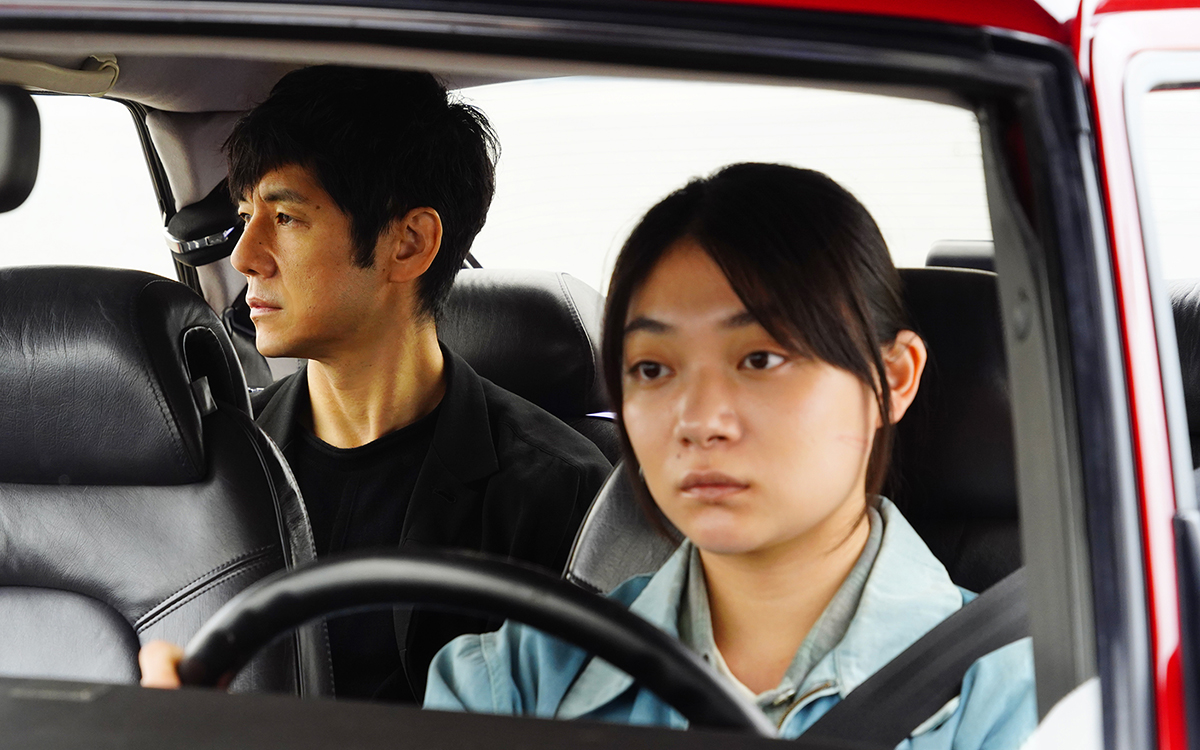
- Article Hero Image Caption: Hidetoshi Nishijima and Toko Miura in <em>Drive My Car</em> (still courtesy of Potential Films)
- Alt Tag (Article Hero Image): Hidetoshi Nishijima and Toko Miura in <em>Drive My Car</em> (still courtesy of Potential Films)
We begin with a glimpse into the marriage of a middle-aged couple: the Kafukus. Oto (Reika Kirishima), a television writer, summons her stories from a trance-like state after sex. She forgets them the morning after, but her stage actor–director husband, Yūsuke (Hidetoshi Nishijima), dutifully serves as scribe. In turn, Oto lends her voice on an outmoded cassette to Yūsuke, to help him rehearse lines on long drives in his vintage Saab. There are two sides to their symbiotic relationship: an intense, mutual love; and a swirling darkness shaped by their young daughter’s death years prior and Oto’s covert infidelities (one example of which we witness). Yūsuke’s chance to confront Oto is snuffed out when his wife dies unexpectedly, leaving Yūsuke and one of Oto’s young lovers, actor Kōji Takatsuki (Masaki Okada), bereft. Two years later, Yūsuke takes on a festival residency in Hiroshima to direct Chekhov’s Uncle Vanya on stage. He grudgingly accepts the offer of a driver – a young woman named Misaki Watari (Tōko Miura) – to ferry him to and from rehearsals in his car. As opening night approaches, Yūsuke engages in a quiet power struggle with Takatsuki as he learns more about his wife. Meanwhile, the bond between Yūsuke and Watari grows as they confide in each other over long stretches of road.
Hamaguchi’s films are concerned with the messy, dark feelings that bubble up in the relationships between his middle-class subjects. In Asako I & II (2018), his characters act selfishly and impulsively to ruinous effect, and his recent triptych, Wheel of Fortune and Fantasy (2021), is a thought-provoking paean to the twists and turns of desire. With Drive My Car, he hands his cast of players an elegant script loaded with humanity; in return they deliver subtle, compelling performances. The first we see of Kirishima’s Oto is her silhouette against the dusk; her sensuous, enigmatic presence lingers throughout the film in both men’s minds. Nishijima’s Yūsuke is on the wrong side of forty and his lined face is fixed with the stoic demeanour of a man used to repressing grief. His interactions with the younger Takatsuki are guarded, but sympathetic. A lesser filmmaker would cast Okada’s brash Takatsuki as the antagonist of the piece, but Hamaguchi opts to give Takatsuki’s anguish equal weight to Yūsuke’s. He even hands the young Adonis one of Murakami’s most perspicacious lines in a virtuosic and revelatory scene: ‘if we hope to truly see another person, we have to start by looking within ourselves.’ But it’s Miura’s understated and intelligent performance as Watari that steals the show, with her taciturn demeanour edged with an inscrutable cool; a superb example of ostensible non-acting. Her own story of grief isn’t necessarily connected to Yūsuke and Takatsuki’s drama, but it serves to remind the audience that everyone has their own shit to deal with.
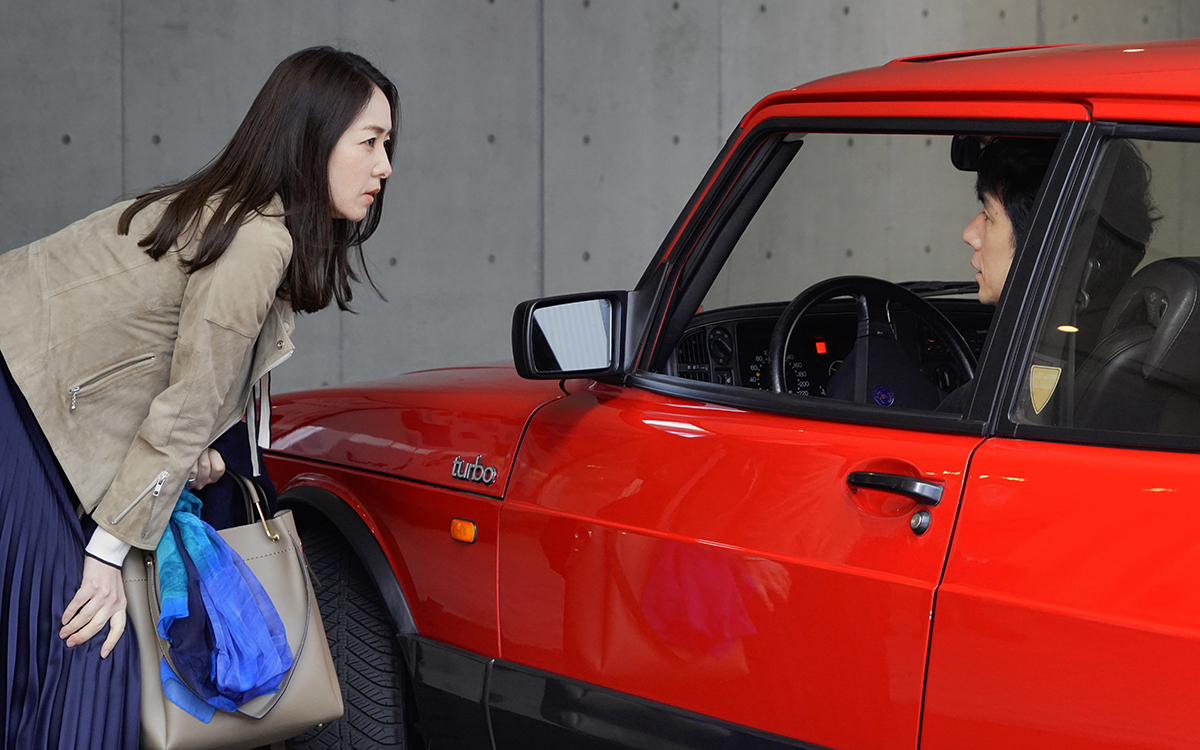 Reika Kirishima and Hidetoshi Nishijima in Drive My Car (still courtesy of Potential Films)
The fifth member of Hamaguchi’s ensemble is the gorgeous old Saab at the centre of the film; a mobile confessional, crimson red as a human heart that gently rumbles along to Yūsuke’s, Watari’s, and Takatsuki’s disclosures. For Yūsuke it’s a heterotopia, a space inside which he can shed his usual stoicism and speak his frustrations aloud – albeit as Uncle Vanya or other characters – to Oto’s disembodied voice, and to Watari, without the searing intimacy of eye contact. Yūsuke clings to this ‘living’, mechanical embodiment of his wife. When he ‘responds’ to Oto/auto and converses with Watari (she is twenty-three, the same age his daughter would have been), we are given fleeting glimpses of a familial scene. Throughout the course of the film, we follow the car across cityscapes at night, verdant highways along coasts, and industrial zones. Hamaguchi’s choice of Hiroshima as a setting for the film is an astute one; Yūsuke and Watari’s inner conflict is a microcosm of this site of national sorrow and desolation now going through a process of renewal.
Hamaguchi patiently and gently unravels the mysteries of his bottled-up characters à la Chantal Akerman and Wim Wenders, and his vision aligns with the grand scope of Abbas Kiarostami’s works. In the Iranian auteur’s Taste of Cherry (1997), his protagonist drives around the industrial outskirts of Tehran looking for someone to aid him in his suicide. He pleads his case to a young soldier, a seminarist, and an elderly taxidermist. Both Hamaguchi’s and Kiarostami’s films aim to impart the lesson spoken by the character of Sonya at the end of Chekhov’s Uncle Vanya: ‘What can we do? We must live our lives.’ Worthy of the many accolades it has already received, Drive My Car is a luminous, moving work and a shining example of style and substance working in perfect unison. It takes your breath away.
Drive My Car (Potential Films), 179 minutes, is screening now.