


- Free Article: No
- Contents Category: Film
- Review Article: Yes
- Article Title: Flee
- Article Subtitle: An animated journey from Afghanistan
- Online Only: No
- Custom Highlight Text:
A teenager’s arduous journey from a Taliban-occupied Afghanistan in 1989 to the safe haven of Denmark is given a uniquely painterly treatment in Flee. Far from diminishing the story’s impact, this animated documentary is all the more profound for the insidious way the visuals undermine our defences.
Danish filmmaker Jonas Poher Rasmussen became friends with Amin soon after the Afghan refugee arrived in Denmark as an unaccompanied minor. Despite a friendship that has lasted twenty-five years, Amin had never told Jonas the full story of the harrowing experiences that led to his eventual asylum. He hadn’t told anyone. Through the course of Poher Rasmussen’s film, we find out why.
- Article Hero Image (920px wide):
.jpg)
- Article Hero Image Caption: Still from <em>Flee</em> (courtesy of Madman Films)
- Alt Tag (Article Hero Image): Still from <em>Flee</em> (courtesy of Madman Films)
Flee chronicles a series of filmed interviews that Poher Rasmussen conducted with Amin. The director’s initial concept was to create a hybrid piece with the live-action footage of their conversations interspersed with animation of Amin’s memories of Afghanistan and his journey. When Amin later requested that he remain anonymous, the interviews were animated to obscure his identity.
Rather than employ rotoscoping to trace over the original footage, the animators created a more handcrafted effect by simply using the footage as a reference in terms of how Amin moves and acts. The medium of animation transforms Amin’s image, but it also seamlessly transports us into his world. An interview session will begin with Amin lying down on a couch, a traditional Persian cover behind him. Then the backdrop changes and we are transported back to the places he recalls.
The first of these recollections is of his childhood in Kabul. He was around four years old and he remembers himself as a flamboyant boy who liked wearing his sister’s dresses in public. The animated memory sequences are intercut with archival film footage, which is presented in a rounded edge 8mm film frame. When Jonas asks questions about Amin’s family, Amin is unable to continue. He says he isn’t ready to talk about certain things yet.
Away from the camera where Jonas has set up the interview, we learn more about Amin’s current life in Copenhagen. He is set to marry his Danish boyfriend, Kasper, but Amin is evasive with Kasper during conversations about home buying, and prioritises his studies and career over their relationship. This results in his spending lengthy periods overseas away from Kasper.
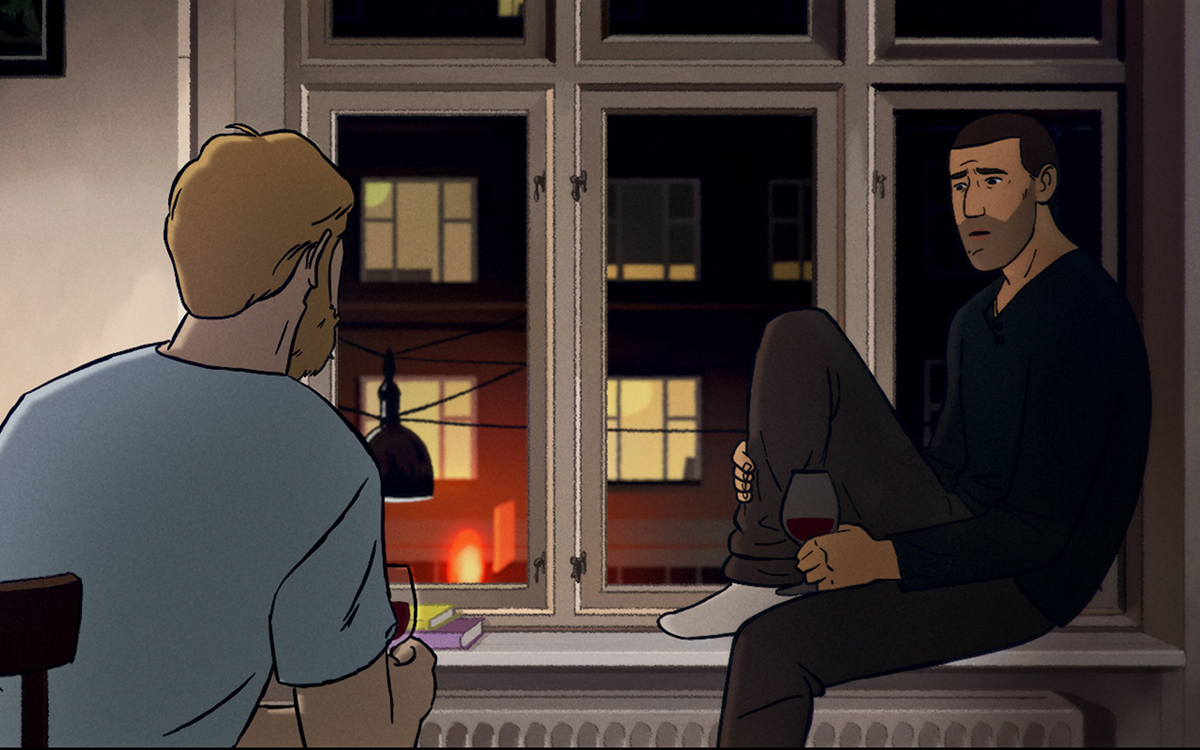 Still of Amin and Kasper in Flee (courtesy of Madman Films)
It is six months before the second interview between Jonas and Amin takes place. Now Amin feels ready to talk about his family. His recollections this time take us back to 1989. By now he knows that he is gay, but in Afghan culture there is no word for what he is; he only knows it is something that brings shame to one’s family.
His country is about to experience a major upheaval. The Soviet Union is preparing to leave Afghanistan, resulting in civil war. The rise of Mujahideen groups means that there is a genuine threat that Amin and his family will be killed. Thus begins Amin’s ordeal, fleeing Kabul for a new home. It will be a six-year journey that encompasses several countries. He talks about horrific experiences with unconscionable people traffickers, a life-threatening boat ride, an inhumane asylum centre in Estonia, and corrupt police in post-communist Russia.
The style of the animation departs from realism at moments when Armin is recounting particularly distressing memories. Here the more expressionist visuals take on a darker, haunting quality that is directly connected to Amin’s emotions and effectively pulls us into the trauma with him. We find out why Amin has not to this point told anyone about his experiences, and we learn about the emotional toll of having to keep this secret. His silence has affected his ability to forge connections with others. He has been forced to filter his communications for so long that he has forgotten how to be open.
The most obvious example of this is Amin’s inability to allow himself happiness with Kasper. It’s here that we see how the trauma of Amin’s past affects his decision making. Depression and guilt engulf him; he finds it difficult to trust others or to trust himself to get close to others. It is a guilt borne of the debt he feels he owes those who have sacrificed so much for him.
The reason for telling this real life story through animation may have been a way for Amin to retain his anonymity, but there is no doubt the approach has a more disarming by-product. This is a confronting subject, and there is an instinct to brace oneself for the oncoming atrocities. The filter of animation tricks us into letting our guard down to an extent, and before we realise it, we have succumbed to the power of Amin’s story.
While Flee may sound like an exercise in fortitude, it surprisingly contains the best feel-good moment of any film to be released this year. Amin tells of a completely unexpected moment in Sweden. It is so uplifting that it’s hard to imagine another film this year surpassing it in terms of sheer joyousness.
The original Danish version of Flee contains the original dialogue between Amin and Jonas. The English language cut features the voices of actors Riz Ahmed and Nicolaj Coster-Waldau, both of whom are executive producers on the film.
Flee is the first film to be nominated for Academy Awards across the categories of Best Documentary, Best International Feature Film, and Best Animated Feature Film, a testament to its ground-breaking approach to a challenging subject. This is a timely story, given the Taliban’s resurgence in Afghanistan. It’s a sobering thought that Amin’s plight of more than thirty years ago is now being experienced by a new generation of Afghan people seeking refuge.
Flee (Madman Entertainment) 90 minutes. In cinemas 17 February 2022.