


- Free Article: No
- Contents Category: Opera
- Review Article: Yes
- Article Title: Die Walküre
- Article Subtitle: A triumphant performance from Melbourne Opera
- Online Only: No
- Custom Highlight Text:
Richard Wagner’s famous pronouncement, ‘Kinder, schafft Neues!’ (‘Children, create something new!’), has often been the inspiration to take daring creative risks, particularly (but not exclusively) with productions of his works. Using The Ring as a starting point, directorial licence has been extended in all sorts of intriguing ways that have, over the years, seen Valkyries roaring around on motorcycles, Rhinemaidens as strutting Victorian doxies, the dragon Fafner at the turret of an army tank, Wotan as a Texan oligarch, Siegfried as a hippie, and Gunther and the Gibichungs as Nazis.
- Article Hero Image (920px wide):
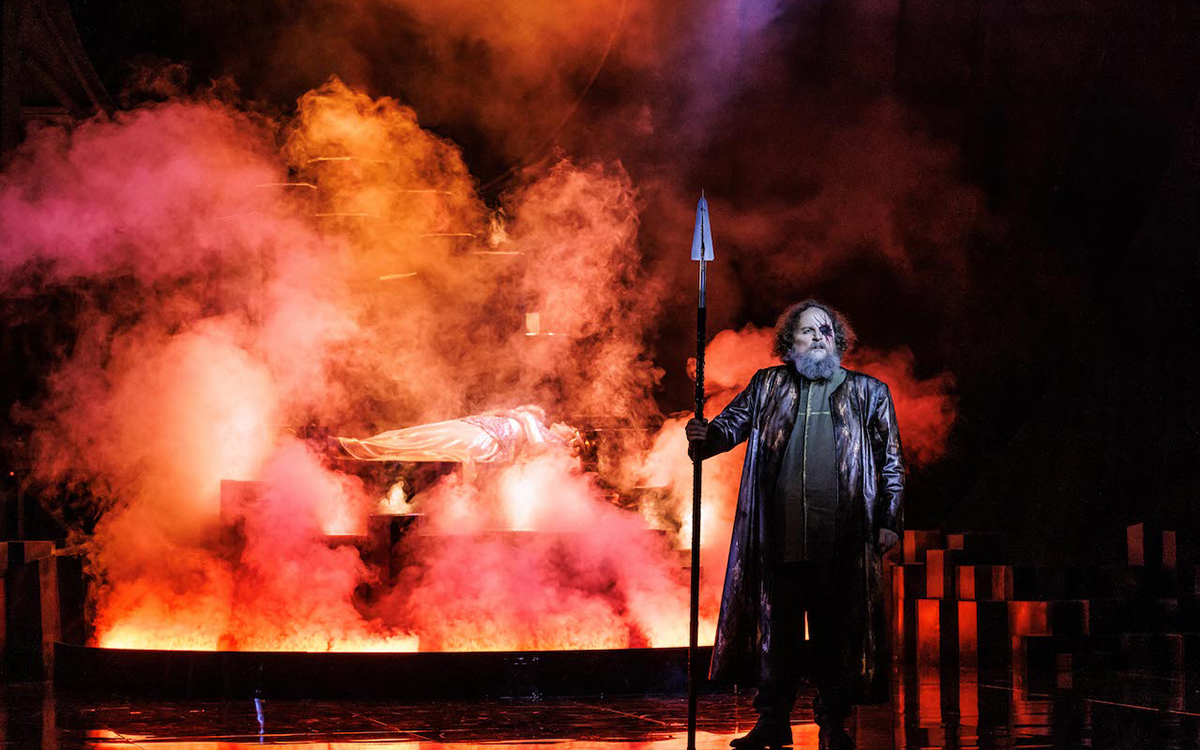
- Article Hero Image Caption: Warwick Fyfe as Wotan in <em>Die Walküre</em> (photograph courtesy of Melbourne Opera)
- Alt Tag (Article Hero Image): Warwick Fyfe as Wotan in <em>Die Walküre</em> (photograph courtesy of Melbourne Opera)
How refreshing – how unusual – then to see Suzanne Chaundy’s new production of Die Walküre. No cycles, other than the one usually attached to the word ‘Ring’, and no confusing ad libitum subplots or backstories. In a word: traditional. But not completely so. Mahler’s equally famous statement, ‘Tradition ist Schlamperei!’ (‘Tradition is sloppiness’) certainly does not apply to Chaundy’s staging, which, although a straightforward storytelling, has an edginess and quirkiness all of its own. It is also energetic and enthralling.
Chaundy achieved as much a year ago with Das Rheingold, the Vorabend to The Ring. But in the vast reaches of the Regent Theatre, not a natural place for opera, there was a lack of intimacy between stage and audience.
The Walküre was a different story from a different, more preferable venue: the smaller, more intimate Her Majesty’s, which holds its own distinguished operatic history. Any fears the theatre might prove too compact were banished immediately. If anything, the production fitted the stage perfectly, with Andrew Bailey’s ingenious and stylish set blending, as if by design (so to speak), with the warm décor of the auditorium and embracing the audience. Betwixt stage and auditorium, the Melbourne Opera Orchestra (all ninety musicians, including four harps) were snugly accommodated in the pit.
In the event, the result, in visual and sonic terms, was a faithful realisation of Wagner’s vision of Gesamtkunstwerk: to meld music, text, and production values into a seamless entity. At the heart of this was conductor Anthony Negus, whose fluid and sensitive account of the score emerged with distinction and clarity; never bombastic or prosaic, but always attentive to the balance between individual instruments and the performers on stage.
Although Negus, a disciple of the great Reginald Goodall, shares that legendary Wagnerian’s knowledge and scrupulous attention to detail, achieved through long rehearsals. Negus does not (thank heavens) share Goodall’s famous predilection for slow tempi. Instead, it was clear, right from the first jagged, stormy bars of the Act I prelude, that the music would indeed draw one into each act, as if into a vortex, and maintain its elasticity and power. The orchestra’s playing was simply superb, with an inner strength to the strings and remarkable breath control from wind, brass, horns, and (of course) Wagner tubas.
Die Walküre is, in essence, a series of encounters and conversations that determines the subsequent operas in The Ring. The momentum towards the twilight of the gods is driven by a combination of contradictions: between love and hate, life and death, morality and immorality, invincibility and vulnerability.
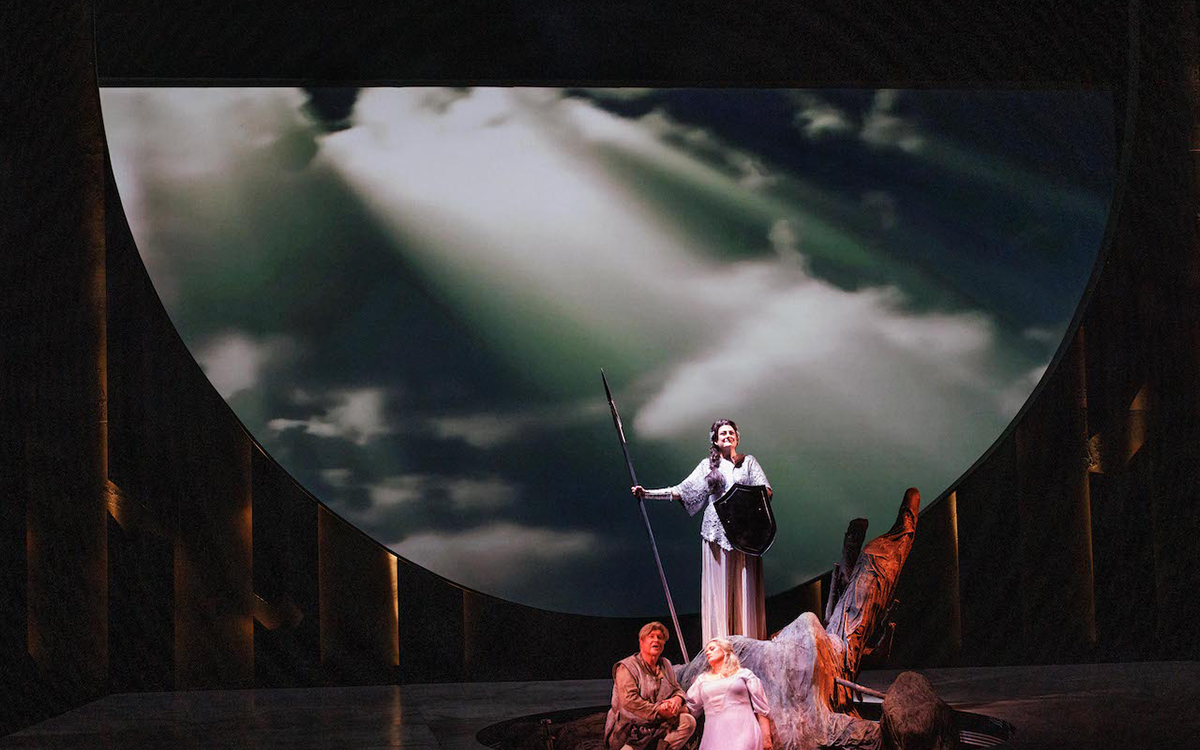 Zara Barrett as Brunnhilde, Lee Abrahmsen as Sieglinde, and Bradley Daley as Siegmund in Die Walküre (photograph courtesy of Melbourne Opera)
Sometimes, though, there is so much going on in Walküre that it is hard for an audience to grasp the dramatic significance of what is happening in the music. Chaundy’s particular skill is in depicting the directness of the human relationships from which the tale develops. For example, the key narrations of Siegmund and Sieglinde in Act I; Wotan’s long unravelling in Act II; the Brünnhilde–Wotan excoriations of Act III. Also, quite often, Chaundy goes back to the source, by observing Wagner’s own detailed stage directions, as noted in his scores.
Chaundy also adds a few supernumeraries (two henchmen for Hunding; two extra Valkyries on sway poles; a few deceased warriors destined for Valhalla), but these are more helpful than gratuitous.
Bailey’s set is almost another character in itself, and is hardly inanimate. A huge platform with a Ring-like hole in the middle, centres the action, as well as serving as a sort of drawbridge between the darkness of Hunding’s hut, the wild and rocky place of Act II, and the mountain summit of Act III. Rob Sowinski’s lighting, underwriting the action, was respectful, telling, and vivid. The costumes, by Harriet Oxley, were inspiring and fetching – especially Wotan’s impasto cloak, which could easily be framed and hung on a wall, and Brünnhilde’s slinky, art-deco dress.
The cast could barely be faulted in terms of musicianship and dramatic qualities. Warwick Fyfe, long an acclaimed Alberich, was equally compelling as the dwarf’s nemesis. Fyfe, a strong-voiced, tireless, magnificent Wotan, adroitly portrayed a god at the end of his tether, but whose own human frailties are just below the surface of his grandeur.
Zara Barrett’s lithe and lyrical Brünnhilde, a little underpowered at the beginning, gained in power as the evening went on. She is a performer to watch. Likewise, Sarah Sweeting’s Fricka, embodied all her character’s hauteur and chilly sense of self-righteousness.
The excellent Siegmund of Bradley Daley, already a significant Siegfried in international opera houses, was lustrous and powerful. His equally matched Sieglinde, Lee Abrahmsen, should, I hope, in time consider Brünnhilde. Steven Gallop, a saturnine Hunding, was expertly portrayed.
The eight spear-waving Walküren (Rosamund Illing, Eleanor Greenwood, Jordan Kahler, Olivia Cranwell, Naomi Flatman, Caroline Vercoe, Sally-Anne Russell, and Dimity Shepherd) sang with gusto, penetrating accuracy, and more than proved themselves worthy members of the closest Wagner ever got to a chorus line.
By the end, as Brünnhilde lay in her ring of fire and Wotan ruefully trudged off the stage, it seemed to me that the performance encapsulated all the magical qualities of Die Walküre. It is a hard opera to bring off, and Wagner’s Curse (whatever goes wrong, will go wrong in spades), thankfully, was not invoked. Instead, this was one of those rare nights when everything seemed right with the world. This triumphant performance must be regarded as a glory for Melbourne Opera. It augurs well for the rest of its Ring.
Die Walküre is presented by Melbourne Opera at Her Majesty’s Theatre. Performance attended: 9 February 2022. Final performance on 16 February; also at Ulumbarra Theatre, Bendigo on 27 February.