


- Free Article: No
- Contents Category: Film
- Review Article: Yes
- Article Title: Benedetta
- Article Subtitle: Paul Verhoeven’s ‘convent life gone wrong’
- Online Only: No
- Custom Highlight Text:
Catholicism gets a bad rap when it comes to sex these days. The Church fixates on condoms and abortion. It isn’t always big on homosexuality either. Paul Verhoeven’s ‘historically inspired’ film, on one level, explores the hypocrisies that arise from such callow credos: the religious renounce the flesh but flagrantly eroticise spiritual and interpersonal relationships. Carnal obsessions abound on screen. Nuns mortify themselves (quite literally) and male clergy are reassuringly lascivious. The whole film is as revealing of the female figure as you would expect from the director of Basic Instinct (1992) and Showgirls (1995). Indeed, those who buy their ticket for the soupçons of Sapphic frottage are unlikely to be disappointed.
- Article Hero Image (920px wide):

- Article Hero Image Caption: Virginie Efira and Daphne Patakia in <em>Benedetta</em> (photograph via Hi Gloss Entertainment)
- Alt Tag (Article Hero Image): Virginie Efira and Daphne Patakia in Benedetta (photograph via Hi Gloss Entertainment)
- Production Company: Hi Gloss Entertainment
The question, though, as with any baroque invention, is whether the sum of this art is greater than its parts? Verhoeven’s ‘convent life gone wrong’ melodrama is full of lush visuals from austere Romanesque churches to immaculately ironed wimples. And it endorses a seemingly simple moral message: that it can be hard to tell the wryly cynical from the downright crazy. Yet the script’s layers of self-consciously ironical detachment are such that you can’t quite tell if Verhoeven takes the whole thing seriously or not. One-liners are good and the audience will guffaw. But is the joke on the Catholic Church or just on those who would lap up such sensationalising costume romps?
Benedetta Carlini (Virginie Efira), our eponymous heroine, is an intensely enigmatic sort of tragedian. We first meet her on screen as that stubborn, spoiled little rich girl whose parents are escorting her to a nunnery (Verhoeven may not have intended this, but the decision seemed quite understandable to me). Bandits try to rob them, but Benedetta’s faith in the Virgin saves the day. Yet the tone is set when Mary’s instrument proves to be an anonymous feathered friend with unusually good posterior aim. Further episodes explore the divine’s growing presence in Benedetta’s life. She ‘sees’ Jesus as a sexy shepherd, as a smiter of sinister snakes, and as a Zorro-like horseman who lops the head off enemies (complete with gushing blood). A couple of ersatz tributes to The Exorcist and some gratuitously graphic stigmata glaze the whole thing in Grand Guignol. Verhoeven misses a trick only when he depicts the crucified Christ as an object of Benedetta’s masochistic desire. The absence of his genitalia is notable but inauthentic, and not clearly purposeful (except perhaps for helping placate beady-eyed censors).
Benedetta, absorbed into her religious order, leads an unremarkable existence until a new girl, her love interest, Bartolomea (Daphne Patakia), shows up. Half Lolita, half that kid from Hard Candy, Bartolomea is rough and earthy and decidedly lower class. Incestuous rapes at the hands of her father and brother have toughened her. But she knows just what she wants and shows remarkable self-confidence when it comes to seduction’s delicate arts. Sex scenes ensue. The climax – if that’s le mot juste – arrives when Bartolomea whittles down Benedetta’s childhood statue of the Virgin into something more shaped for pleasure than piety. Alas, the former Mother Superior (Charlotte Rampling), whose office Benedetta has usurped, sees the whole thing through a spyhole. She tells the papal nuncio (Lambert Wilson) who latches onto the investigation as a vehicle for indulging his sadism. He arrives in town just in time to witness plague-induced mass hysteria (a prescient plot device in a film shot pre-pandemic) and the whole affair ends in a sort of godless Götterdammerung complete with pestilential pustules. Strangely, though, Benedetta herself, rising up from her lovers’ bed in a bucolic hut outside town, doesn’t seem all that fazed by any of it.
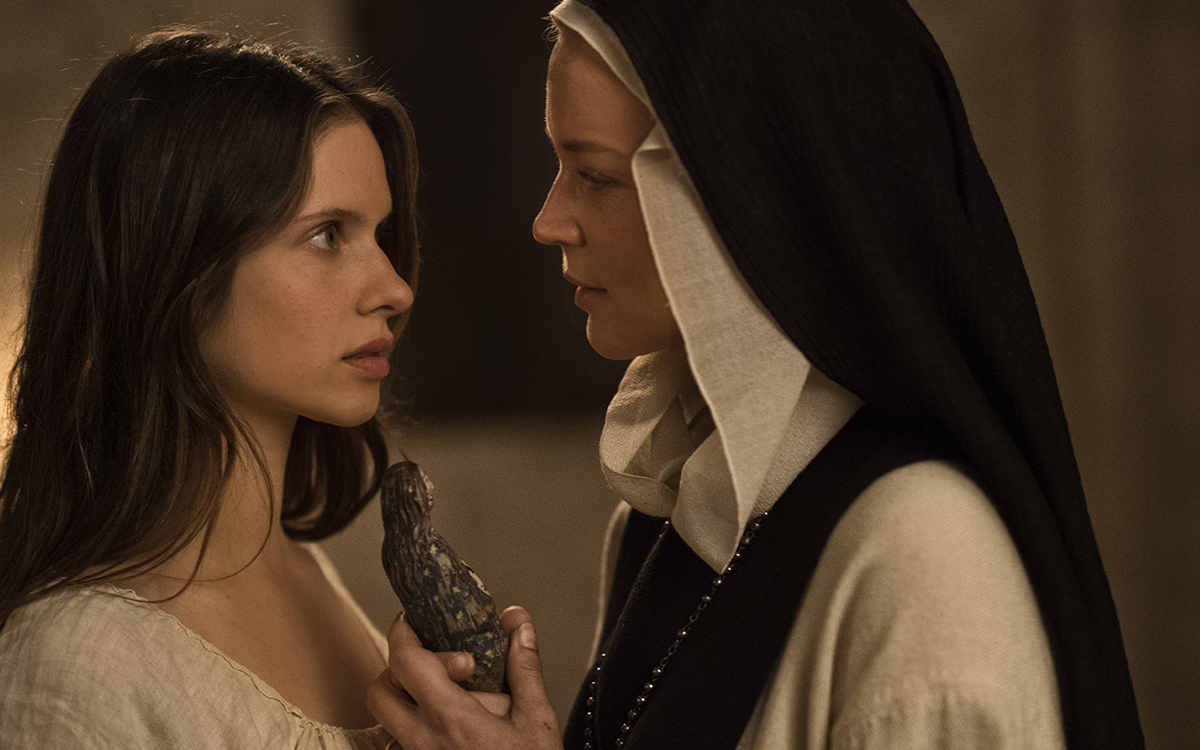 Daphne Patakia and Virginie Efira in Benedetta (photograph via Hi Gloss Entertainment)
The actors clearly have great fun with what they are doing, and Rampling is the standout as the convent’s wizened, world-weary matriarch. Yet the director never solves some basic dilemmas on which the credibility of his narrative ultimately depends. First problem: the ‘lesbian nuns’ theme feels titillating rather than taboo these days. And, to shock, post The Devils or The Exorcist, you have to go a lot further than basic sacrilegious insertion of foreign objects. Second: Benedetta’s visions must tread a fine line between vividity and ridiculousness. It was always going to be hard to get that right when so few who will see the film are ever likely to entertain thoughts that the visions might be real. Verhoeven seems caught between two strategies for dealing with this. He makes us laugh at the gothic grotesqueness of what Benedetta sees (or claims to see), but also hints that she herself may be slyer and more manipulative than she lets on. That further discourages suspension of disbelief.
Certainly, few other characters in this story believe in Benedetta. Not the Mother Superior. Nor the cynical prevôt (Olivier Rabourdin), whose interest in her waxes in proportion to his chances of gaining a bishop’s crozier. Nor the sleazy nuncio, whose gratifying comeuppance is fully deserved. Yet there is no great reveal to the plot’s central mystery, nor to the related question of what motivates our lead character: is she awestruck by Jesus, lovestruck by Bartolomea, or just drunk on the prospect of attaining power in her community? And what exactly is the dynamic in the relationship between the two lovers?
In the end, the film’s most striking feature may simply be Verhoeven’s latent but still disquieting obsession with lacerated and violated female bodies. Par for the course after Elle you might think. But if such thoughts weren’t a healthy focus for concupiscent clergy back then, are they any more wholesome now?
Benedetta, 131 minutes, is now showing in select cinemas.