


- Free Article: No
- Contents Category: Film
- Review Article: Yes
- Article Title: Belfast
- Article Subtitle: Kenneth Branagh’s coming-of-age dramedy adds little to the genre
- Online Only: No
- Custom Highlight Text:
On the sunny streets of Belfast in 1969, nine-year-old Buddy (Jude Hill) fights imaginary dragons with a wooden sword and a shield made from the lid of a garbage bin. When his Ma calls him home for tea, he races through the neighbourhood, bright-eyed and carefree. But the afternoon idyll is quickly shattered by a small army of Protestant rioters laying siege to the street, smashing windows and firebombing cars in a targeted attempt to weed out any remaining Catholic residents.
- Article Hero Image (920px wide):

- Article Hero Image Caption: A still from <em>Belfast</em>, directed by Kenneth Branagh (photograph by Rob Youngson/© 2021 Focus Features, LLC)
- Alt Tag (Article Hero Image): A still from Belfast, directed by Kenneth Branagh (photograph by Rob Youngson/© 2021 Focus Features, LLC)
- Production Company: Universal Pictures
Written and directed by Kenneth Branagh as a semi-autobiographical, black-and-white love letter to the place, time, and community of his childhood, Belfast divides its time and attention between two distinct storytelling modes: an affable coming-of-age narrative about Buddy and his family, and a historical drama set during the Troubles, the religious conflict that plagued Northern Ireland from the late 1960s well into the 1990s.
After the powerful opening sequence, we get to know Buddy and his peace-abiding Protestant family, including his Ma and Pa (Caitríona Balfe and Jamie Dornan) and his Granny and Pop (Judi Dench and Ciarán Hinds). We see Buddy fall in love, mix with the wrong crowd, mourn the inevitable death of a loved one, and eavesdrop as his parents clash over money troubles and the idea of uprooting their children from their beloved city, which is fast becoming a war zone. When Belfast switches gears, we see streets barricaded, supermarkets raided, and tough-talking Protestant militants like Billy Clanton (Colin Morgan) threatening Buddy’s Pa to fully commit to their violent ‘clean up’ efforts, or else. These disparate halves coexist but never truly gel, and the film’s split focus means that we only ever get the most rote and conventional aspects from each. The overwhelming sweetness of the film’s coming-of-age narrative can’t help but temper its political elements (especially with Van Morrison’s persistent, happy-go-lucky lyrical score). Even Branagh seems undecided whether to treat later scenes of civil unrest with po-faced realism or to inject them with a dash of benign comedy.
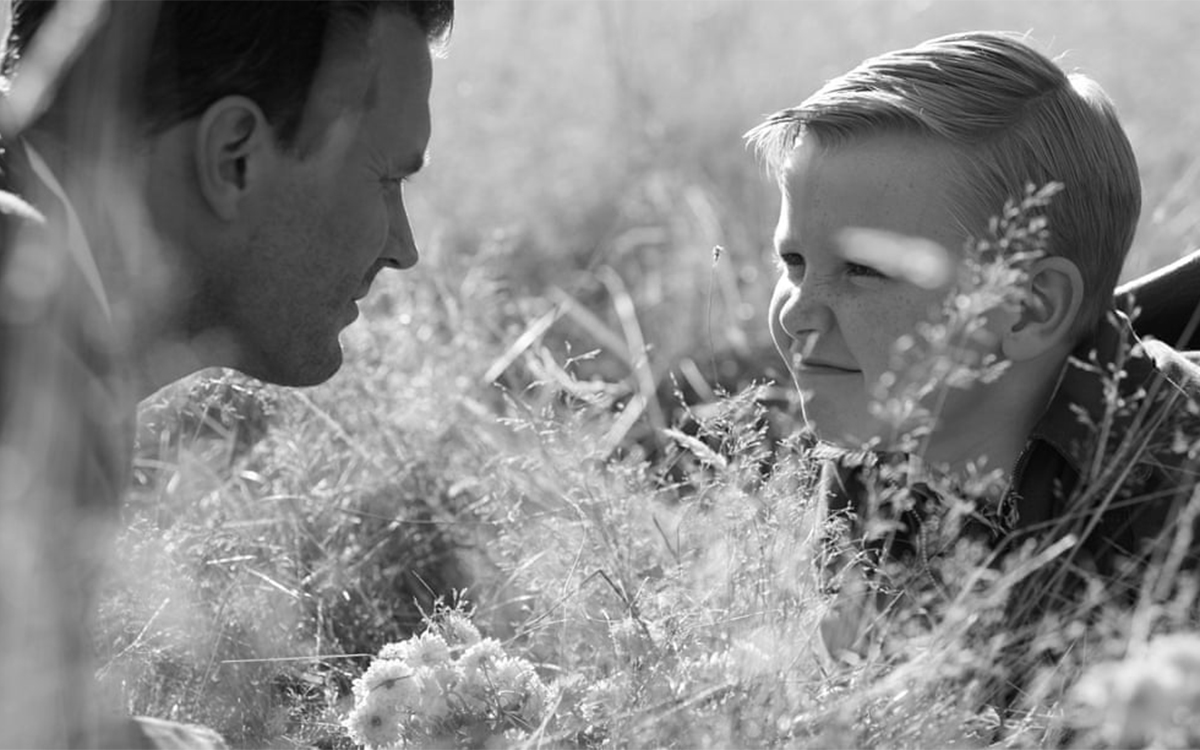 Jamie Dornan as Pa and Jude Hill as Buddy in Belfast (photograph by Rob Youngson/© 2021 Focus Features, LLC)
Given that Branagh is depicting a version of his own childhood, one might expect an origin story of sorts. How did this gentle, working-class boy from Belfast become one of the world’s finest Shakespearean actors and Hollywood directors? But instead of his family’s woes and the violence on the streets providing a crucible for Buddy’s creativity, his adolescent development runs more or less parallel to these events without feeling as though they ever really overlap. Even when Buddy is taken to the cinema or the theatre, and we’re ready to discover how a burgeoning love for art and storytelling helped this young man through these difficult times, Belfast doesn’t fully make the connection. Beyond a stylistic splash of colour, these day trips are rendered as just another pleasant childhood memory.
Still, the film is charming in many ways, particularly its performances. Hill is terrific as Buddy; he’s the sort of child actor that makes audiences breathe a collective sigh of relief when he proves more than capable of carrying the entire film on his small shoulders. Balfe and Dornan bring plenty of heart and mettle to their roles as Buddy’s parents, generating meaningful drama even when the film never really makes us doubt their odds of a happy ending. And Dench and Hinds routinely steal the show as Buddy’s grandparents, with their gentle banter and pearls of no-nonsense wisdom. But again, some of this easy charm compromises the film’s overall originality. The fact that these characters are never even named, referred to only by their familial monikers – Ma and Pa, Granny and Pop – makes it clear that Branagh is presenting us with idealistic, nostalgic archetypes. This is an economical but reductive move; he’s made it easy for us to like these characters, but difficult to truly get to know them.
Ultimately, a project like this is measured not by how well it enshrines one person’s precious memories but by how effectively it translates those memories into universal experience. Belfast suffers from the inevitable comparison to Alfonso Cuarón’s Roma (2018), another black-and-white period piece inspired by the filmmaker’s childhood. Roma made its deeply personal experiences feel almost primally relatable, and its depiction of historical violence horrifyingly real. By contrast, Belfast is like a slideshow from someone else’s holiday; it will always mean more to them than it will to us. Perhaps Branagh overestimated our appetite for his story, or underestimated the work it would take to earn our full investment. His film excels as an endearing, coming-of-age dramedy, but it adds little to the genre. Much like its young protagonist, Belfast’s heart proves bigger than its ambition.
Belfast (Universal Pictures), 97 minutes, is showing in Australian theatres from 3 February 2022.