


- Free Article: No
- Contents Category: Opera
- Custom Article Title: Macbeth
- Review Article: Yes
- Article Title: Macbeth
- Article Subtitle: Grappling with the complexities of Verdi's opera
- Online Only: No
- Custom Highlight Text:
As the third Verdi opera on offer in Melbourne this season (along with Opera Australia’s Aida and Ernani), Melbourne Opera’s production of Verdi’s Macbeth at Her Majesty’s Theatre is a mixed offering. Verdi wrote Macbeth – one of his earliest operas and less celebrated than his later Shakespearean works, Otello (1887) and Falstaff (1893) – when he was thirty-three; it had its première in Florence in 1847. Both musically and dramatically, it is clearly rooted in the bel canto era, which prioritised beautiful singing above all else. In 1865, Verdi revised the opera for the Paris Opera. Usually, one version or the other is performed; however, this performance saw an amalgamation of the two. This creation of a new version of Verdi’s work might be considered either innovative or musicologically messy. Regardless, it further complicates the relationship between source work and adaptation that is, for better or worse, always at play in Shakespeare-based opera.
- Article Hero Image (920px wide):
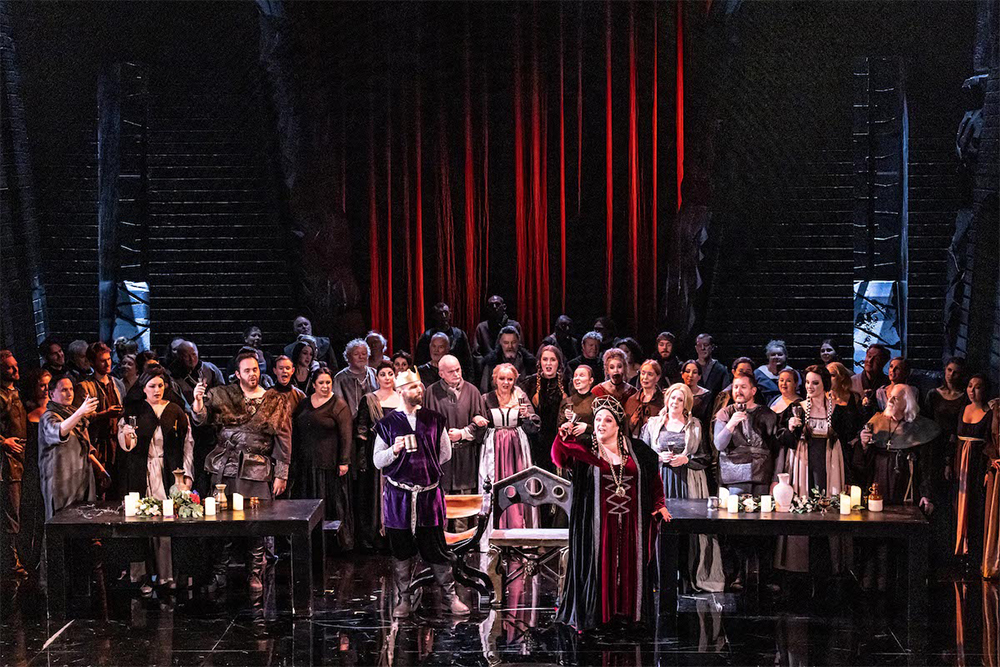
- Article Hero Image Caption: The cast of <em>Macbeth</em> performed by Melbourne Opera
- Alt Tag (Article Hero Image): The cast of Macbeth performed by Melbourne Opera
- Production Company: Melbourne Opera
Shakespeare’s legacy is both as a revolutionary playwright and an innovative linguist. Attempting to extricate Shakespeare’s drama from the language of its performance gives rise to numerous challenges. These come into focus when a Shakespeare text is translated and then further adapted into an opera libretto (by Francesco Maria Piave in this case). Not only is the work no longer in English, but it also ceases to exist within Shakespeare’s poetic, text-heavy sphere. After all, a libretto is only one component of an opera, and must – by virtue of the time it takes to sing rather than speak words – be considerably leaner than a play. When we think of a Shakespeare opera in Italian, such as Verdi’s Macbeth, we are several steps removed from the source work. Of course, while an adaptation is a stand-alone work in its own right, an adaptation of a cornerstone of the English-language literary and dramatic canon comes with cultural baggage and a level of audience familiarity that cannot be ignored. The director and singers must work especially hard to create richness and subtextual nuance to match Shakespeare’s masterpiece – a feat not quite achieved in this production by Melbourne Opera. While this production had its moments, too many opportunities, both musical and dramatic, were thrown away. Directed by Bruce Beresford (best known for his films, but no stranger to opera) and conducted by Greg Hocking, this production failed to explore the depth of Shakespeare’s tragedy.
Beresford’s rather traditional direction often served to obscure rather than illuminate the storytelling (something that cannot be taken for granted in so sparse a libretto); this created some confusion around important plot points. Additionally, Macbeth’s crown – the ultimate symbol of power – looked flimsier than its pivotal role in the tragedy demands, and was treated a notable lack of ceremony.
 Helena Dix as Lady Macbeth and Simon Meadows as Macbeth in Macbeth (Melbourne Opera)
Vocally, Helena Dix as Lady Macbeth demonstrated ease and beauty in her top register, though the middle was frequently lost in the orchestration, and the ‘ugly’ vocal effects that Verdi sought for Lady Macbeth were perhaps a touch overused. Nonetheless, her ability to command the audience, particularly when alone on stage, was admirable. Simon Meadows sang with surety throughout as Macbeth, handling the demanding stamina of the role with aplomb. Dramatically, however, the complexity of Macbeth and Lady Macbeth’s troubling relationship (his bubbling paranoia, her power-hungry manipulation) was missed. The characters’ trajectories struggled to emerge, their fatal flaws not quite giving way to tragedy’s cathartic payoff. Eddie Muliaumaseali’i as Banquo gave a warm and genuine performance, with both his arias proving moments of honest gravity and emotional depth. Samuel Sakker was in fine voice as Macduff; his Act IV proved a highlight of the evening. Supporting performances by Robert Macfarlane, Eleanor Greenwood, and Alex Pokryshevsky were also notable.
While the acoustics of Her Majesty’s Theatre did the Melbourne Opera Orchestra few favours in exposed passages, it found its groove in the score’s bigger moments, though it overwhelmed the soloists at times. The chorus came into its own when in full voice, and the dynamism of the Act III witches’ party was a welcome change to the otherwise static chorus blocking. Visually, the space could have been used more effectively; there seemed to be far too many chorus members for the size of the stage, generally gathered in straight lines and impenetrable blocks. Additionally, the subtext to be found in the spatial relationships between characters in key moments could have been further explored. The use of projections onto the back of Greg Carroll’s stone set to portray Macbeth’s castle and premonitions of future kings was both clear and atmospheric, and there was considerable scope for the expansion of this element. Glimmers of the later Verdi in the final acts gave the drama more urgency and momentum, pushing toward the final duel scene, which involved some of the most genuinely thrilling fight choreography seen recently in opera.
While this opera and production pose challenges for music lovers, Melbourne Opera’s Macbeth has some fine moments and still manages to hold a worthy place in this season’s Verdi-heavy operatic schedule.
Macbeth continues at Her Majesty’s Theatre in Melbourne until 26 May 2021. Performance attended: 20 May.