


- Free Article: No
- Contents Category: Art
- Custom Article Title: The National 2021: New Australian Art
- Review Article: Yes
- Article Title: The National 2021
- Article Subtitle: An expansive celebration of contemporary Australian art
- Online Only: No
- Custom Highlight Text:
The National 2021: New Australian Art, conceived in 2017, is a biennial survey exhibition to ‘address the specificities and nuances of what it means to make art from and for an Australian context at this point in time’. It is a joint initiative of the Art Gallery of New South Wales (AGNSW), Carriageworks, and the Museum of Contemporary Art, Australia (MCA). In its first iteration, the ethos of collaboration – not just between these three major Sydney art institutions but between curators, artists, and writers – was writ large.
- Article Hero Image (920px wide):
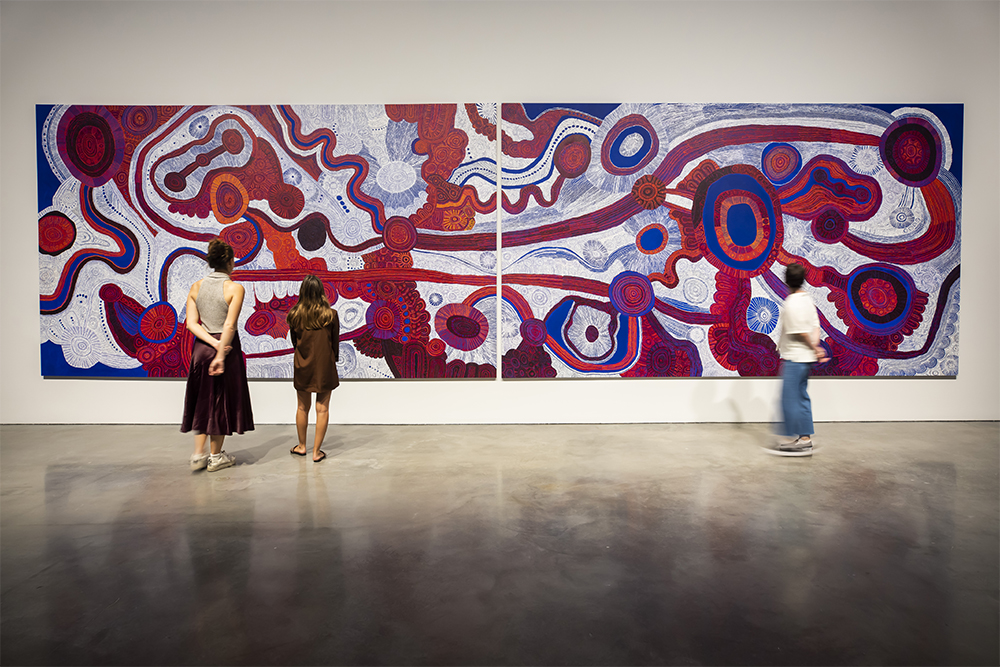
- Article Hero Image Caption: Betty Kuntiwa Pumani, <em>Antara</em>, 2020, installation view, <em>The National 2021: New Australian Art</em>, Museum of Contemporary Art Australia, Sydney, synthetic polymer paint on linen, image courtesy and © the artist (photograph by Anna Kučera)
- Alt Tag (Article Hero Image): Betty Kuntiwa Pumani, Antara, 2020, installation view, The National 2021: New Australian Art, Museum of Contemporary Art Australia, Sydney, synthetic polymer paint on linen, image courtesy and © the artist (photograph by Anna Kučera)
- Production Company: Museum of Contemporary Art Australia
Now in its third iteration, featuring thirty-nine commissioned projects, this notion of interconnecting threads rather than overarching aim has been retained. At the launch of The National 2021, MCA curator Rachel Kent elaborated three key themes animating MCA’s approach: environment and planetary care; narrative and storytelling; and intergenerational learning and transmission of culture. Carriageworks curator Abigail Moncrieff, in her essay ‘Turning of the Tide’, locates connectivity through difference as a key thread; and in separate essays, AGNSW’s Matt Cox and Erin Vink articulate shared but differently inflected concerns with the legacies of colonialism within the art museum – not just in its historical formation but, more urgently, in current practices.
With the upswelling of the Black Lives Matter movement in 2020, AGNSW and MCA made public pledges to ‘do better’ and to ‘[listen] to those whose lives are different from our own’. But how, Vink asks in her impassioned essay ‘Idle No More’, can art museums, especially those with strong relationships with Indigenous communities, ‘really respond to the current national conditions of social unrest and political turmoil’? How can they genuinely do things differently? Her questions resonate across all three institutions and across the exhibition as a whole.
Not surprisingly, works by Indigenous artists play a significant role. Also unsurprisingly, the mood and staging of works at each gallery – with their distinct physical spaces and institutional identities – are quite different. Indigenous art can be roughly divided into two groups – one concerned with cultural maintenance and continuity of knowledge that is deeply embedded with place, and one that highlights destructive legacies of colonialism, whether in the form of damaged lives or aporias in collective knowledge.
In the first category come major works by senior artists Betty Kuntiwa Pumani, Mulkun Wirrpanda, Betty Muffler, Maringka Burton, Alick Tipoti, and Maree Clarke, among others. Audiences at the MCA (which I visited first) are greeted by a suite of paintings by Yolŋu artist Wirrpanda, which depict through precise, fine linework the interior multi-species lives of termite mounds in Eastern Arnhem Land. These sophisticated architectural structures also house other ant species, birds, bird eggs, and bees. The next room contains Pumani’s monumental, ten-metre-long painting Antara (2020), which, in a palette of red, white and blue, details intimate understanding of her mother’s country Antara in the Anangu Pitjantjatjara Yankunytatjara Lands in South Australia.
 Betty Muffler, Maringka Burton, Ngangkari Ngura (Healing Country), 2020, acrylic on linen, 300 x 500 cm. Courtesy the artists and Iwantja Arts© the artists (photograph via AGNSW, Felicity Jenkins)
Equally imposing in scale are two paintings by Pitjantjatjara artists Muffler’s and Burton’s two paintings, independently executed but conceived and hung as one work, Ngangkari Ngura (Healing Country) (2020), which comes early in AGNSW’s arrangement of works, and which is clearly staged as a key feature. Brushstrokes of whites, palest of yellows, muted purple, and soft greys are webbed together in recursive, wavering, overlapping lines suspended against the painting’s darker ground. Collectively, there is a confident, even triumphant, mood to these works. One gets the sense of mature artists working at the height of their powers with great conviction.
At Carriageworks, the mood is bleaker. Carriageworks went into administration in May 2020 as the economic impact of Covid-19 hit. With philanthropic support, it reopened a few months later, but it is hard not to read the institution’s own precarity as a kind of liberating force enabling riskier, darker curatorial choices. There is a more provisional edge to the installations, which only just hold their own in the cavernous spaces.
Here, the Karrabing Film Collective’s five-channel video installation A Day in the Life (2020) defies genres with its combination of humour, tropes of both fiction and documentary, and scenes of devastating poignancy as a group of characters go about their daily lives in Belyuen in the Northern Territory. Set to a rap soundtrack, the narrative unfolds across five ‘time chapters’: breakfast, play break, lunch run, cocktail hour, and takeout dinner. One of the song’s refrains, alluding to that much-coveted notion of intergenerational knowledge transfer, runs: ‘I get it. He wants us to learn.’ When the group pull up at one ancestral site, they find debris and damage wrought by extractive industries (lithium for batteries), and the refrain segues into the lines: ‘You can feel the terror of this era. No matter how much I try, this fuckin’ land is gonna die.’
Vernon Ah Kee and Dalisa Pigram’s three-channel video (with Marrugeku) and sound installation Gudirr Gudirr (2021) is equally unflinching in its portrayal of ongoing trauma experienced by Indigenous peoples. In one scene, Pigram, a Yawuru/Bardi choreographer and dancer, performs a grim mimicry of drunken night-time street fighting. Repeatedly, she hits herself in the side of her head with a clenched fist. This gesture could allude to traditional grieving practices, or it could be a symbol of unbearable suffering that turns on the self In its text-based imagery and spoken-word components, Gudirr Gudirr explicitly mentions high Aboriginal suicide rates. Under such conditions, how Indigenous peoples are meant to lead the way in environmental and social stewardship – implicit in notions of ‘planetary care’, ethical relationships with Country, and cultural maintenance and renewal – is a confounding question directed squarely at the viewer.
On a quieter note (back at AGNSW), James Tylor’s photographic series We Call This Place… Kaurna Yarta (2020) engraves Kaurna place names from the Tarntanya/Adelaide, Thura-Yura language region into the surface of twenty-five daguerreotypes. At first glance, this seems a process of literal reclamation of nineteenth-century photographic technologies that romanticised stolen landscapes and emptied them of long First Nations histories. However, the process is more complex than it first seems. Tylor makes the daguerreotypes himself, photographing Kaurna places and checking their names through the work of non-Indigenous historian Chester Schultz (who works with the Kaurna community). Tylor describes his work as both a form of language maintenance and a way to counteract colonial erasure, especially at sites that are heavily settled and overlaid by non-Indigenous systems. The photographs, with their silvery, mirror-like surfaces and moody, alluring faux nineteenth-century black-and-white landscapes overlaid with cursive script, encourage non-Indigenous audiences to apprehend and mouth their everyday landscapes anew.
 James Tylor, We Call This Place … Kaurna Yarta, 2020, engraved daguerreotype photographs, vinyl, installation dimensions variable. Courtesy the artist and Vivien Anderson Gallery, Narrm (Melbourne) © the artist (photograph via AGNSW, Felicity Jenkins)
One of the highlights of this year’s National is its interweaving of established artists with lesser-known voices. Among the former are Fiona Hall with her charred bushfire remnants, EXODUST (2021), arranged in the neoclassical entrance of the AGNSW; Sally Smart’s multimedia The Artist’s Ballet (2020); Judy Watson’s series of suspended canvases, clouds and undercurrents (2021); and John Wolseley’s (sometime collaborator with Wirrpanda) Magnetic, arborial and subterranean nests on the savannah plains of East Arnhem Land (2020–21). Unexpected pieces come from newer artists, such as Sancintya Mohini Simpson, a descendant of indentured labourers sent from India to work on colonial sugar plantations in South Africa. Her kūlī/karambu (2020–2021) extends Indian miniature painting conventions with expanses of bare paper serving as a minimalist background for tiny, finely detailed gouache and watercolour vignettes of violence and resistance set among sugarcane fields. A woman’s figure can be glimpsed hanging by rope from a tree, another shields her face in what seems a rape scene, another lies dismembered in a pool of blood, and yet another lifts a burning torch to set sugarcane alight. These scenes are informed, Simpson says, by stories told to her, with difficulty, by her mother.
Mehwish Iqbal also draws on personal and intergenerational memory. In Grey Wall (2020–2021), innumerable small decoupage figures move in a great monochrome, ragged-edged cloud surging along the wall. These migrating figures are anonymous, sketched in rough brushstrokes, massed together into an ephemeral relief. Yet each implicitly holds their own story. In contrast, her Assemblage of a Fragmented Landscape (2020) is playful and whimsical, with a folkloric air: a tangle of winged human figures, bees, a slavering wolf, an upside-down pigeon, and pregnant women spool in vivid colour across a flimsy horizontal panel of dressmakers’ paper. There’s an intense, celebratory, haptic quality to the work, embroidery thread stitched so densely it forms nest-like accretions. Humans and animals are resolutely all-in-together, with no sense of Cartesian space or hierarchy.
Abdullah M. I. Syed’s suite of works pays tribute to his recently deceased mother. His two-channel HD video, Last Observances (2021), shows his mother’s hands plunging among bright pomegranate seeds just months before her death in Karachi, preparing her son a favourite meal, or darting artfully among swaths of fabric, sewing at her machine. Other muted scenes show her lying motionless on her sickbed, then stirring, once, fitfully; the camera dwells on a side table filled with medications and a grave covered in red petals. The footage is intensely personal, almost voyeuristic. His work de-trivialises the domestic and redraws lines between art practice and home-making practices, asking where the distinction lies.
Acute attention to a handiwork and craftsmanship forms a leitmotif across a number of other works, such as Kate Just’s ongoing knitting project, Anonymous Was a Woman (2019–20), and Deborah Kelly’s finely honed collages, which are one component of her larger multimedia CREATION project. Other pieces hold environmental questions firmly in their gaze: Caroline Rothwell’s animations, crafted from a medium forged from soot scraped from car exhaust pipes, bushfire debris, and industrial smokestacks; and Lauren Berkowitz’s salvaged plastic objects threaded from the ceiling in curtains of ‘colourways’. She refers to the Jewish philosophy of Tikkun Olam: ‘humanity’s responsibility to repair the world through good deeds and small gestures’. Cameron Robbins’s drawing machine also alludes to responsibility. Oenograf (2021) is propelled by bubbles of CO2 rising in a large flask of fermenting grape juice. A pen records the passage of this usually intangible gas, which holds the future of the planet as we know it in its hands, stuttering across thick paper – here in dark, recursive circles, there in stammers, peaks, and valleys not unlike data feeds on an Intensive Care Unit screen.
One of the most startling works is Gabriella Hirst’s sophisticated double-sided screen installation, Darling Darling (2021). One side of the screen is filled with leisurely camera takes of an exhausted Baarka/Darling River, depleted by drought, years-long mismanagement of the Murray–Darling River system, and the compounding influence of climate change. Simultaneously, on the opposite side of the screen, an art conservator painstakingly restores W.C. Piguenit’s painting The Flood in the Darling 1890 (1895). Piguenit depicts swollen waters and abundant wildlife and flora – a thriving ecosystem long maintained by local Aboriginal people, now a haunting, lost world living only in paint. As I watched the almost motionless, quiet footage of the desiccated Baarka riverbed – crumbling banks, overhanging trees, the occasional flitting of a bird – a mechanism in a stagnant pool suddenly erupted into life, pumping water into the system. Its efforts seem forlorn, pitiful, misguided. We can devote energy and resources to restoring colonial artefacts, Hirst’s work suggests, but is reparation of damaged waterways and other natural resources, ‘gifted’ to Australia through colonisation, already far beyond our reach? In Darling Darling, the notion of ‘handiwork’ exemplified by the art conservator’s meticulous brushwork is interrogated as tangled up (still) in a colonial project that has not yet drawn to an end.
It is a fitting metaphor for The National 2021 as a whole, with its knotty questions about the role of the art museum in the wake of the Black Lives Matter movement, and its carefully optimistic concept of ‘the transformative power of art’, as Cox writes in ‘Sharing Time with the Past and Caring for the Future’. Neither the social and economic fault lines exposed by the pandemic, nor the climate crisis, are named themes in this year’s survey, but they rest palpably in the background. Set against these weighty matters, Cox cautions that ‘even if it is possible for artists to find forms of practice that are generative of an ethics and labour of care towards fellow artists, audiences and wider publics and the greater living world … shifts will also be needed in the work of curators, institutions and audiences to embrace the way artist’s work and share the responsibility of social and environmental reform’. The National 2021 might be conceived as a form of call and response, inviting audiences to participate via their own handiwork and ‘small gestures’.
The National 2021: New Australian Art is showing at the Art Gallery of New South Wales from 26 March until 5 September 2021, Carriageworks from 26 March until 20 June 2021, and the Museum of Contemporary Art Australia from 26 March until 22 August 2021.
This review is supported by the Copyright Agency’s Cultural Fund.