


- Free Article: No
- Contents Category: Film
- Custom Article Title: The Father
- Review Article: Yes
- Article Title: The Father
- Article Subtitle: A masterful, emotionally wrenching tale of dementia
- Online Only: No
- Custom Highlight Text:
So much critical discussion of films adapted from plays centres on the notion of the ‘opening out’ of the action and on the ways in which the director and screenwriter have disguised the work’s theatrical origins, the implication being that this is always desirable or appropriate. Mike Nichols, with his extraordinary adaptation of Edward Albee’s Who’s Afraid of Virginia Woolf? (1966), understood that some works demand a restricted, claustrophobic setting; that film can indeed feed off the physical limitations that define the stage. With this principle squarely in mind, French playwright Florian Zeller has, along with English screenwriter Christopher Hampton, adapted for the screen his own play La Père (2012). A finer example of the process of translation is hard to conceive.
- Article Hero Image (920px wide):
- Article Hero Image Caption: Anthony Hopkins in <em>The Father</em> (Sony Pictures Classics)
- Alt Tag (Article Hero Image): Anthony Hopkins in The Father (Sony Pictures Classics)
- Production Company: Sharmill Films
Zeller is sympathetic to Anne’s plight, but The Father is unmistakably Anthony’s story, and it only takes a few more minutes for us to feel this viscerally. In a quiet moment he goes to the kitchen and when he comes back something fundamental has changed. That business with the lost watch, that slight anxiety over the ability to tell time, pitches precipitously into a far more frightening cognitive dissonance. A stranger (Mark Gatiss) is sitting in the living room calmly reading the paper, claiming not only to be Anne’s husband of many years but also the owner of the apartment. It is information that directly contradicts Anne’s statements from moments ago. And where is Anne, anyway? From here on, we are inside Anthony’s head, an increasingly disturbing and unstable place to be.
Those first shocking shifts of perspective only intensify: there is an absent daughter, Lucy, the prodigal child who may or may not resemble Laura (Imogen Poots), the replacement carer Anne has now brought on board. Anne’s possible husband, who is either named James or Paul, is played initially by Gatiss and then by Rufus Sewell. They are both smarmy types, deeply antagonistic towards their father-in-law, even possibly abusive. And another potential carer (Olivia Williams) is sometimes referred to as Laura, sometimes Lucy, and even, in one awful, lurching moment, Anne herself. The shifting identities of the central characters only add to the sense of unease, and when Anthony says ‘I don’t like what’s going on here’, we feel both his fear of being gaslit by the people surrounding him, and his creeping suspicion that he is, in fact, losing his mind.
 Olivia Colman and Anthony Hopkins in The Father (Sony Pictures Classics)
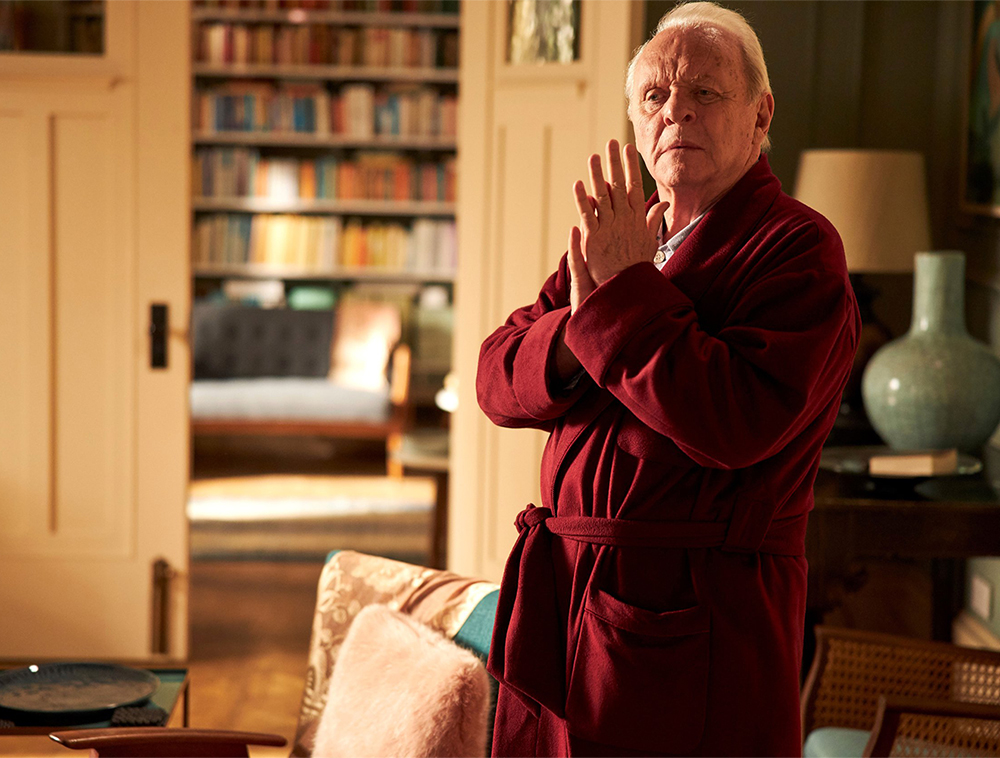
Hopkins is sublime. Vast worlds of possibility and loss move across his features like sunlight on an ocean, brief piercing illuminations suddenly clouding over into confusion and despair. He is angry and defensive one instant, a railing Lear in the storm, and tragically lost in the next; his intelligence and will for independence, even his wicked and mercurial sense of humour, are ultimately no bulwark against his increasing slippages, his unloosing of the tangible space. Colman, her wide brown eyes looking hopefully up at her less expressive father, is achingly good in support. Her heartbreak, her impossible bind as the daughter of a man simultaneously drifting away and hopelessly needy, is masterfully understated. The rest of the cast are uniformly magnificent, expert exercises in ambivalence and menace.
While it is common for a film’s production design to have a profound impact on the viewing experience – one only needs to recall Andrew McAlpine’s work on Jane Campion’s The Piano (1993), Lawrence G. Paull’s work on Ridley Scott’s Blade Runner (1982), or the entire career of Baz Luhrmann’s designer partner Catherine Martin, to understand how a film’s visual palette alters its meaning – it is rare for it to play such a key role in the narrative architecture. Peter Francis’s work on the precise and subtle transformations in the film’s apartments, the way the sets seem to bleed into one another in increasingly depressing and barren iterations, is central to the emotional impact. It will be a travesty if the Academy Award doesn’t go his way. Yorgos Lamprinos should win for his excellent, often heart-stopping editing too.
Zeller hasn’t even been nominated as best director, but his work on this film should, in time, take its rightful place among the finest cinematic débuts. The Father isn’t remotely concerned with ‘opening out’ its action, or ironing away the non-naturalistic elements in its story; it finds cinematic responses to its theatrical origins, amplifying the eponymous character’s emotional stakes in ways that are as devastating as they are visually and dramatically rewarding. A WHO international report has just estimated that ‘every second person in the world is believed to hold ageist attitudes’. Our own country’s appalling record on aged care is a national disgrace. Watching Hopkins embody a man of towering dignity so reduced, so traduced, not only by his affliction but by the surrounding attitudes to it, is one of the most emotionally wrenching, intellectually sobering experiences of my film-going life. The Father is a humanist wonder and I urge you to see it.
The Father (Sharmill Films), 97 minutes, is available in cinemas April 1.