


- Free Article: No
- Contents Category: Theatre
- Custom Article Title: Jesus Wants Me for a Sunbeam
- Review Article: Yes
- Custom Highlight Text:
I made the mistake of rereading Peter Goldsworthy’s 1993 novella before seeing Steve Rodgers’ adaptation of Jesus Wants Me for a Sunbeam at Belvoir St Theatre, so I knew the play’s advertised surprise ending and may have been resistant to its emotional charge. At its première production for National Theatre of Parramatta at the Riverside Theatre in 2018, it was said to reduce audiences to tears. Some audience members could be seen wiping their eyes after the opening night performance at Belvoir.
- Production Company: Belvoir St Theatre
Embodied in a group of actors, Goldsworthy’s archetypal characters necessarily develop individual personalities that invite varying degrees of sympathy, slipping away from authorial control. Rodgers’ adaptation considers the possible consequences of the events in the novella, so it begins with the quest of the eighteen-year-old son, Ben, to understand his parents’ decisions six years earlier. Liam Nunan plays Ben as an engaging teenager, intelligent and reflective as he asks questions of the adults around him. Grace Truman commands a range of emotions in her smaller role as his suffering sister, Wol. At times, these children appear more adult in understanding than their parents; they offer the potential for the play to take a clear ethical position on its potentially dangerous subject matter.
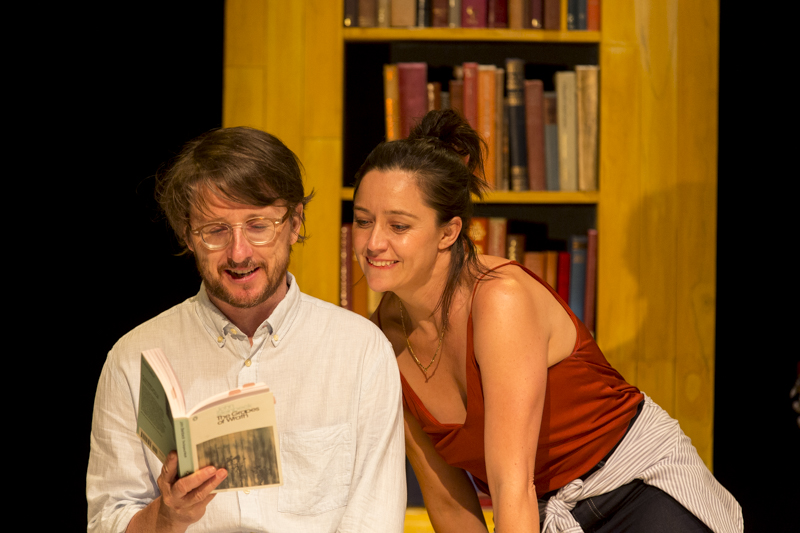 Matthew Whittet and Emma Jackson in Jesus Wants Me For a Sunbeam (photograph by Brett Boardman)
As the play shifts to the past, the parents dominate, often speaking to the audience to explain their thoughts and responses. Matthew Whittet’s Rick appears to be the humorous and understanding father idealised in television commercials, while Emma Jackson’s Linda brings an edge of hysteria that suggests more fragility. Well versed in literature and religion, they are both educated, church-going Christians. Their familiar jokes about parenting and the conflicting attitudes of grandparents invite us to share their perspectives. Valerie Bader and Mark Lee manage to give all the supporting parts – grandparents, doctors, clergy – an air of sympathetic generosity, never seriously confronting the weaknesses in Rick and Linda’s logic.
The play’s title of course refers to a saccharine Sunday-school song taught to children, but under the stress of illness the couple stops going to church regardless of the children’s desires. The Christian notion of the afterlife seems to linger as they plan for the future. Indeed, the logic behind their final act is never made clear, and Ben finds little explanation for the deprivation he has suffered. The play poses serious questions but never ventures far from Goldsworthy’s novella, sometimes content merely to illustrate it rather than to explore its possibilities.
While Emma Vine’s simple storybook set, with its central bookcase full of old books, suggests that this may be a fairytale, a drama populated by people who prefer fiction to reality, some unnecessary film projections push the play back towards the mundane and illustrative. Other elements indicate a critical interpretation of events: Rick and Linda’s narcissistic pleasure in each other and their children; their disposal of a television set; the cutesiness of their Winnie the Pooh obsession; Linda’s refusal of news from the wider world, especially when it suggests that all families are not caring and happy. In one excruciating scene, Wol’s moment of intimacy with her brother is interrupted by her parents who stifle her demand to be allowed to stay awake. The child is not even allowed ownership of her disease. These people appear both infantilised by parenthood and yet all-powerful. A shift in emphasis might have developed this in interesting ways, allowing Ben a final word.
 Mark Lee, Matthew Whittet, and Valerie Bader in Jesus Wants Me For a Sunbeam (photograph by Brett Boardman)
In the end, the play evades serious critical engagement with issues that require Belvoir’s ‘trigger’ warnings for the unsuspecting and are usually treated with more care than this. The lights fade, the Allegri Miserere begins to play, and the audience is invited to feel sad about a selfish and stupid decision.
While the acting is consistently engaging and the set clever, and while the play addresses challenging issues, it cannot maintain the balance between sympathy and criticism that is essential to its subject matter. Indeed, the sentimentality of its ending appears to endorse a disturbing series of decisions, in ways likely to cause concern in the wider community.
Jesus Wants Me for A Sunbeam is being performed by Belvoir St Theatre at the Upstairs Theatre until 8 March 2020. Performance 7 February.