


- Free Article: No
- Contents Category: Art
- Custom Article Title: Manet and Modern Beauty
- Review Article: Yes
- Custom Highlight Text:
Five years ago, the J. Paul Getty Museum acquired Édouard Manet’s Jeanne (Spring), 1882, for US$61 million – a record for the artist. It was a bold acquisition, for later Manet – he died in 1883 – has never enjoyed the critical esteem of the earlier. Absurdly so, if you recall that the incomparable Bar at the Folies Bergère ...
- Production Company: Getty Center
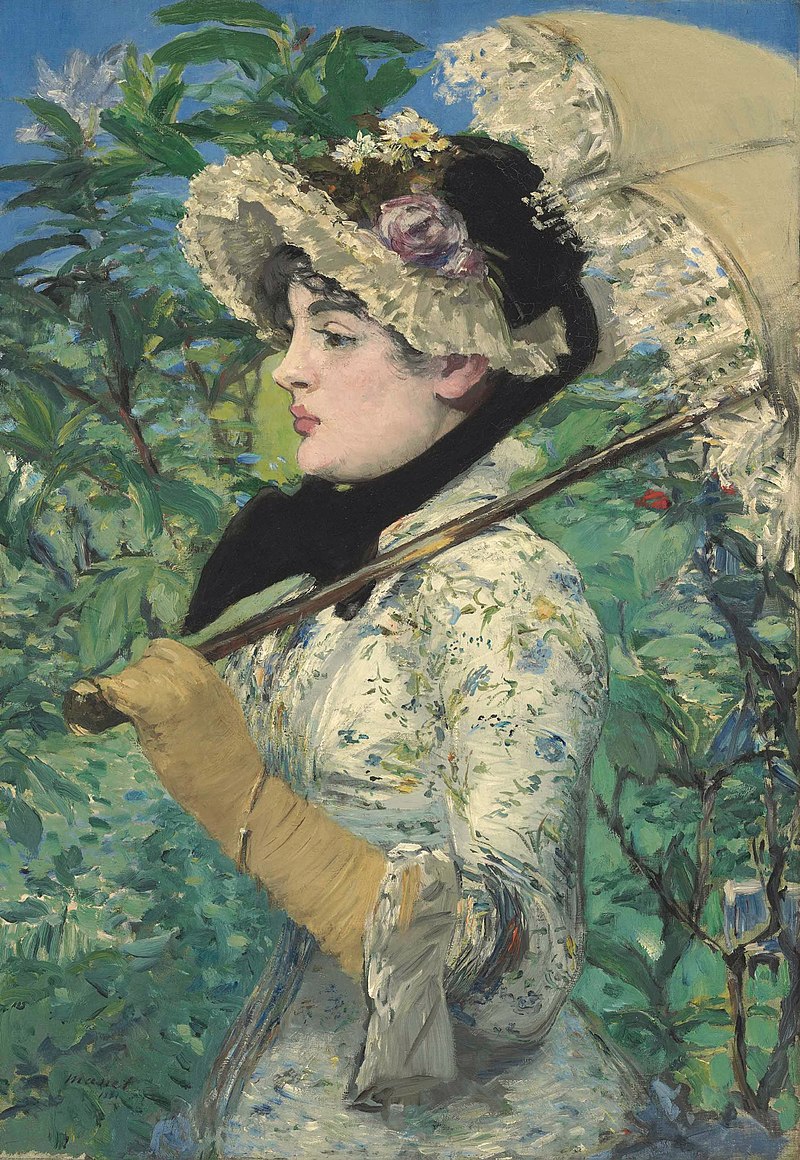 Jeanne (Spring), Édouard Manet, 1881 (photograph via Wikimedia Commons/J. Paul Getty Museum)Jeanne was originally intended to represent spring in a quartet on the seasons. (Manet was able to complete only Autumn – a portrait of his much favoured model, Méry Laurent.) Manet smothers his primavera with flowers and foliage. Except for Jeanne’s dazzling profile and the elbow-length suede gloves, everything else is covered in hot-house greenery. The decorative overload shocks the eye. Out of this riot comes the firmness of Jeanne. The ramrod parasol handle, the promise of voluptuousness in the swelling upper arm and bosom, and the luxuriant black velvet ribbon and bow attaching hat to body all suggest feminine beauty, substance, and presence. Like Mona Lisa, Jeanne gives little away. Her gaze falls on nothing, turns inwardly. The picture is a tour de force; Manet a virtuoso at the very end.
Unsurprisingly, the Courtauld Institute declined to lend A Bar at the Folies Bergère – it has been a much travelled picture – but Berlin’s Altes National Galerie has made the exceptional loan of its masterpiece In the Conservatory. The density of expression, its subdued tonality, and the mysterious intercourse between Monsieur and Madame Guillemet make it read like a fable by Flaubert. The mise en scène of the conservatory, with its reputation for secrets and seduction adds to the strangeness and strangely moving quality of the Berlin picture. Guillemet leans over the back of the bench on which his wife is sitting and points to his wife’s left hand with its wedding ring. His is equally visible. The rings form the centre of the painting. Yet Madame Guillemet looks away, so impassive, so distant, so cool to her husband, that you have a stronger sense of estrangement than of intimacy.
Later Manet is getting more interesting by the minute.
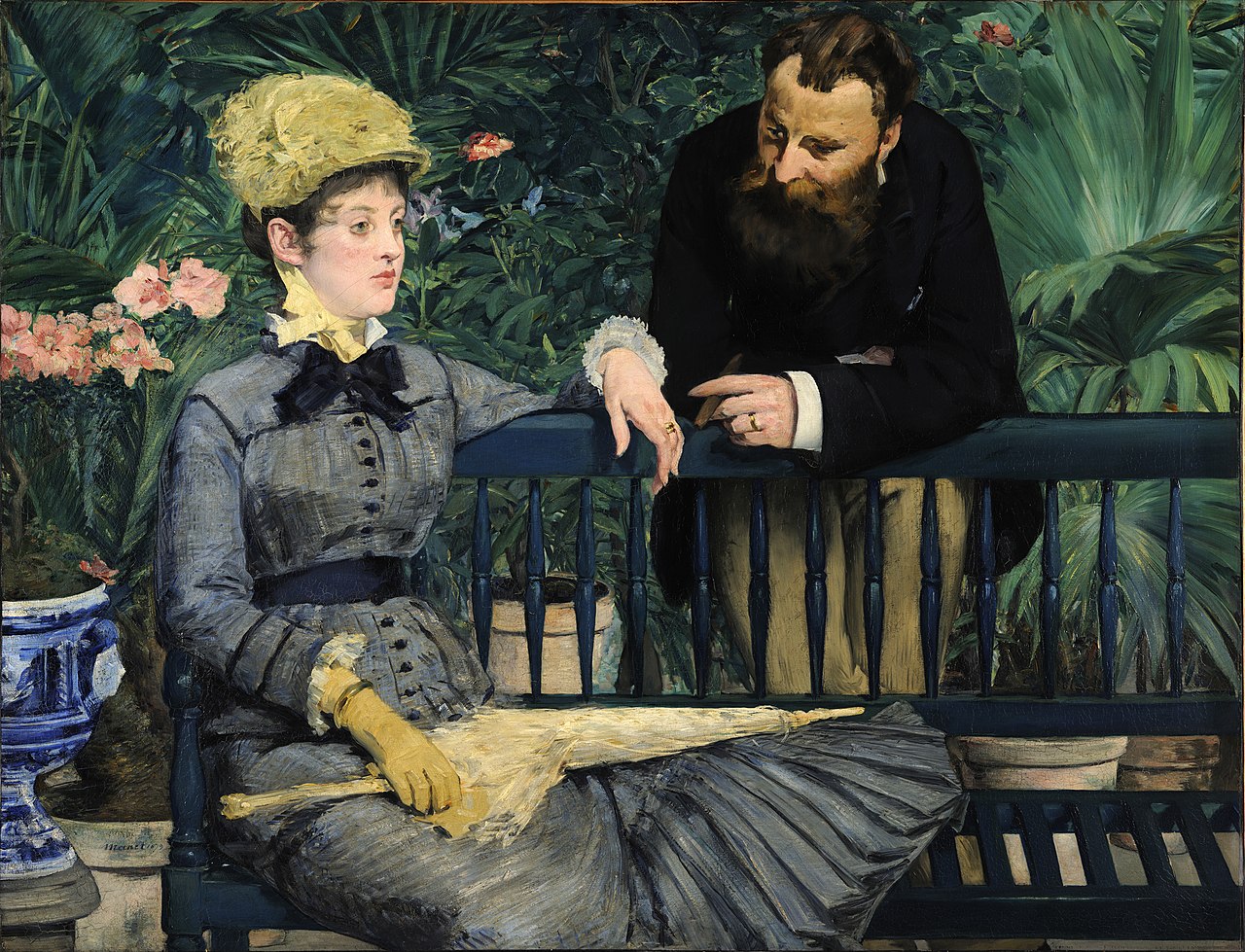 In the Conservatory, Édouard Manet, 1879 (photograph via Wikimedia Commons)
The exhibition catalogue minces no words about Manet’s decline. By 1880 syphilis had crippled him so badly that he could no longer stand before the motif or the easel for extended periods. He worked on a smaller scale, most notably in the still lifes of flowers and fruit, and in less taxing medium such as pastel or watercolour. The old Adam was not, however, to be so easily put down. The charm, beauty, and endless variety of La Parisienne excited and aroused his brush. In a good essay on the topic, Helen Burnham defines La Parisienne as ‘the type of the era’, the emblem and manifestation of modern life. La Parisienne has many guises, from the fashionable world to the agreeable solitaries at a bar before a glass of plum brandy or sitting in the café engrossed and amused by a periodical. They stroll in the parks or muse indecisively at the milliner’s. They are the embodiment of modern beauty.
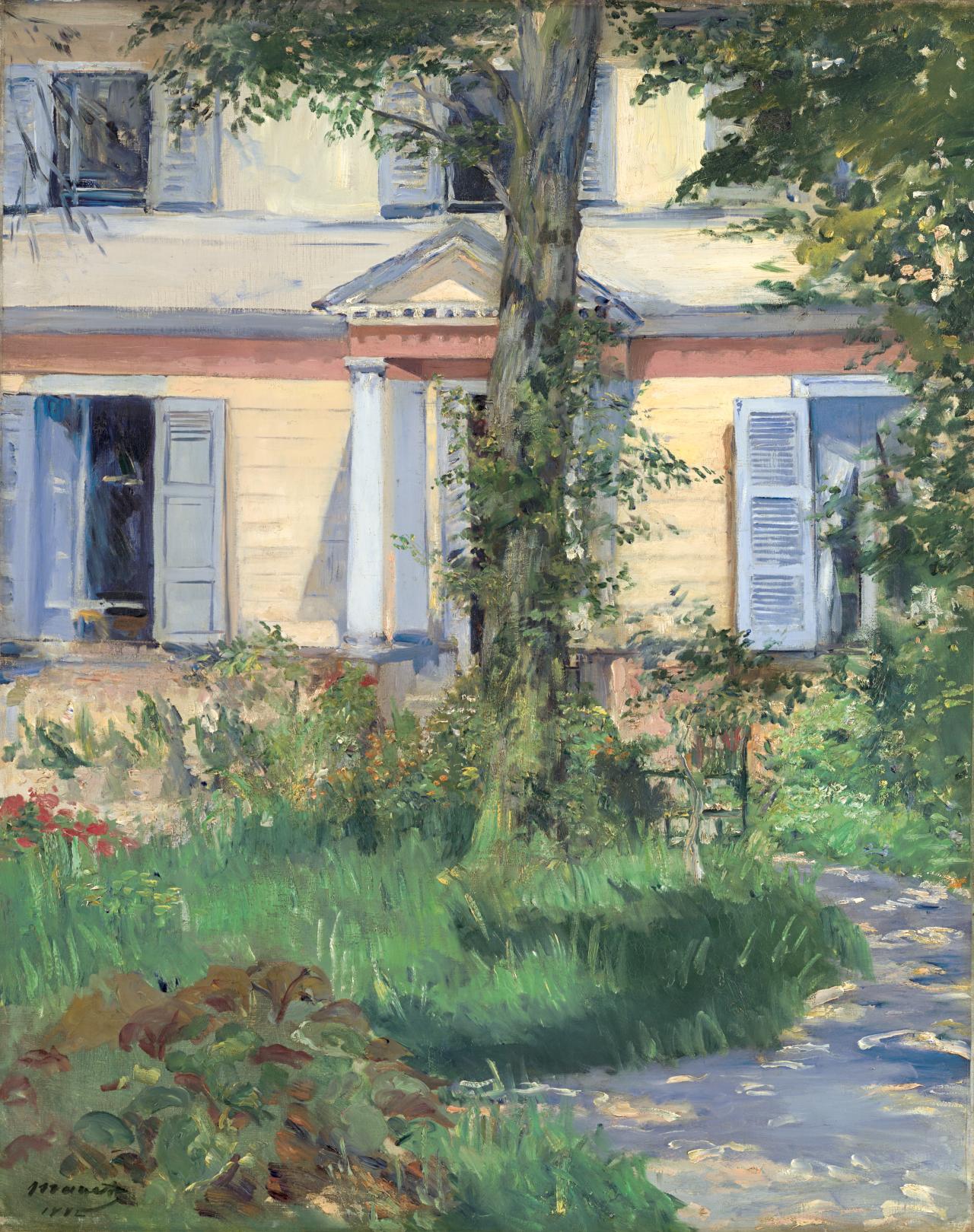 The house at Rueil (La Maison à Rueil), Édouard Manet, 1882 (photograph via National Gallery of Victoria, Melbourne Felton Bequest, 1926)Where others have seen slightness in Manet’s change to different media and scale, the organisers and authors of the catalogue have tackled the issue head on. A whole section of the exhibition, and a commanding essay in the catalogue by the Yale art historian Carol Armstrong on ‘Manet’s Little Nothings’, focus on his watercolour illustrations or, more accurately, illuminations of his letters to intimates. Similarly, the final sequence of floral still lifes read more substantively when treated by Bridget Altsdorf as ‘Manet’s Fleurs de Mal’. ‘Many a rose regretfully confides / the secret of its scent / to empty air.’ Although one might have hoped for a tighter connection between Baudelaire’s text and Manet’s image, it points us in the right direction to understand the uncanny brilliance of those final still lifes.
How good it is to see Melbourne’s beautiful but undersung House at Rueil confirmed as a masterpiece in this company. Painted in his last summer, it is also the last plein air painting he signed and dated. The warm yellow facade of the house set off by its blue shutters converses so fluently with the myriad of blue shadows on the path, thrown by the sturdy oak (?) that bisects and sustains the work. It combines perfectly, effortlessly, the palette and immediacy of high impressionism with a classical poise and serenity. We are lucky to have it.
Manet and Modern Beauty, after being shown at the Art Institute of Chicago (May to September 2019), moves to the J. Paul Getty Museum from October 8 to January 12. Manet and Modern Beauty: The artist’s last years, written by Scott Allan, Emily A. Beeny, and Gloria Groom, is published by Getty Publications (US$65 hb, 384 pp, 9781606066041).