


- Free Article: Yes
- Contents Category: Theatre
- Custom Article Title: The Torrents (STC) ★★
- Review Article: Yes
- Custom Highlight Text:
Anyone with an interest in Australia’s drama history is likely to have some curiosity about Oriel Gray’s play The Torrents, joint winner of a Playwright Advisory Board prize in 1955 alongside Ray Lawler’s ground-breaking Summer of the Seventeenth Doll. Unlike Lawler’s play, it was not performed at the time...
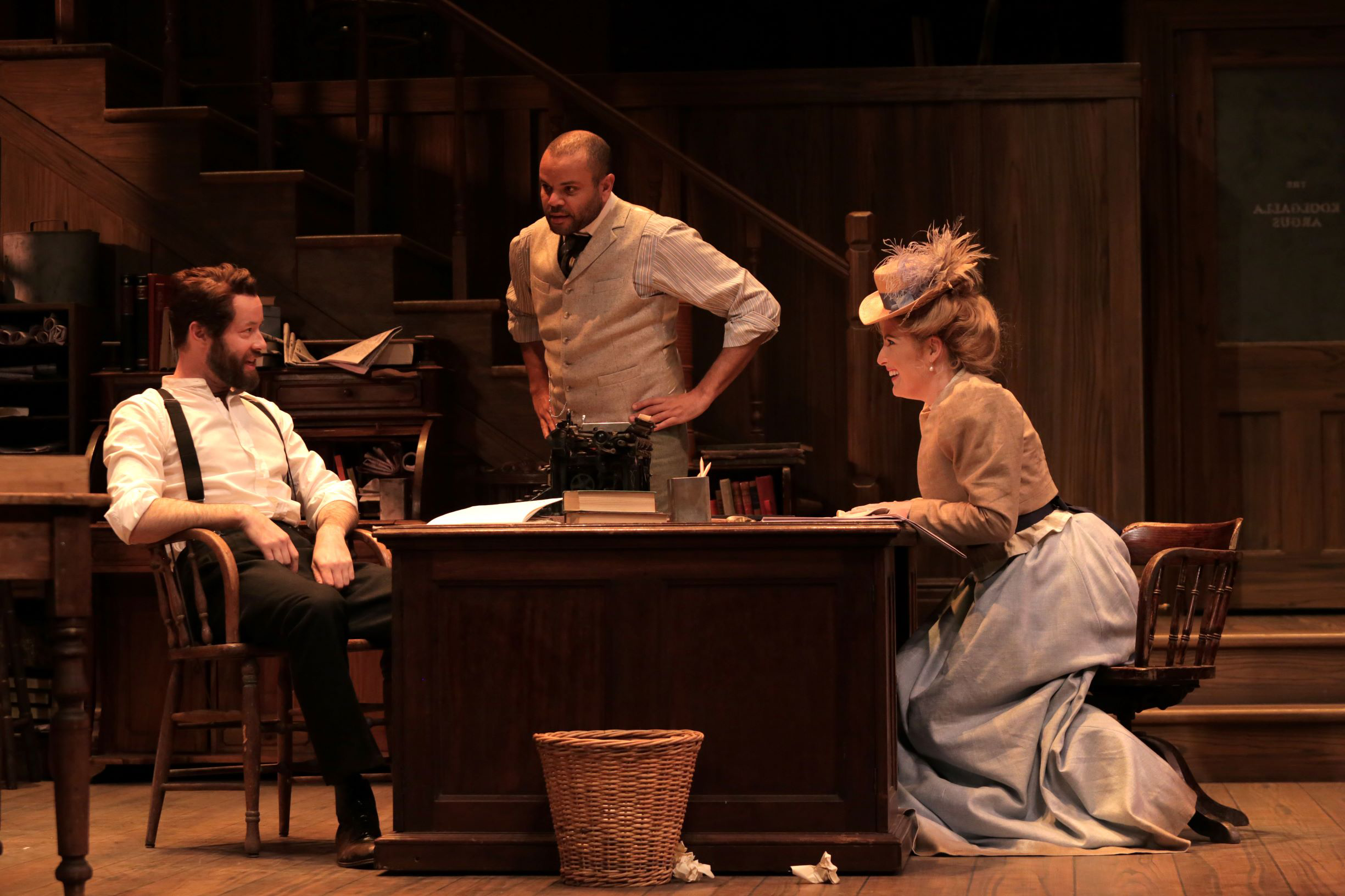 Gareth Davies, Luke Carroll and Emily Rose Brennan in The Torrents (photograph by Philip Gostelow)
It is a light-hearted imagining of life in a 1890s goldfields town in Western Australia where the gold is running out and new measures – the piping of water for agriculture – are needed for its survival. For the present, there is wealth enough for the local newspaper to thrive and dominate town politics, but its editor, Rufus Torrent, needs to embrace the modern world of the 1890s if the town and his paper are to survive. The agent of change turns out to be a young woman journalist, J.G. Milford, who has been employed by the editor’s son Ben to shake things up.
In this production, the old guard all have accents from the Old Country, with Tony Cogin (Rufus), Geoff Kelso (Christie), and Sam Longley (Jock) wielding Irish and Scots brogue, while the younger generation – Ben, Jenny Milford, the copy boy Bernie, the water engineer Kingsley, and the local beauty, Gwynne – speak as modern Australians and clearly belong to a less rigid future. The humour derived from the newspaper staff is laboured, with Christie delivering a series of British empire riffs that may indicate something about 1950s comedy but fall flat for a contemporary audience. On opening night, the audience responded more to the bits of business about hat and cane-throwing, or the tall Longley’s struggle to get through doors than to the dialogue. Humour is notoriously bound by time.
 Luke Carroll, Celia Pacquola and Tony Cogin in The Torrents (photograph by Philip Gostelow)
It is down to the charming Celia Pacquola as Jenny the woman journalist, and Gareth Davies, as Ben to carry the play. Even a talented actor like Steve Rodgers as the blustery nouveau-riche John Mason can do little to help them. Pacquola’s role has similarities with Nat, the part she plays in the television comedy Utopia, where her good sense and evident competence serve as a sane reference point for the audience. Here, she is the voice of the playwright, explaining the New Woman and converting Gwynne to the cause of woman’s independence; she is the adviser to both senior and junior Torrents, winning Rufus over to new causes with her rational arguments and setting Ben on the path to a productive working life. More fantastic to any woman who has found herself an unwanted arrival in a male-dominated office, she is soon loved by everyone.
The play presents little in the way of genuine dramatic conflict or narrative development. It depends on its lovable and eccentric characters for its rather dated humour. Perhaps, if Gray had been party to a series of productions she might have had the opportunity to develop the play into something more able to withstand changing tastes. One can imagine it diverting audiences at the New Theatre in the 1960s or providing fun to high-school performers, but it has little to offer adult audiences familiar with the sophistication of television drama.
That, of course, was the other development that obscured Gray’s play. In 1956, television broadcasting began in Australia, offering viewers a new world of realist drama. It is satisfying to know that Gray quickly adapted to this situation, with six of her plays produced in the ABC’s Playhouse theatre in the 1960s, including The Brass Guitar, Burst of Summer, Wall to Wall, and Drive a Hard Bargain. A quick consultation of Leslie Rees’s The Making of Australian Drama reveals that a production of The Torrents was shown on the ABC in the early 1970s. Interested drama scholars can find these scripts in the National Archives; the ABC probably has a black-and-white video stashed away somewhere. Yes, The Torrents was professionally produced for television decades ago, and undoubtedly found a bigger audience than it will today. Gray forged a career as a writer for Bellbird, Rush, and other television series. The lamentations about her lost career, then, are somewhat misplaced and more revealing of the studied refusal of Australia’s theatre historians to acknowledge television drama than of Gray’s fate.
The Torrents, produced by the Sydney Theatre Company and Black Swan State Theatre Company, continues at the Drama Theatre, Sydney Opera House, until 24 August 2019. Performance attended: July 20.