


- Free Article: No
- Contents Category: Theatre
- Custom Article Title: ‘Troy: A production overtaken by real life events’
- Review Article: Yes
- Article Title: Troy
- Article Subtitle: A production overtaken by real life events
- Online Only: No
- Custom Highlight Text:
Look out – here comes Cassandra. Her hair falls long and loose with a braid running through it: part classical heroine, part bohemian drifter. She could be a warrior maiden or the lead singer of an indie rock group. Fake-vintage band T-shirt, gold metallic miniskirt cut like the flaps of ancient armour, and the detail that unsettles the image: a large shopping bag she schleps from scene to scene.
- Article Hero Image (920px wide):
- Article Hero Image Caption: Troy (photograph by Pia Johnson)
- Alt Tag (Article Hero Image): Troy (photograph by Pia Johnson)
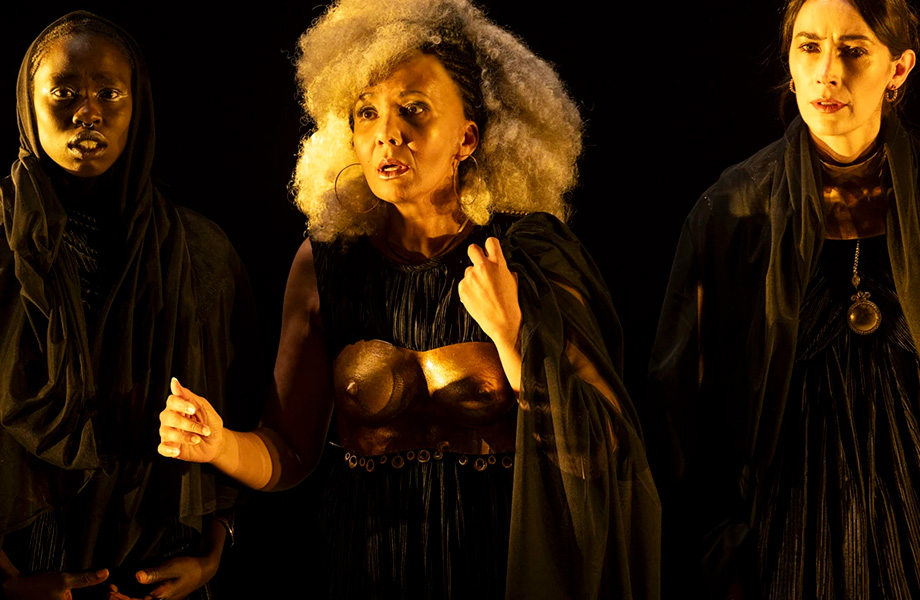
Cassandra (Elizabeth Blackmore) is our guide. She is one of us. The rest of the cast parade in nonsense toga-party costumes, but Cassandra might have stepped out of the audience. She is cynical, literary, attuned to the slipperiness of language. Death is never far from her thoughts. Her message is that all things pass: flowers and universities, polar ice caps and masterpieces, everything rots or burns or melts away. Forget the gods and heroes: death is the truth of the universe.
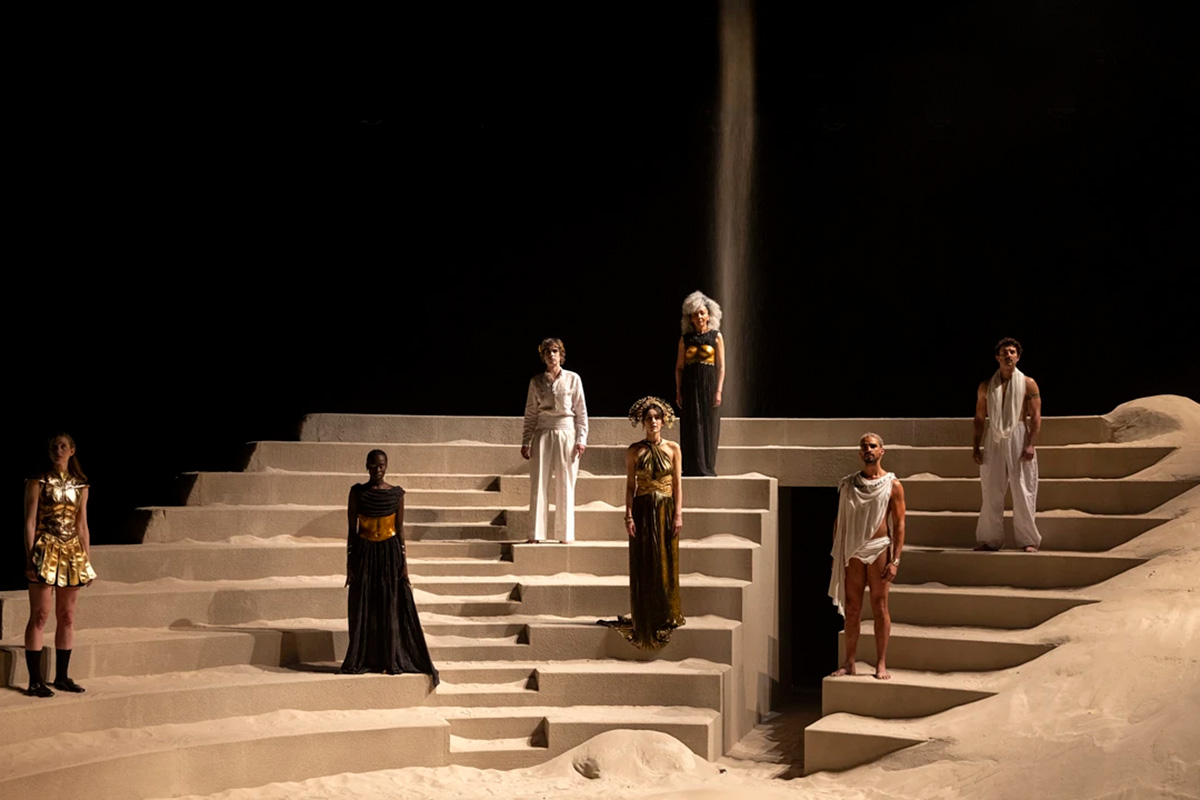
Her outbursts are consonant with the play’s macro-historical perspective. Troy is invoked not as a city of towers but as a heap of dirt, roamed over by untold peoples. The play opens with the cast gathered on a ruined amphitheatre, half swallowed by sand, a structure that is both arena and tomb. They chant the names of vanished tribes and empires, a litany of occupation stretching across millennia. From overhead, a thin stream of sand pours into the theatre, collecting below like the hourglass of forever.
The idea seems to be that the Trojan War was only the local intensification of a larger, longer process in which invasion and migration became blurred. All wars are like this, if you pull back far enough. In a later scene, amateur archaeologists puzzle over the intermingling of Achaean and Trojan artefacts. The point is clear: the imagined clash of warriors before the Scaean Gate is a dramatic fiction that obscures the messier realities of cultural change.
Foreigners arrive, adapt, and alter the local ways of life. There is violence. Religions change, habits transform, landscapes are reimagined. And yet all this human stuff is eventually buried under the charm of a grand mythology of opposing armies.
All well and good. But I am ambivalent about this distanced treatment of the Trojan stories in our present moment. The method of this production is attractive: the deliberate anachronisms, the shifting registers, the non-linear assembly of material. And I enjoy the way it layers history and pop culture to produce ironic or jarring juxtapositions. The use of music – the haunting songs performed by ensemble member Lyndon Watts – is especially striking. Yet I cannot help feeling that too much is withheld.
Perhaps it is simply that this production does not give me what I was looking for, and what I suspect many others might also seek: a more empathetic reckoning with the vision of violence and suffering projected through the story of Troy and its destruction, a vision that has inspired some of the most influential reflections on war in the Western tradition.
Instead, war, as figured in director Ian Michael’s staging, is rendered as almost nothing. It is bodiless, weightless, a puff of air. When a character is killed, a small jet of dust spurts from a vent in the stage and the action continues; the body wanders off. In the play’s final moments, the entire cast stand on the steps of the amphitheatre to be executed one by one, each death marked by the same brief plume of dust. They hurry back into place to be shot again, and again, until the mass killing becomes an abstraction. The murder of an entire people is reduced to a series of clouds that dissipate as quickly as they appear.
Is this a kind of desert wisdom? Is there an echo of Ecclesiastes? ‘Vanity of vanities, saith the Preacher, vanity of vanities; all is vanity.’ The Hebrew word hebel means breath, which the King James translators rendered as vanity, meaning futility. All is as a vapour. But what does it mean to withdraw among the dunes and escarpments at a time when the most appalling violence is unfolding in Palestine, on the heap of dirt where David once ruled? At this moment, I do not find the long view of world events very consoling.
The poetics of renunciation and insubstantiality are actually an affliction for this production. There is little real physicality; the performers rarely seem to inhabit their own bodies. There is so much text that they are unsure what to do with themselves, as if balancing on the words. They tentatively pick their way up and down the steps of the amphitheatre, afraid to disturb the dreamworld they inhabit, or to wake the sleeper in the audience.
Violence here is only the thing that creeps into your bedroom and steals what you love the most. Hector (Mark Leonard Winter) and Achilles (Danny Ball) –pursue one another through the shadows in a sequence that feels more than a little absurd: a pantomime of vengeance. The women of Troy (Paula Arundell, Geraldine Hakewill, and Ciline Ajobong) lounge on the citadel walls and imagine that they are on the edge of the world, far from everything. They don’t know what war is. The implied parallels between Troy and Australia are clever but problematic, not to say evasive.
 Troy (photograph by Pia Johnson)
The play’s most effective scene is the one in which Iphigenia (Ajobong) volunteers herself as a human sacrifice so that the Greeks can finally set sail for Troy. She is cast as the fanatical daughter of a race of warrior-colonists. She declares that the conquest of Troy is the manifest destiny of her people and that she alone can bring that destiny to completion. Ajobong takes full command of the text, her words coiling and striking like a whip. It is a moment with real Sophoclean force and the one passage in this production that genuinely moves.
But this production largely steps away from the modern tradition of reading Homer and the tragedians in order to think productively, if uncomfortably, about how war is fought. Which is a shame because that tradition still feels vital. I think, for example, of what Rachel Bespaloff saw in the Iliad: a pattern in which the conqueror, unable to accept the limits of destruction, responds to the mute defiance of the conquered with ever-escalating violence.
This production is interested in something else. It is not tragedy but myth that preoccupies Wright and Michael; not the horror of war but the ways in which stories are recycled and redeployed to give meaning to it. In the program notes, Wright explains that the play was written as a response to the rhetoric that preceded Russia’s invasion of Ukraine. Fair enough, but my feeling is that events – the most terrible sort of events – have overtaken this project.
So, we make do with Cassandra. I have seen her image many times on the Malthouse stage: the one who is certain she knows how the world works, the child of privilege who fetishises the marginalised, who likes to imagine herself as one of them. She screams, but her screams are existential rather than political. A howl of despair on behalf of everyone in the audience who believes the dice are loaded or the fight is fixed. She looks forward to her own death, counting down the minutes and welcoming it like an old school friend. And why not? When we are no more than specks in the ether, why bother with the struggle to make things different?
Troy (Malthouse Theatre) continues at Malthouse Theatre until 25 September 2025. Performance attended: September 9.