


- Free Article: No
- Contents Category: Film
- Custom Article Title: ‘Blue Moon (★★★★ 1/2), The Mastermind (★★★★) and If I Had Legs I’d Kick You (★★★): A Melbourne International Film Festival packed with luminary visions of imperfection’
- Review Article: Yes
- Article Title: Blue Moon (★★★★ 1/2), The Mastermind (★★★★) and If I Had Legs I’d Kick You (★★★)
- Article Subtitle: A Melbourne International Film Festival packed with luminary visions of imperfection
- Online Only: No
- Custom Highlight Text:
Point to any one of the near 300 films at this year’s Melbourne International Film Festival (MIFF) and you will likely find a luminary vision of imperfection. For three weeks Melbourne’s cinemas housed testaments to the incapable, the broken, and the mediocre.
- Article Hero Image (920px wide):
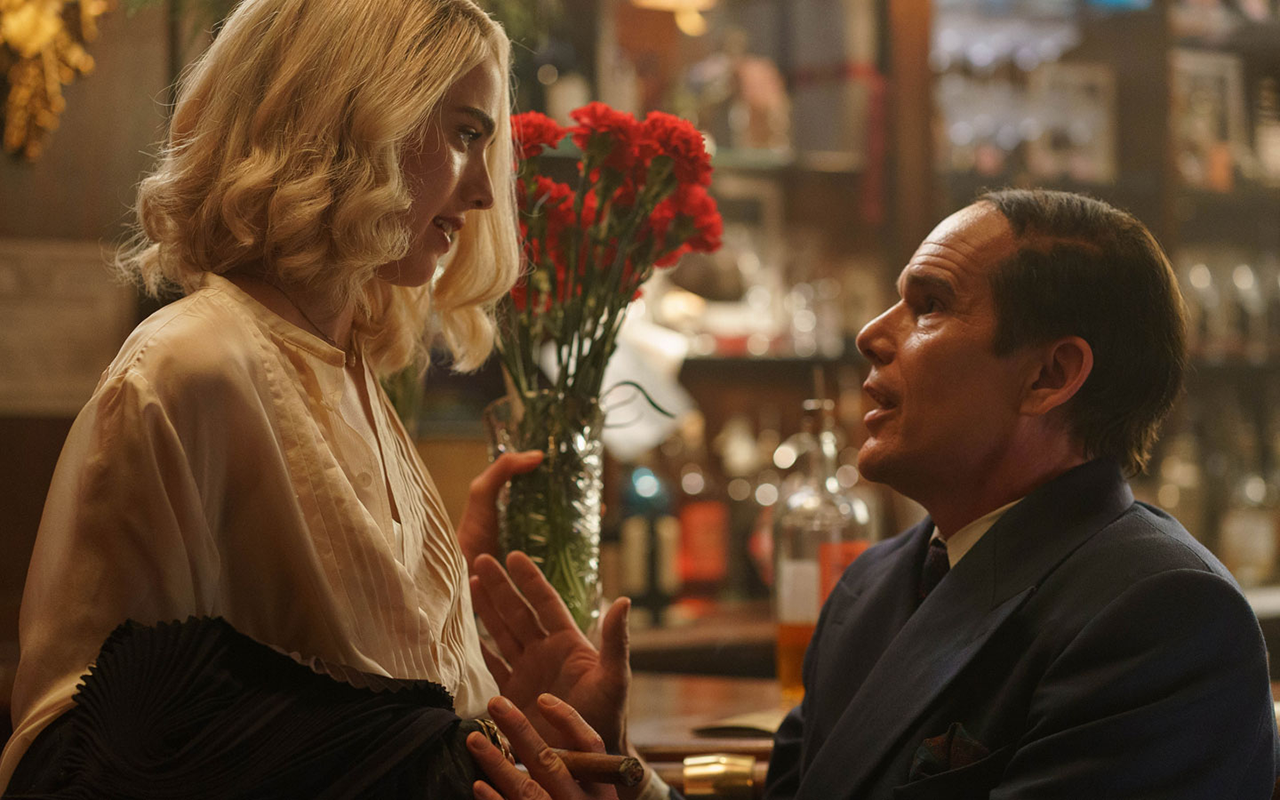
- Article Hero Image Caption: Margaret Qualley as Elizabeth Weiland and Ethan Hawke as Lorenz Hart in Blue Moon (courtesy of Sony Pictures Classics)
- Alt Tag (Article Hero Image): ‘Blue Moon (★★★★ 1/2), The Mastermind (★★★★) and If I Had Legs I’d Kick You (★★★) Melbourne International Film Festival: A festival packed with luminary visions of imperfection’ by Guy Webster
Once he’s got a drink the curtain rises on a performance of his own. We become just one among the many enraptured strangers that double as the audience for a one-man show. Linklater has often pulled from theatre, most notably in the real-time, duologue style of The Before Trilogy. But he mitigated the theatricality of those films by leaning into explicitly cinematic shifts in mis-en-scène. Blue Moon is a straight chamber piece: largely one setting, minimal cuts, and an almost entirely diegetic score. Screenwriter Robert Kaplow frontloads the film with back-to-back monologues for Hart. Meanwhile, Linklater’s long-time collaborator cinematographer Shane F. Kelly keeps the camera still and at mid-level. It’s as if we’re at the end of the bar eavesdropping. Together they replicate the insular feel of site-specific theatre; like the supporting cast, the bar tender (Bobby Cannavale), the coat check (Elaine O’Dwyer), and the pianist playing Rodger’s and Hart (Jonah Lees) are all in on Hart’s bit.
Slowly, the opening night party begin to arrive: Rodgers (Andrew Scott), Hammerstein (Simon Delaney), and among the crowd of guests a young Stephen Sondheim (Cillian Sullivan). These are three names that signal a future of musical theatre that Hart, self-aware to a fault, knows is leaving him behind. Quietly, reality intrudes onto his stage. The warmth of the bar’s Art Deco-style golds, yellows, and deep reds are replaced by the harsher whites and blacks of the lobby and stairs where the guests are gathering to heap praise at Rodger’s feet. Hart’s monologues become snatched remarks, carefully disguised barbs and tense conversations about material realities: his next project with Rodgers, his alcoholism, his loneliness.
There is a skeletal plot in the form of a love story between the youthful Elizabeth Weiland (Margaret Qualley) and Hart, which functions to underline Hart’s bright-eyed romanticism and the tragedy of anything that threatens to smother it. But Hawke does not play Hart like a tragic figure. Hawke sharpens his natural boyish charm against a more acerbic edge to give his whip-smart mischievousness a charismatic warmth. This combination ensures Hart’s emotional dramatics feel theatrical but never disingenuous; his insults artful but never cruel.
In the end, Hart’s innate theatricality underlines Blue Moon’s real tragedy. What Hart loses as he leaves the safety of this bar, and what he has lost in a career that he can now only recall, is an audience. For the intimacy of being listened to, seen, and known, Hart must suspend disbelief; he must pretend there is an audience here just for him. The film ends with a simple title card that describes Hart’s death. He caught pneumonia after being found lying in a gutter in the rain, alone and humming his music to an empty street.
Kelly Reichardt adds heist comedy to her ever-growing slate of genres in the masterful The Mastermind. Imagine an Oceans film distilled to its bare essentials, led not by George Clooney or Brad Pitt but rather the most mediocre man to come out of Massachusetts since Norman Rockwell. James Blaine Mooney (Josh O’Connor) is a middle-class art-school dropout and occasionally present father. Driven by a fear of being beholden to payouts from his in-laws, he decides to steal four paintings by the American modernist Arthur Dove.
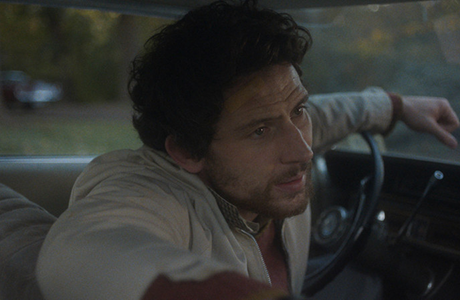 Josh O'Connor as James Blaine Mooney in The Mastermind (courtesy of Mubi)
We open in the early 1970s at the scene of the crime, Framingham Art Museum, with Mooney and his family. Reichardt’s contemplative minimalism paired with Rob Mazurek’s lo-fi blues imbues the museum with an air of elegance as Mooney casually pockets a figurine from a display case. Cinematographer Christopher Blauvelt follows his movements in fluid panning shots and close-ups, each sporting a gauzy and autumnal filter. The film’s studied minimalism begins as smooth as the gloved hand of a veteran cat burglar, as if Reichardt might be about to offer a suave seventies pastiche of Alfred Hitchcock’s To Catch A Thief. But suburban Massachusetts is not Monaco. Mooney is no Cary Grant. Reichardt uses the close attention this opening encourages to revel in the banality that transforms Mooney’s attempted heist into a comedy of errors and a testament to everyday mediocrity.
Reichardt has made a career exposing the foibles of American mythmaking, showing us just how absurdly disconnected these myths are from the minutiae of ordinary lives. Mooney’s casual failures stumblingly propel The Mastermind forward. Reichardt gently pokes at the genre tropes of the heist thriller that are oriented around two particular myths: self-entitlement and male exceptionalism. All the men in The Mastermind seem thrilled to be in a heist film but also unsure – or unable – to do anything else.
Mooney is a pathetic supporting character in a leading role. O’Connor’s gangly silhouette and hunched back, paired with the depthless passivity of his expression makes his lack of charisma entrancing. Each contemplative close-up seems to question why he is our subject. The subtlety of O’Connor’s performance means that his lack of charisma isn’t strong enough for us to assign him the romance of being an anti-figure.
Mary Bronstein’s If I Had Legs I’d Kick You is led by Rose Byrne, who won the Berlinale Silver Bear for Best Leading Performance as Linda, a psychiatrist and mother who must vacate herself of all individuality for the sake of her work, an absent husband, and a daughter who requires constant care after a medical procedure leaves her with a stoma. We meet Linda when a hole in her home’s ceiling forces her daughter and her into a nearby hotel.
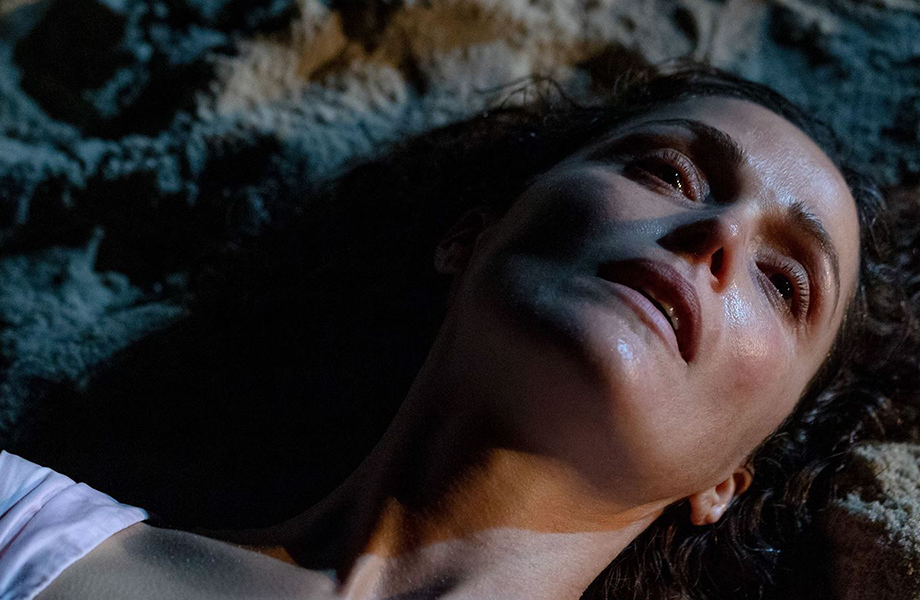 Rose Byrne as Linda in If I Had Legs I’d Kick You (courtesy of A24)
Linda is a patchwork of obligations, locked in a routine. She wakes up, drives her daughter to school, meets with her doctor, goes to work, meets with vapid patients, checks on the house repairs. The film’s monotony intensifies; a sense of restriction is deepened by extreme close-ups on Bryne’s increasingly vacant expressions and pained eyes.
In If I Had Legs I’d Kick You, Bornstein combines the unrelenting anxiety of Lynne Ramsay or the Safdie brothers with the uncanny everyday conversations of Lorgos Lanthimos and moments of David Cronenberg-esque body horror. Scenes swing from surreal interactions in cramped offices and therapy rooms to visceral depictions of medical procedures. Its crowded and fragmented style replicates the overwhelming scale of motherhood’s daily pressures.
Yet, the film can be unwieldy and unfocused. Its repetitiveness grows stale, re-treading the same themes and emotional beats. Too often Bornstein favours momentary gaffs or stylistic flourishes over choices that might have made individual moments accumulate into something more coherent. It is up to Byrne – given a meaty role at last – to do most of the film’s heavy lifting. Her dead-pan delivery and subtle expressiveness pull its dourness back from sterility, adding a much-needed wry humour to Bornstein’s stilted dialogue. Byrne’s performance is complemented by a rich ensemble cast of comedians: Conan O’Brien, Ivy Wolk, and the surprisingly hilarious A$AP Rocky. A last-minute turn to a relatively basic trauma plot in the film’s final act is jarringly sentimental, simplifying the unreality of the film’s chaos and the rich questions raised by Linda’s identity crisis.
Still, it was a perfect film to open MIFF this year. Its final scene offered the first of many metaphors sprinkled throughout the festival to represent our essential fallibility: a woman in her pyjamas, throwing herself against increasingly violent waves; at war with the idea that she might be as uncontrollable, imperfect, and sublime as the tide.