


- Free Article: No
- Contents Category: Theatre
- Custom Article Title: Super: Red Stitch takes on the cultural dominance of the superhero
- Review Article: Yes
- Article Title: Super
- Article Subtitle: Red Stitch takes on the cultural dominance of the superhero
- Online Only: No
- Custom Highlight Text:
We are perhaps finally within sight of the superhero genre’s demise. Declining box office, scandal, oversaturation, and ill-advised reboots have all contributed to a sense that, as one notable trade magazine recently put it, ‘super burn out’ is upon us
- Article Hero Image (920px wide):
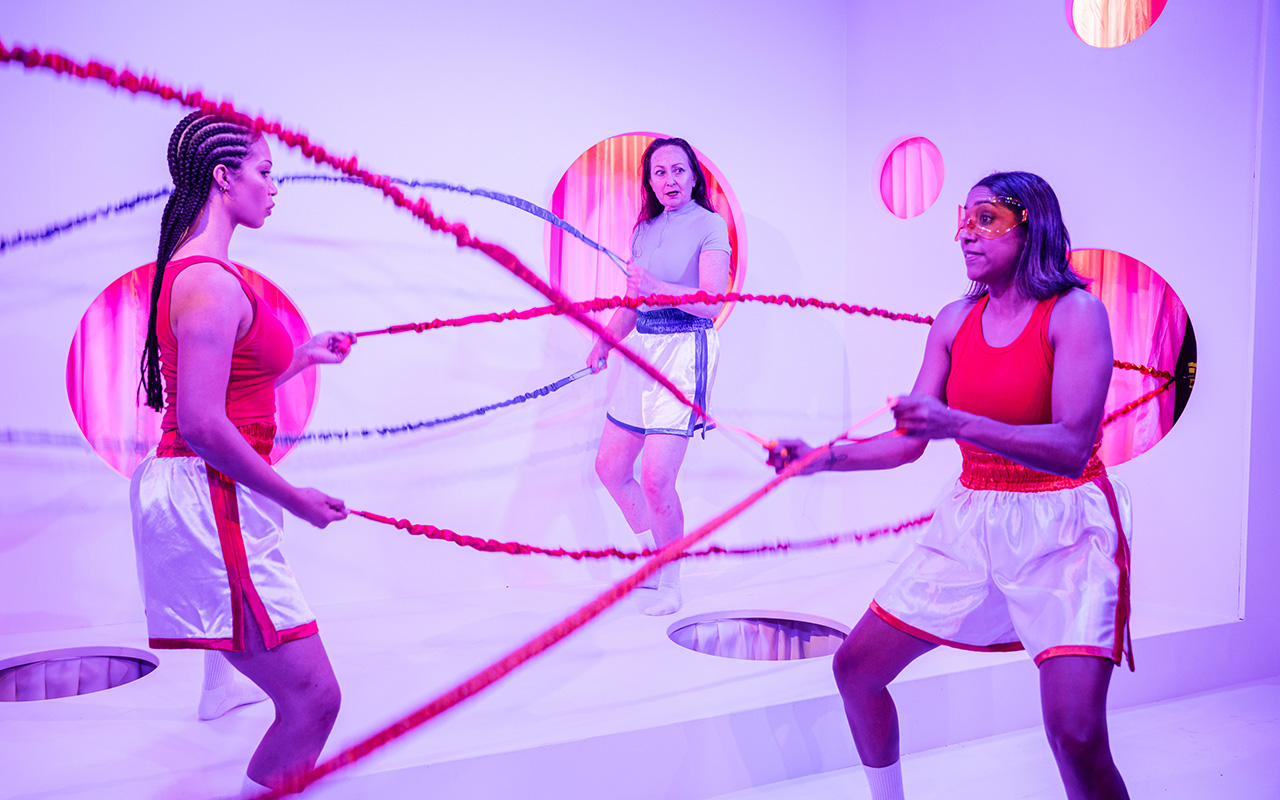
- Article Hero Image Caption: Lucy Ansell as Phoenix, Caroline Lee as Rae and Laila Thaker as Nel (courtesy of Red Stitch)
- Alt Tag (Article Hero Image): ‘Super: Red Stitch takes on the cultural dominance of the superhero’ by Ben Brooker
- Production Company: Red Stitch Actors Theatre
Almost as ubiquitous as the genre itself has been its parodies, and little wonder. Over the top, frequently self-serious, more or less formulaic, and politically located somewhere in the middle of last century, the caped crusader with his or her underwear on the outside makes an easy target for the satirist. Less common have been interventions which don’t so much as poke fun at the genre as deconstruct it, laying bare its absurdities without merely reducing them to a series of re-commodifiable clichés.
One such intervention is Emilie Collyer’s ebullient new play, Super, which crafts a world in which certain individuals are endowed with ‘body occurrences’ that set them apart from their fellow humans. Phoenix (Lucy Ansell) and Nel (Laila Thaker) are members of a ‘super power support group’. The latter has ‘administrative and calming powers’ – think your office coworker with an overenthusiastic relationship to corporate jargon and spreadsheets – while the former can drain the anger from people, including despondent sports fans so that they don’t ‘kick the shit out of their families’. As the play opens, this odd couple are joined by an even odder third member: Rae (Caroline Lee), a celebrity chef whose power entails a kind of contagious crying which reduces everyone around her to tears.
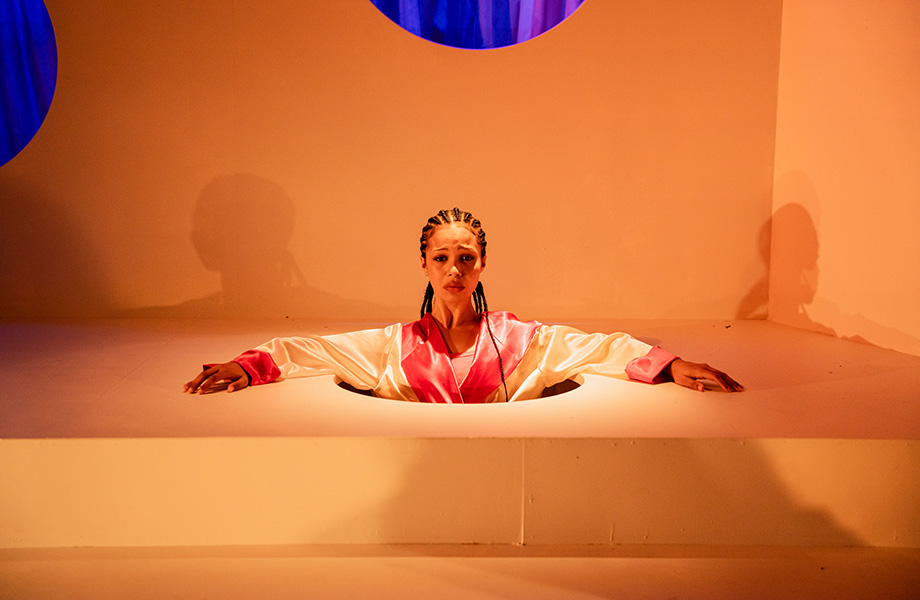 Lucy Ansell as Phoenix (courtesy of Red Stitch)
All three are, shall we say, reluctant superheroes. Clichés like ‘origin stories’ are anathema to them. Even the word ‘superhero’, they tell us, ‘can lead to hubris’. Nor are they fully in control of their powers; part of the point of the support group is the learning and encouragement of their disciplined use. The group’s motto, much repeated, runs: ‘We hold our powers with care, we strive to do no harm, we hope to make the world a better place.’ The contrast with the hypermasculine, might-is-right figures of the Marvel and DC cinematic universes could not be more pronounced.
At the same time, the group is not beyond commercialising their powers in our era of runaway capitalism. The trio are invited to host a TV talent show, So You Think You Have a Superpower, which features contestants whose ‘special abilities’ include knowing when an avocado is ripe and what presents to buy for teenagers. While Phoenix is sceptical of the enterprise and Rae studiedly enthusiastic, Nels is a true believer. For her, a bigger profile and more money need not be ends in themselves but ways of supercharging the group’s mission to better the world – or so she says. What follows is a whirlwind of incident and affect, Nel evermore Svengali-like in her efforts to propel the group towards lives of minutely calibrated fame, success, and monetised self-promotion. All of it is engineered and policed by increasingly intrusive surveillance and data-mining tech. Phoenix, says Nel, is now a ‘cash cow’, complete with overpriced merch and a legion of adoring fans.
When it comes, the cost of the trio selling out is not just psychic but acutely physical. Rae begins to leak profusely, an embarrassing surfeit of liquid requiring the constant application of a sealant spRae. Phoenix comes out in possibly radioactive welts and, like Rae, experiences a loss of control over her power. For Phoenix, this culminates in vigilante attacks on groups of thuggish men; for Rae, the loss of control results in ‘cry parties’. Nell, meanwhile, temporarily loses the use of her eyes, an LED band she places around her face displaying a single, scrolling word: AMAZING.
Collyer seems less invested in ridiculing the superhero genre’s nonsenses than in exploding and reconstituting them as a sort of funhouse mirror reflection. Her writing is sharp and witty and, as with her terrific 2015 play, Dream Home, probes contemporary anxieties and obsessions with relish. Super feels, refreshingly, neither identitarian nor issues-based in its conception, even if it does touch on real-world problems like family violence and gender discrimination. Its form, too, is bracing, eschewing the naturalism that dominates our stages in favour of a pushed up, lightly absurd theatricalism. It might be described as a satire, although exactly what it is satirising in any given moment can feel nebulous.
This première production, under the adroit direction of Emma Valente, succeeds in bringing Collyer’s text to full, cartoonish life. Taking place within Romanie Harper’s white, retro-futurist set – a series of nested playing spaces with holes cut into the floor and walls, allowing the actors to scurry about like the subjects of some Truman Show-like experiment – the action is breathless. Harper’s outlandish costumes – including some of the most eye-popping headwear since the hat parade of Caryl Churchill’s Far Away (2000) – as well as both Beau Esposito’s filmic sound design and Natalia Velasco Moreno’s frenetic lighting succeed in conjuring a microcosmic yet larger-than-life world. The cast are similarly impressive, from Ansell’s dry, cynical turn as Phoenix to Thaker’s fervid Nel to Lee’s winningly eccentric Rae. Each performance is intensely physical – it’s a wonder a specialist wasn’t required to choreograph the endless appearances and disappearances through walls and floor, movements that contain a flavour of the grotesque, the buffoonish.
While Super is not a play likely to linger long in the mind, it is nevertheless delightful and occasionally thought-provoking. It is also – and this matters in the age of the perpetual reboot – markedly original. As the superhero genre flames out, it reminds us that we are all, as Nel puts it, flawed, but deserve to be super.
Super (Red Stitch) continues until 6 July 2025. Performance attended: June 18.