


- Free Article: No
- Contents Category: Theatre
- Custom Article Title: The Spare Room: Helen Garner’s address to the messy chaos of existence
- Review Article: Yes
- Article Title: The Spare Room
- Article Subtitle: Helen Garner’s address to the messy chaos of existence
- Online Only: No
- Custom Highlight Text:
Long before the concept of autofiction entered the conversation, Helen Garner was confronting the messy chaos of existence in a manner that managed to be at once analytical and empathetic. In novels like Monkey Grip (1977) and in-depth reporting like This House of Grief (2014), she balanced her clear-eyed observance of facts with an almost clinical dissection of her feelings arising from them.
- Article Hero Image (920px wide):
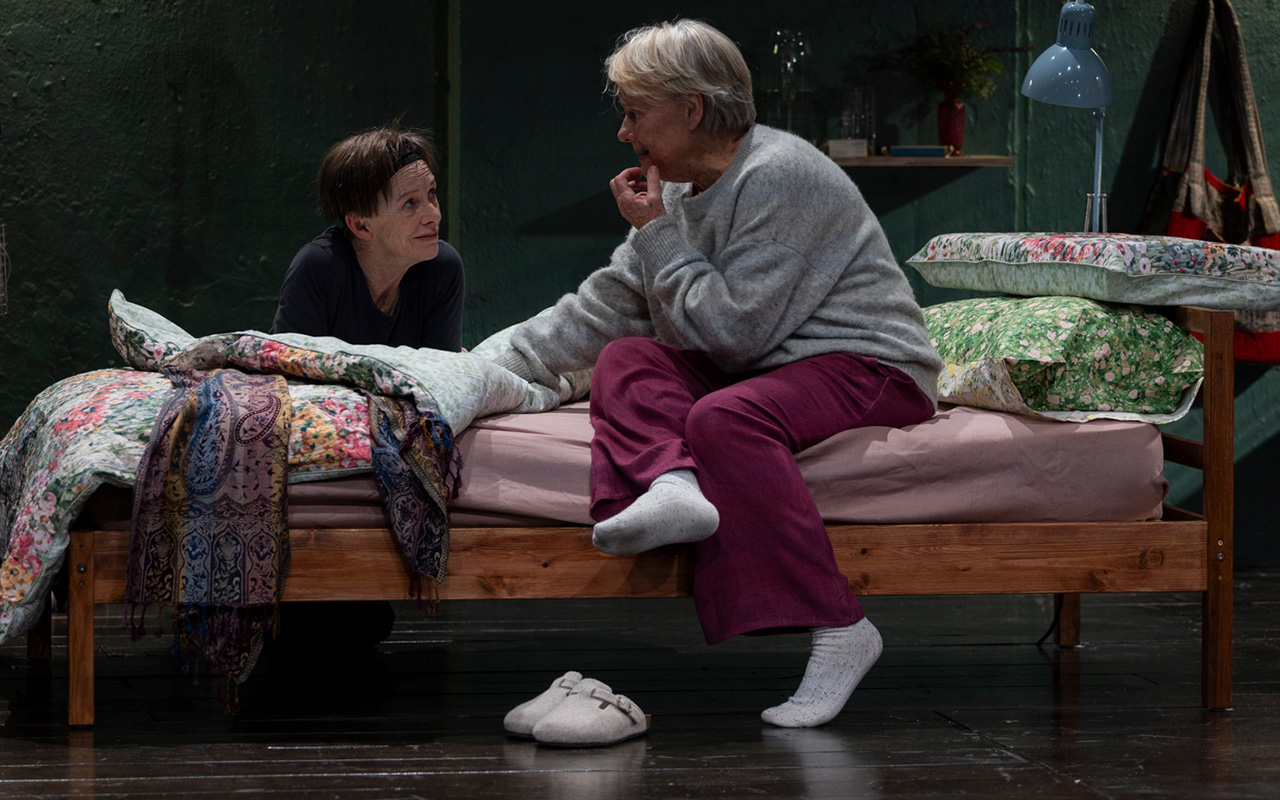
- Article Hero Image Caption: Judy Davis as Helen and Elizabeth Alexander as Nicola (courtesy of Belvoir St Theatre)
- Alt Tag (Article Hero Image): ‘The Spare Room: Helen Garner’s address to the messy chaos of existence’ by Ian Dickson
- Production Company: Belvoir St Theatre
Helen has agreed to have her ailing long-time friend Nicola come down from Sydney and stay with her in Melbourne for a couple of weeks while she undergoes a course of treatment. She envisages a scenario in which she channels Florence Nightingale and the two of them spend time making music and reminiscing. Instead, she finds herself in a nightmare, attempting to wean her grievously ill friend away from a cultish quack while laundering her nightly sweat-stained sheets and reluctantly abetting her determination to deny the obvious; death was in the room with them.
Transferring this novel to the stage has its challenges. Writing about the 2007 film version of Raimond Gaita’s Romulus My Father (1998), Garner succinctly addresses the problem. ‘For a movie to be drawn from this memoir, the tale would have to be taken apart, and the pieces picked up off the floor and compressed into a new configuration, without the one element that holds it together on the page, makes sense of it, and redeems it: Gaita’s unique narrating voice.’
It is the lack of an equivalent – Garner’s unique narrating voice – that denies Eamon Flack’s curiously lightweight adaptation much of the emotional power of the novel. To be sure, Helen’s narration in the play draws on passages from the book, but this is undercut by the mundanity of scenes that are played without being filtered through Garner’s acute perception. Moreover, the decision seems to have been made to accentuate the work’s humour. One of Garner’s strengths is to find the comic in even the darkest moments; this production highlights the comedy to the extent that, at times, it almost feels like watching an antipodean version of The Man Who Came to Dinner (1941).
From the opening, Flack makes us aware that this will be Helen’s version of events. As the lights come up, Judy Davis’s Helen is sitting quietly waiting for her moment. When ready, she comes forward, cues cellist Anthea Cottee, whose music is powerfully integral to the play, and starts. Davis is, of course, an electrifying presence and she has the audience eating out of her hand from the beginning as she charts Helen’s journey from shock to exasperation, from anger to exhaustion. She is very funny as her frustration mounts in the face of Nicola’s determination to believe in the dubious ministrations of Professor Theodore. There are a couple of powerful moments when Helen’s grief breaks through her exasperation; she is formidable when she finally lets loose on her friend. But it is only at the end, when she describes Nicola’s final moments in Garner’s words, that she gets the chance to tear our hearts out.
Part of the problem is the way in which Nicola is presented. Elizabeth Alexander is a hugely talented actor and could have played the novel’s version of Nicola, a brittle and patrician woman with private-school charm and formidable willpower. Flack’s version is a rather nebulous, undefined figure. As such, it is difficult to understand Helen’s complicated relationship with her. We just see her as a woman whose self-obsession makes her totally unaware of the trauma she puts others through. In the novel’s account of the time after Nicola’s departure, Garner describes Helen finding ‘a valedictory letter of such self-reproach, such tenderness and quiet gratitude that … I was racked with weeping’. This episode, and therefore a crucial aspect of Nicola’s personality, is omitted from Flack’s version.
The rest of the cast flit from character to character with aplomb. Emma Diaz’s Iris, Nicola’s niece, brings a refreshing blast of sanity to the proceedings. Alan Dukes as a variety of medicos is alternately despicable or supportive and has fun as a rather mysterious magician, while Hannah Waterman has a glorious moment as Helen’s sister.
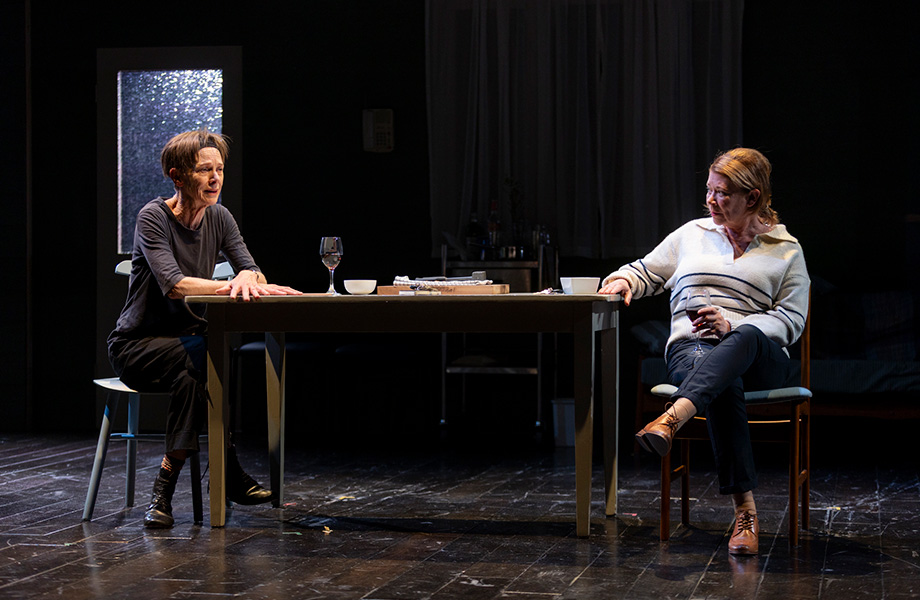 Judy Davis as Helen and Hannah Waterman as Dr. Caplan (courtesy of Belvoir St Theatre)
Mel Page’s set keeps the spare room intact while seamlessly changing the rest of the stage from home to clinic to theatre, aided by Paul Jackson’s subtle lighting.
As both Garner and Flack’s Helen tell us: ‘Death will not be denied … It injects poison into friendship and makes a mockery of love.’ Even if Flack’s adaptation lacks the depth of the original, this message still comes across.
The Spare Room (Belvoir St Theatre) continues at the Upstairs Theatre until 13 July 2025. Performance attended: June 15.