


- Free Article: No
- Contents Category: Theatre
- Review Article: Yes
- Article Title: The Birds
- Article Subtitle: A contemporary interpretation of Daphne du Maurier’s post-war story
- Online Only: No
- Custom Highlight Text:
Readers who encountered Daphne du Maurier’s ‘The Birds’ when it was first published in 1952 (as part of her short story collection The Apple Tree) would have heard in the story an echo of the German assault on Britain during World War II, images of rural England under attack from aggressive birds an apt metaphor for everything the country had recently endured. Yet what lifted the story from being merely an allegory of a past war to a tale that resonated – and continues to resonate – beyond its time is the cyclic nature of the birds’ incursions.
- Article Hero Image (920px wide):
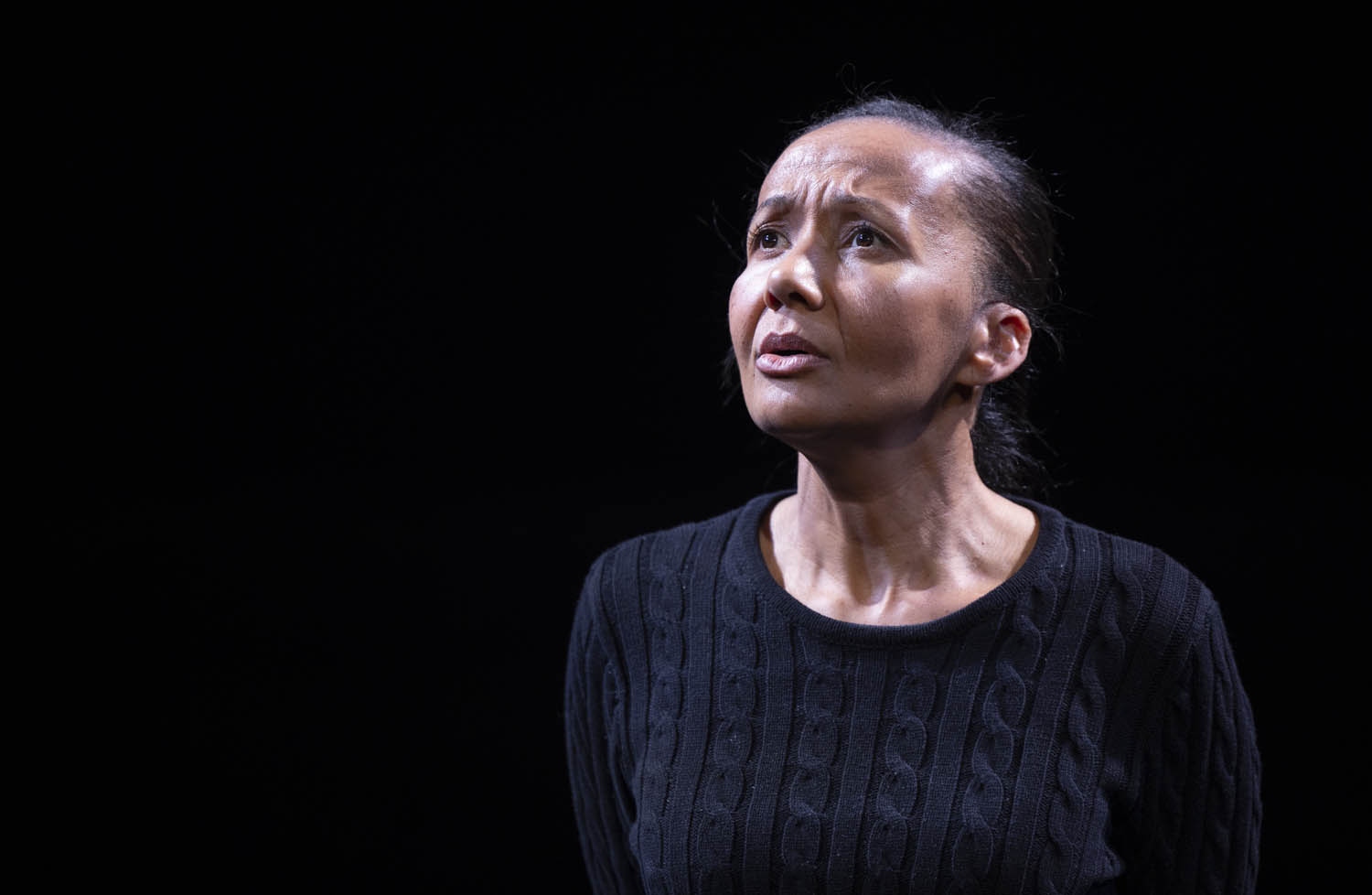
- Article Hero Image Caption: Paula Arundell as Tess (photograph by Pia Johnson)
- Alt Tag (Article Hero Image): ‘The Birds: A contemporary interpretation of Daphne du Maurier’s post-war story’ by Diane Stubbings
- Production Company: Malthouse Theatre
Tidal rhythms underpin the story’s plot. The birds’ attacks and retreats coincide with the movement of the tides. Offensives come in waves and over time those waves rise and recede and rise again. In this, the birds in du Maurier’s story transcend a single moment in history and become instead a symbol for all that is unknown, unpredictable. They remind us of the chaos and threat that lurk at the edges of social order and daily routine. They represent, to borrow the words of the United States Secretary of Defense Donald Rumsfeld, the ‘unknown unknowns’. This sense of something erratic and volatile and violent waiting for the next tide – an ‘instinct’, to quote du Maurier, ‘to destroy mankind with all the deft precision of machines’ – is what imbues ‘The Birds’ with its Gothic terror.
Malthouse Theatre’s dramatisation of du Maurier’s story situates the action in a small coastal community in present-day Australia, and reads into the birds’ savage urge to decimate the human population a backlash against environmental degradation, a not uncommon interpretation in the years since the story’s publication and one underscored here by Kat Chan’s stage design: an assembly of nesting boxes hanging precariously over and around a grey central platform.
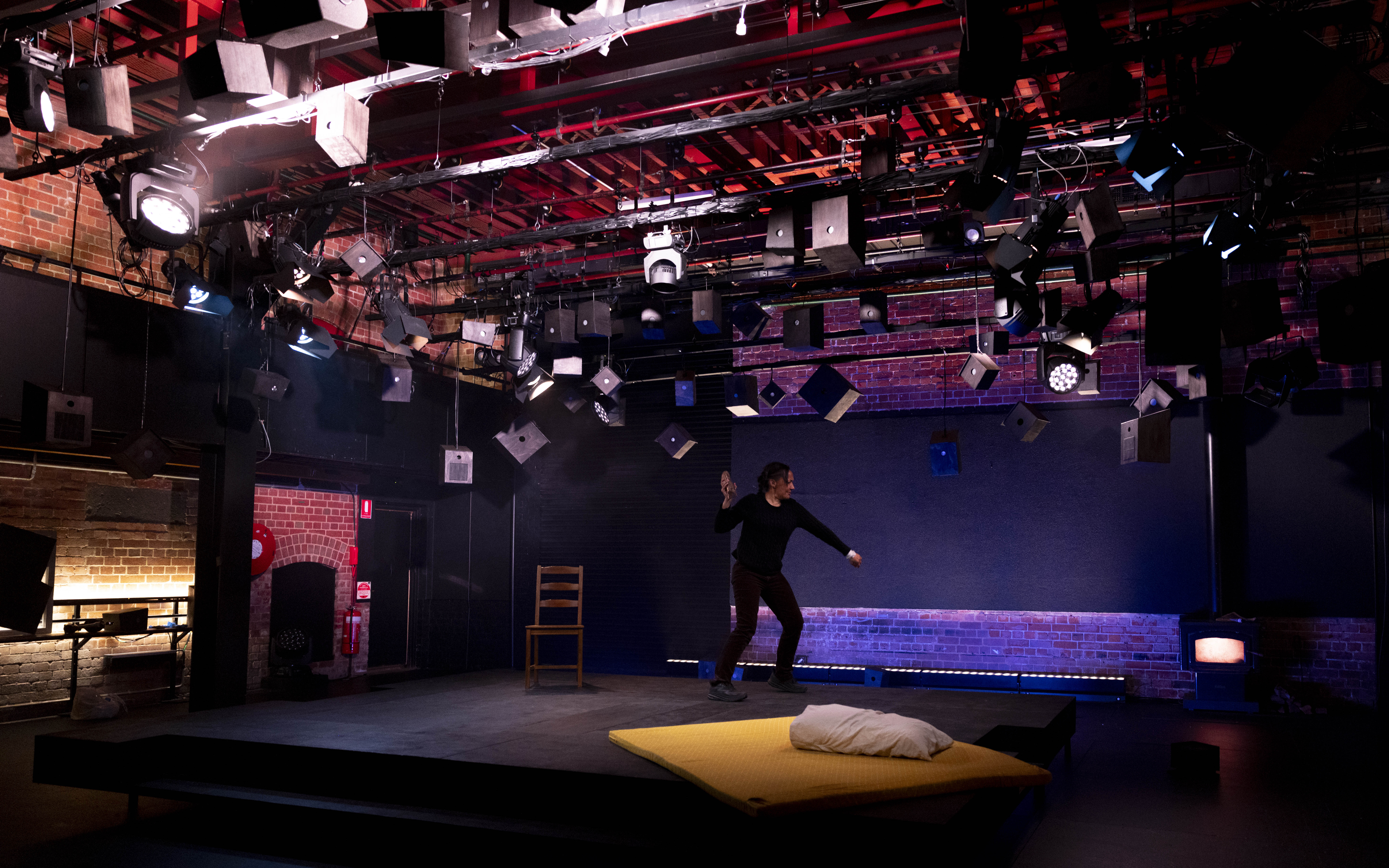 Paula Arundell as Tess (photograph by Pia Johnson)
Although marked by stunning moments of light and sound that starkly render the birds’ attacks, and a spirited performance by Paula Arundell, the production is ultimately undone by its script. Writer Louise Fox and director Matthew Lutton have not so much adapted ‘The Birds’ for the stage as re-written it as a longer, and weaker, short story. The effect is a play which offers little by way of contemporary context while squandering much of the symbolism and existential horror inherent in the original.
Tessa and her family have recently undertaken a seachange, looking to escape the dirt, crime, and expense of living in a city. Tessa’s husband Nat has suffered some sort of breakdown – we are not told the cause, but the inference is that it stems from some violence he suffered in the city. Tessa works from home (her profession is unspecified), giving her the freedom to care for both Nat and their two school-aged children. What spare time she has Tessa spends by the sea, watching the shorebirds playing at the edge of the ocean.
In its early stages, Fox’s adaption sticks close to du Maurier’s original, although the perspective shifts from Nat - who in du Maurier’s story has returned from the war disabled and whose worldview is tempered by the physical and psychological wounds he still carries - to Tessa. In doing so, the focus of the story is not so much on resistance as resilience. This is not the story of a blighted man – a blighted nation – pushing back against a tide that bears yet another assault on their freedom, their sanity. This is, as the script implies, a mother bird defending her nest against an undivinable onslaught, the irony being, as Fox’s script sees it, that the birds are essentially doing the same.
The first attack on Tessa’s home – the smaller birds of the area gang together and rap ominously on the outer surfaces of the house before breaking through the window of the children’s room – is suitably chilling, largely because of a razor-sharp light-and-sound assault (Niklas Pajanti is lighting designer and J. David Franzke is composer and sound designer). While the decision to have the sound played through individual headphones seems, at first, inspired, particularly in conveying the shock of that initial attack, its ultimate effect is to isolate the audience from Tessa’s experience and to distance us from the physical jolt of the ongoing strikes.
Overall, the production relies too heavily on the light and sound effects to realise the dread embedded in the story, and the sensory bombardment of the attacks diminishes rather than builds. This is not helped by Fox’s script which in its stretched-out second half eschews the concise, closely observed realism of du Maurier’s text and moves into overly long passages of mawkish description. A story Tessa tells her children about a magpie nest in a tree in her school playground when she was a child, key to the interpretation this production imposes on the text, carries on for so long its point is lost. Similarly, du Maurier’s taut account of the devastation wreaked by the birds – ‘He could see her legs protruding from the open bedroom door. Beside her were the bodies of the black-backed gulls, and an umbrella, broken’ – is here transformed into minutes and minutes of gore-ridden detail. Nothing at all is left to the power of the audience’s own imagination.
Paula Arundell is splendid at Tessa, narrating the events of the story as well as voicing all the other characters. But she is given too much to say and too little to do: as impassioned and energetic as her performance is, it inevitably wilts under the weight of Fox’s words. Lutton’s direction, in his final production as Artistic Director of Malthouse, is uncharacteristically muted and fails sufficiently to define some of the tensions that are key to the story and its Gothic roots. Especially missed are the stillness and silence that punctuates du Maurier’s narrative: it is in the stillness and silence that the true terror lies, the birds waiting and watching, regrouping themselves before their next salvo, the scale and force of which is impossible to predict.
In reshaping the narrative as an environmental parable, the production reduces much of the symbolic potency of the story. We are taken out of 1950s Cornwall and transported to an ill-defined present (would Tessa really check the community noticeboard in the town for information about the birds, rather than social media?). Nothing is gained from the shift in time, aside from a gesture towards conspiracy theory, few contemporary resonances are plumbed, and much is lost. Critical elements of the Gothic that powered du Maurier’s narrative – tensions between innocence and guilt, knowledge and ignorance, the tame and the savage, good and evil – are neglected, and the crucial tidal metaphor is virtually ignored.
Essentially, the production reads too literally du Maurier’s question, ‘how many years of memory were stored in those little brains?’ By concentrating its interpretation of ‘The Birds’ on the conflict between man and nature, the production unnecessarily limits itself, encompassing none of the reverberations of man against man that sound through du Maurier’s original and that, tragically, continue to torment our own times.
The Birds (Malthouse Theatre) continues at Beckett Theatre until 7 June 2025. Performance attended: May 21.