


- Free Article: No
- Contents Category: Film
- Custom Article Title: The Surfer
- Review Article: Yes
- Article Title: The Surfer
- Article Subtitle: A psychedelic, nightmarish beachside bacchanal
- Online Only: No
- Custom Highlight Text:
The Surfer opens with its Australian-American protagonist, played by Nicolas Cage, giving his teenage son a surf-inspired pep talk: the ocean, he says, is ‘pure energy’. And like life, either you learn to ride it ‘or you wipe out’. These words could well have come from Cage himself, an actor known for his self-described ‘nouveau shamanic’ performance style, whose late-career oeuvre seems designed to repeatedly bring the sixty-one-year-old to the brink of spiritual oblivion.
- Article Hero Image (920px wide):
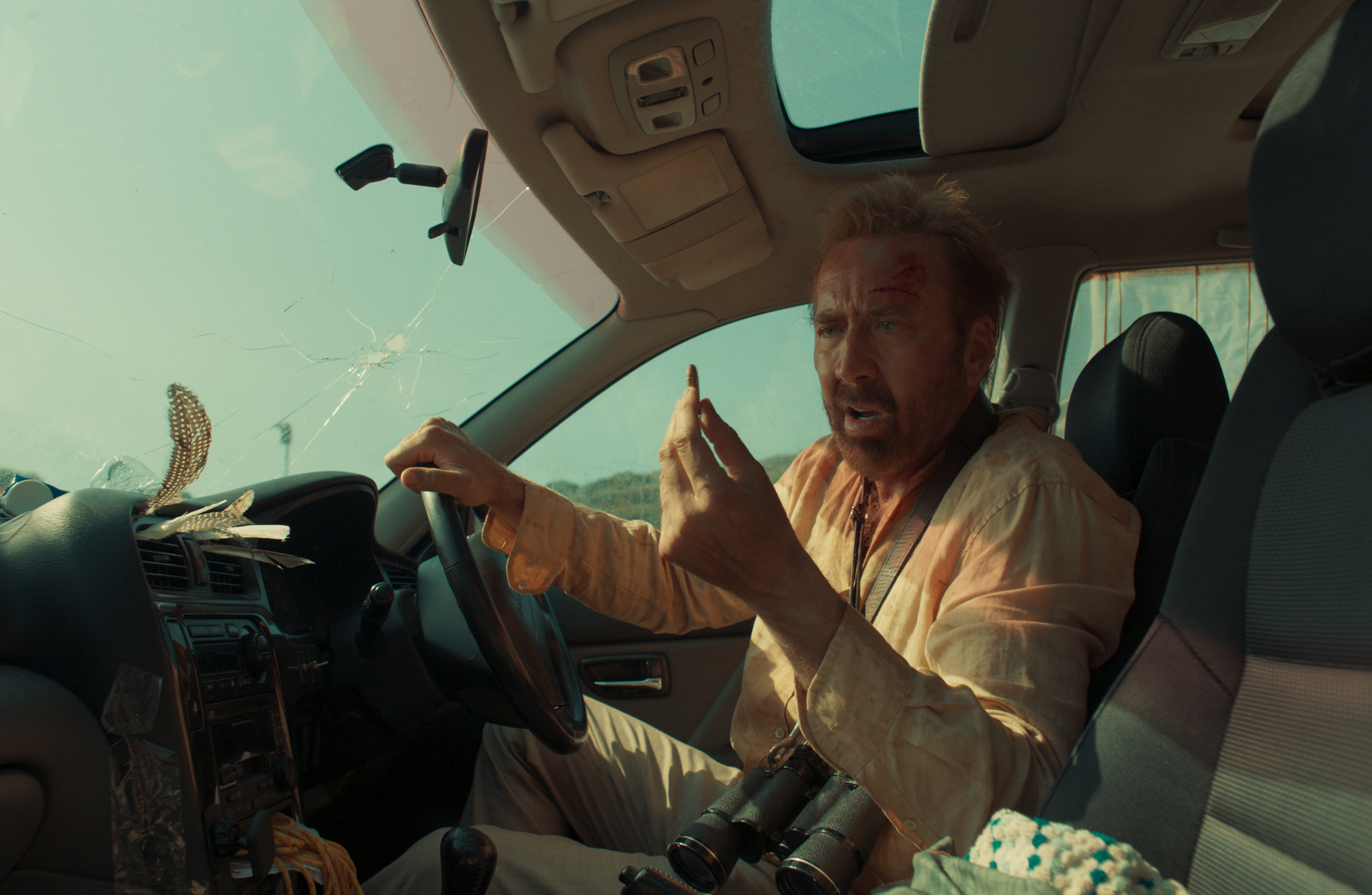
- Article Hero Image Caption: Nicolas Cage as The Surfer (courtesy of Madman Films)
- Alt Tag (Article Hero Image): ‘The Surfer: A psychedelic, nightmarish beachside bacchanal’ by Jordan Prosser
- Production Company: Madman Films
This may sound like a somewhat grandiose precis for a grungy, low-budget throwback thriller that takes place almost entirely in an outdoor car park, but by the time a dehydrated, malnourished Cage is screaming ‘Eat the rat!’, whilst mid-combat with a cult-adjacent bank manager named Pitbull on a West Australian beach, it is clear that The Surfer fits tidily in his cinematic project.
Cage plays the eponymous surfer, credited as The Surfer: Thomas Martin’s script gives him no other name, doing little to delineate the character from the actor playing him. He is a middle-aged corporate everyman who has returned to his picturesque Australian hometown of Luna Bay after a childhood tragedy forced his family to relocate to California, conveniently allowing the Irish-Australian co-production to cast an A-list American lead.
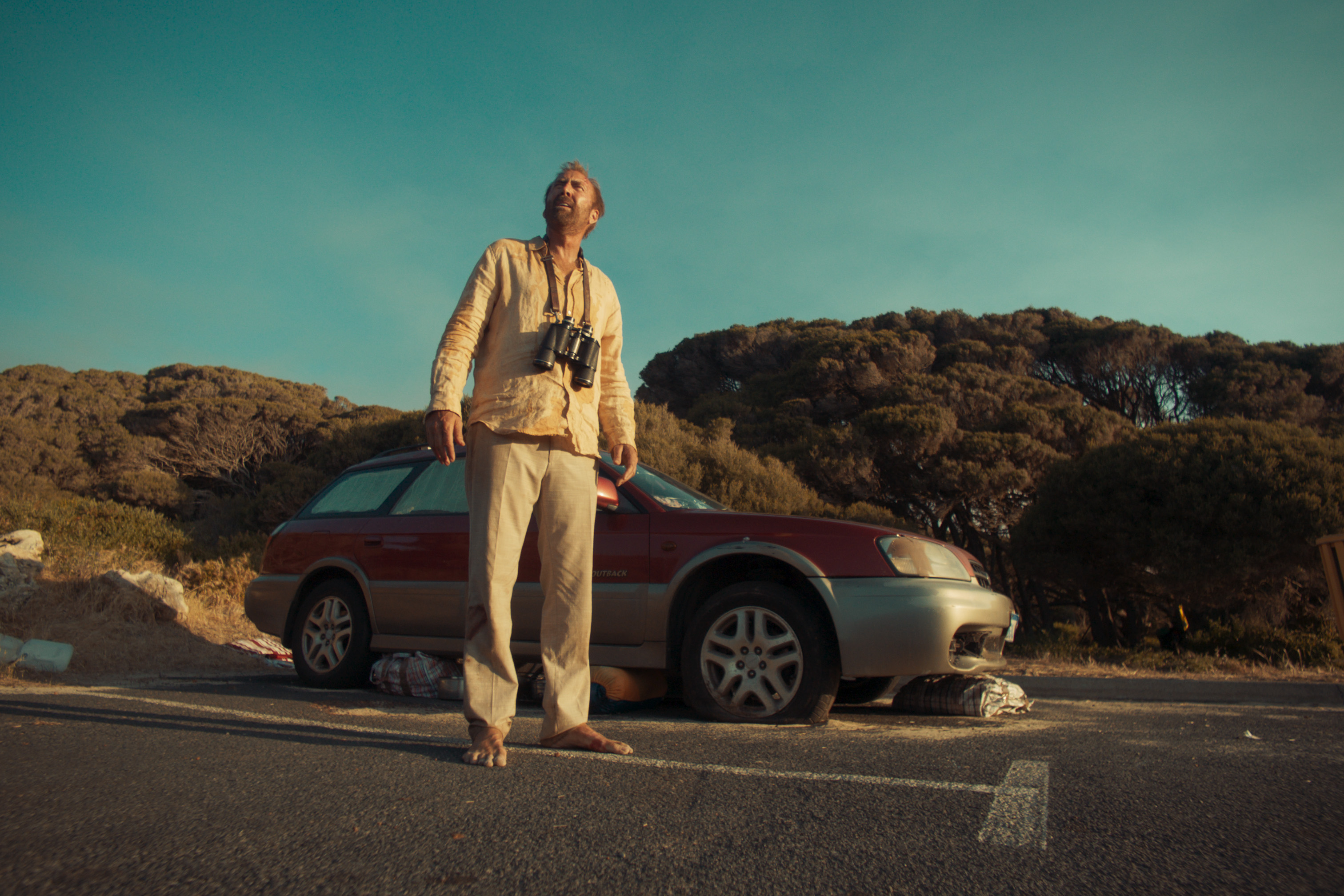 Nicolas Cage as The Surfer (courtesy of Madman Films)
He plans to take his son (Finn Little) to surf the waves of his childhood. From the water, they’ll have a perfect view up to the house on Cliffside Drive that The Surfer is about to buy – his old childhood home, finally reclaimed. It is a full-circle moment, one quickly derailed by a sign that says ‘LOCALS ONLY’ and a pack of beach bros who have essentially annexed Luna Bay in the week leading up to Christmas. ‘Don’t live here, don’t surf here,’ one of them spits in Cage’s face. Roundly emasculated in front of his son and idyllic plans foiled, The Surfer retreats to the car park where he remains camped for the rest of the film, unwilling to cede the beach he sees as his birthright.
As a chain of both cosmic and comical events robs The Surfer of the trappings of civilised life – his sunglasses, his surfboard, his phone, his watch, his shoes, his Lexus – The Surfer becomes a survival thriller of sorts. Cage is attacked not only by feral teenagers but by dogs and rats, forced to dumpster-dive for food and drink sludgy tap water from the public loos, slowly but surely morphing into the mirror image of the vengeful homeless man (Nicholas Cassim) who previously occupied the car park. You can’t help but wonder whether Cage chooses his projects based on the level of personal debasement they afford him.
Humiliations come thick and fast for The Surfer as the tight-knit community seeks to expel ‘undesirables’; even the local cop and the barista in the coffee kiosk are in on it. A chain-smoking dog-walker reflects on the violent localism of the ‘Bay Boys’ with an age-old platitude: it can only be healthy for them to ‘let off a little steam’. ‘Stops them beating the Botox out of their wives’ at home, she says.
Irish director Lorcan Finnegan continues the tradition of foreign filmmakers ruthlessly excavating the Australian male mindset. But whereas the antagonists in Canadian Ted Kotcheff’s classic Wake in Fright (1971) were at least genuine working-class outback folk, what makes the Luna Bay Boys all the more terrifying is that they are upwardly-mobile city-suburbanites – finance managers and real estate agents – aspiring to that kind of outmoded primitivism. ‘Yuppies cosplaying at being surf gangsters,’ as one character describes them.
It makes perfect sense that their ringleader Scally (a superbly slimy Julian McMahon, going toe-to-toe with Cage even at his wildest) is a manosphere corporate influencer, who, when not decked out in his blood red terry-towel robe like a beachside Svengali, is delivering heartfelt Instagram lectures about how the world has ‘made modern man too soft’. The funniest thing about Cage’s character’s plight is that it resembles the kind of self-inflicted agony that tech bros and executives would be falling over themselves to pay for were it only packaged and sold as some sort of ‘ancestral male self-discovery’ regimen. And maybe that is the point – maybe this all a test. ‘Before you surf,’ the Luna Bay Boys chant during one of their quasi-occult night-time rituals, ‘you must suffer.’
Episodic by nature – day becomes night becomes day – Cage’s travails in the car park begin to feel repetitive, a procession of familiar obstacles rather than a ratcheting crisis. The film’s closing statement, which gestures towards some grand, inescapable cycle of male self-destruction, feels somewhat undercooked. While The Surfer’s messaging may be choppy at points, the film is a technical marvel; Finnegan brings flair and precision to the murky and liminal, just as he did in his 2019 surrealist mystery, Vivarium.
François Tétaz’s intoxicating score evokes everything from French New Wave to Spaghetti Westerns to Angelo Badalamenti’s famous collaborations with David Lynch, proving integral to the film’s absurdist humour; a recurring sweep of harp music playing as Cage gazes longingly at the waves gets funnier every time. Cinematographer Radek Ladczuk is no stranger to Australian genre fare, having lensed Jennifer Kent’s The Babadook (2014) and The Nightingale (2018). His work on The Surfer is a highly accomplished, loving throwback to the Ozploitation heyday of the 1970s, complete with eye-popping colours: Scally’s red robe, the lurid greens of the car park at night and, of course, the blue crush of the ocean with its promise of both belonging and obliteration. Deploying quick zooms and disorienting fish-eye lenses, Ladczuk and Finnegan successfully facilitate Cage’s trademark descent into madness, culminating in a psychedelic, nightmarish beachside bacchanal. Once more, Nicolas Cage stares into the abyss – this time, with an Aussie twang, the abyss replies, ‘Yeah, nah.’
The Surfer (Madman Films) is released in cinemas nationally on 15 May.