


- Free Article: No
- Contents Category: Theatre
- Custom Article Title: Happy Days
- Review Article: Yes
- Article Title: Happy Days
- Article Subtitle: Beckettian alchemy on the stage
- Online Only: No
- Custom Highlight Text:
When I was a teenager in Melbourne in the 1980s, fretfully and privately imagining a grown-up life in which I was au courant with ‘culture’, I watched whatever arts programming the ABC threw at me. I have a very clear memory from that time of viewing a story about Anthill Theatre’s production of Samuel Beckett’s Happy Days. I saw footage of Winnie, played by Julie Forsyth, buried up to her neck and speaking, what seemed to me at the time, a whole load of nonsense.
- Article Hero Image (920px wide):
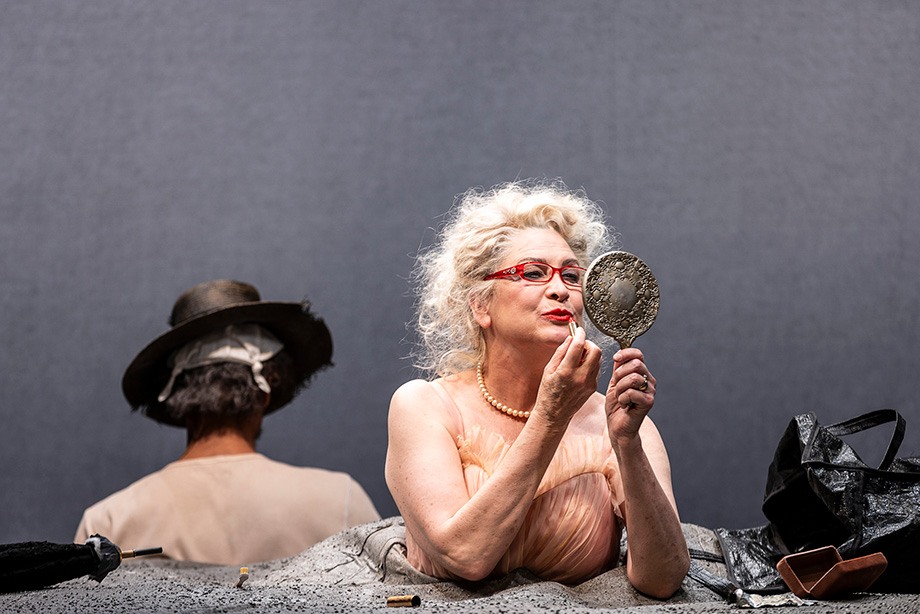
- Article Hero Image Caption: Pamela Rabe as Winnie (photograph by Brett Boardman)
- Alt Tag (Article Hero Image): ‘Happy Days: Beckettian alchemy on the stage’ by Clare Monagle
- Production Company: Sydney Theatre Company
Forty years on, or so, I am now, as Winnie declares of herself, ‘No longer young, not yet old.’ And so I decided it was time to confront those teenage apprehensions and encounter this uncanny and absurd play. And what an encounter it is! This production, directed by Pamela Rabe and Nick Schlieper, and starring Rabe as Winnie, soars fearlessly into the rich ruminations of Beckettian language, and dwells profoundly in its haunting gravitational pull. Winnie is literally trapped in the earth, sinking slowly towards burial. But every ‘happy day’ affords her the chance to apply her lippy, hum her tunes, and brush her hair. Winnie, as played by Rabe, is not delusional, and her beloved bag of possessions is not a tragic distraction. Winnie knows that her situation is fraught, but she determinedly occupies the dignity of her memories and her humour. Rabe’s Winnie is genuinely funny and deeply complex, not only linguistically, but physically. In the first act, when Winnie is buried from the waist down, Rabe contorts her torso, twists her neck, and flaps her arms with perfectly timed gusto. Rabe dances to Beckett’s language, giving Winnie’s words the rhythm and snap that they deserve. I have seen Rabe on stage many times and she has always been excellent. In Happy Days, however, she is transcendent. I wept, laughed, and sighed with Winnie. Somehow Rabe had me on the edge of my seat watching a play in which nothing happens.
Rabe is ably supported by Markus Hamilton, who plays Winnie’s quiet husband Willie. To be fair, it is hard for him to get a word in. Winnie seeks Willie out for affection, but when granted his proximity, she resorts to sarcasm: ‘Well this is an unexpected pleasure!’ Even in their wasteland, Winnie and Willie rehearse the age-old tensions of a marriage. In the most perilous of situations, they remain their ordinary selves. In some productions, no doubt, these moments are played for nihilism. Here, however, Rabe and Hamilton give us the mundanity of daily life as a site of consolation and resilience. Pyrrhic victories feel good in the moment, even if the situation is sinking overall.
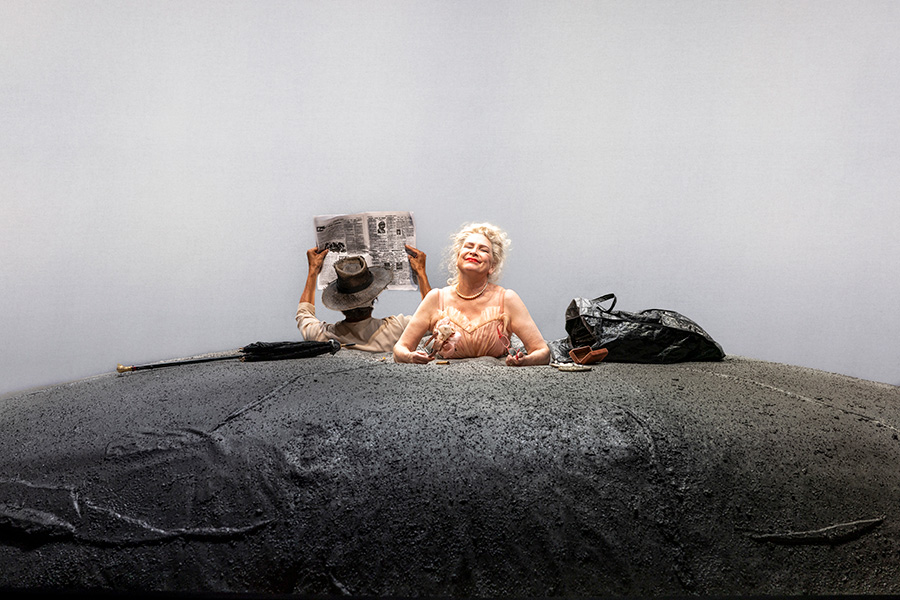 Pamela Rabe as Winnie (photograph by Brett Boardman)
Schlieper’s set and lighting design is artfully modest and faithful to Beckett’s delightful instruction that there be a ‘maximum of simplicity and symmetry.’ The set is maximalist in its stark gloominess, all the better for the contrast it enables with Winnie’s chirpiness. Schlieper’s design comes into its own in the second act when Winnie is buried up to her neck. Contrary to Beckett’s stage directions, Rabe’s head is spotlighted for the act’s duration. Winnie now appears in an expressionist mode, as if ‘Mack the Knife’ might be about to come out of her mouth. This lighting decision risks the deliberate emptiness of the play’s setting, taking the audience into a different theatrical register and loosening its intentional heaviness. The risk pays off, however, as the spotlight enables a focus on the plasticity of Winnie’s expressions; her mood shifts like the weather. Rabe bobbles around, creating a sense of her impending sink into the mud. Not drowning, waving, she might declare, but it is hard to wave without arms.
In the second act, with its focus on Rabe’s richly communicative face, I was reminded of two of the great characters of Australian comedy, the housewives Dame Edna Everage and Kath Day-Knight of Kath & Kim. Edna and Kath are both, like Winnie, determined troopers, capable of putting one foot in front of the other and wilfully ignorant of their own absurdity. Barry Humphries (Edna) did, as Jane Turner (Kath) does, excellent work with the face, deploying side-eyes, and grimaces with knowing winks. Winnie’s face, in Rabe’s performance, becomes similarly rubbery and articulate. Emotions cross her face, words emerge from her mouth, and between them is the gap in which her selfhood is made real.
I would now say to my teenage self, and to anyone wary of Beckett, that there is no need for fear so long as Rabe and Schlieper are your guide. This production is alchemical, turning Beckett’s language on the page into intentionally tarnished gold on the stage. I am the better for having seen it. On the train home, I found myself muttering, ‘today has been a happy day’, meaning it without reservation and in full irony.
Happy Days (Sydney Theatre Company) continues at the Wharf 1 Theatre until 15 June 2025. Performance attended: May 9.