


- Free Article: No
- Contents Category: Film
- Custom Article Title: Small Things Like These: Small acts of courage in Ireland
- Review Article: Yes
- Article Title: Small Things Like These
- Article Subtitle: Small acts of courage in Ireland
- Online Only: No
- Custom Highlight Text:
Ireland’s now infamous ‘mother and baby homes’ have been the subject of several films. Aisling Walsh’s Sinners (2002), Peter Mullan’s The Magdalene Sisters (2002), and Stephen Frear’s Philomena (2013), as well as numerous documentaries, have focused on the abuses suffered by the women detained in these homes and the fates of their children, many of them sold to wealthy families. According to the Irish Government’s 2021 Commission of Investigation into the homes, between 1922 and 1995, approximately 56,000 unmarried women and 57,000 children were detained, at least 9000 of the children not surviving their time in the institutions. As Claire Keegan writes in the Afterword to her 2021 novella, upon which this film is based, ‘Many girls and women lost their babies. Some lost their lives. Some or most lost the lives they would have had.’
- Article Hero Image (920px wide):
- Article Hero Image Caption: Small Things Like These (courtesy of Roadshow Films)
- Alt Tag (Article Hero Image): Small Things Like These (courtesy of Roadshow Films)
- Production Company: Roadshow Films
Where Small Things Like These differs from previous accounts of institutions such as the Magdalene laundries is its focus not on the homes themselves, but on the silence of those within whose communities the homes were embedded. Condemning from a distance the nuns and other authorities within the Irish Catholic Church who superintended the homes is easy: more difficult are the small acts of courage that defy the Church’s all-encompassing authority. In this, the film, like the novella, is not only a closely observed study of Irish society, but also, more importantly, an unflinching parable – one comparable, in the moral heart shown by its central protagonist, to Arthur Miller’s The Crucible – that dares us to examine our own consciences.
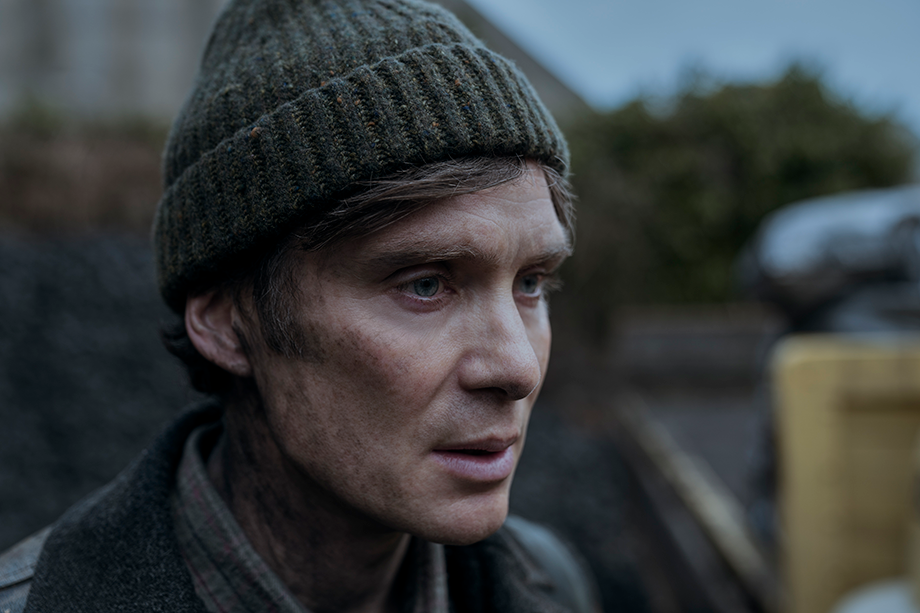
Bill Furlong (Cillian Murphy) runs a coal and fuel business in small-town Ireland. Christmas is approaching and harsh weather is forecast. Furlong busies himself from dawn to beyond dusk, overseeing orders, making deliveries and supervising the men in the yard. One of his deliveries is to the Church-run institution for unwed mothers. When a young girl is dragged screaming into the home, Furlong conceals himself in the shadows of the coal shed, not turning his eyes fully on the scene, but not wholly able to turn away from it either.
The year is 1985, and while much of the political context that seeps through the novella is muted here, there are nevertheless stark reminders of the poverty experienced by much of Ireland in the years prior to the ‘Celtic Tiger’ boom of the mid-1990s. Furlong is unable to pass a child scavenging for the sticks that might warm his family’s home without offering him coins from his own pocket. Nor can he ignore the child drinking milk from a bowl left out on the street for cats.
The incident at the Catholic institution and the advent of Christmas arouse Furlong’s memories of his own childhood, adding to the burden of a life that he seems no longer to understand. Unable to sleep, he sits and watches through his sitting-room window as the nightlife of the town passes by on the other side. He cannot articulate to himself, let alone to his wife Eileen (Eileen Walsh), what is troubling him. When he returns to the institution to make another delivery, he finds one of the young women locked in the coal shed, cowering with fear. Furlong, the father of five daughters, intuits that his life has reached a turning point.
 Small Things Like These (courtesy of Roadshow Films)
Small Things Like These manages to be a faithful adaptation of Keegan’s Booker-shortlisted novella. It renders the delicate notes of Keegan’s narrative through profound silences and intricately framed shots: Furlong sitting in the darkness, a shadow against the dull light through a window, or standing exhausted inside the doorway of his home, looking down the tight hallway to the warm kitchen where his wife and boisterous daughters are gathered.
Director Tim Mielants, working from playwright Enda Walsh’s lean screenplay, refuses to rush the story, allowing it to play out at the creeping pace necessary for Furlong to plausibly wrestle with his conscience. Murphy’s performance as Furlong is subtle yet devastating. His Furlong rarely looks people in the eye, as though he fears that to do so would draw him into the same complicity, the same silence, about the goings-on at the mother and baby home. When, cleaning away the day’s muck, he scrubs his hands to the point of bleeding, we know it is more than coal dust that he is trying to rid himself of.
The grim, cold streets of the town, with its dark river and its tiny houses, its street lights that barely cut the night-time gloom, are bleakly rendered (cinematography by Frank van den Eeden; production design by Paki Smith) and give Furling’s story a richer context than the short novel is able to convey, reminding us of Furlong’s role in the community as a source of heat and light.
Contrasting the lowering dark of the impoverished town is the brightly lit Christmas tree in the town centre, its decorations illuminated not by a civil dignitary but by representatives of the Catholic Church, signifying – as do the church bells and lurking black crows that mark the film’s opening scenes – the promise and threat of the Church’s authority.
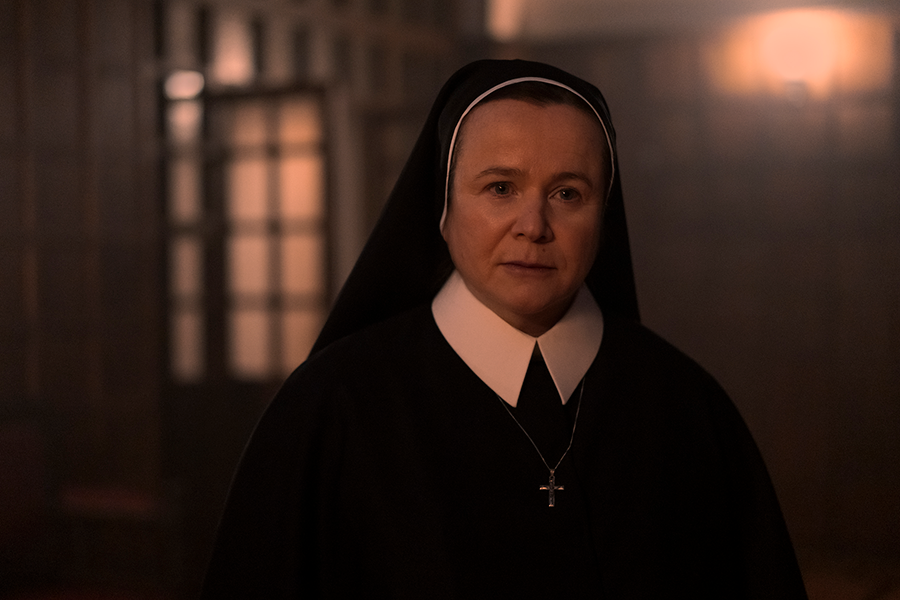
The church’s unyielding power in the community is underlined when Furlong delivers to one of the nuns the girl he found in the coal shed. He is compelled to stay for tea by the Mother Superior (Emily Watson – first seen after a tortuously slow pan across the vestibule of the institution – a precise blend of benevolent vigilance and calm subjugation). The spaciousness of her office and the righteously hot blaze in the room’s fireplace only serve to accentuate the chilling emptiness of the rest of the building and the deprived lives of the girls slaving – even on Christmas Eve – to generate the church’s wealth.
Events from Furlong’s childhood – scenes more brightly lit and vibrantly coloured than those in Furlong’s present – are delicately merged into the main narrative. Walsh has eschewed any heavy-handed exposition of how past and present connect, instead allowing the audience to feel something of the same uncertainty that Furlong himself must feel as he tries to reconcile these memories with the choices that stand before him.
Like the novella, the understatement of the film’s ending – its refusal to offer closure or comfort – is its strength, reminding us that, as Furlong returns home on Christmas Eve, his actions have left his entire family vulnerable to the predilections of a church with seemingly unlimited power. This uncertainty – the unknown cost of his resistance – is what makes Furlongs hard-wrought decision to act so quietly heroic.
Small Things Like These (Roadshow) is on commercial release from 10 April 2025.