


- Free Article: No
- Contents Category: Film
- Custom Article Title: The Count of Monte Cristo: An atmospheric take on the revenge novel
- Review Article: Yes
- Article Title: The Count of Monte Cristo
- Article Subtitle: An atmospheric take on the revenge novel
- Online Only: No
- Custom Highlight Text:
Umberto Eco said of Alexandre Dumas’s novel The Count of Monte Cristo (1846) that ‘it is one of the most exciting novels ever written and on the other hand, it is one of the most badly written novels of all time and in any literature’. It was the unnecessary length and the repetitions that appalled him most. Yet when he tried to produce a more elegant, distilled translation, he gave up: he began to wonder if the repetitions and redundancies were a necessary part of its structure.
- Article Hero Image (920px wide):
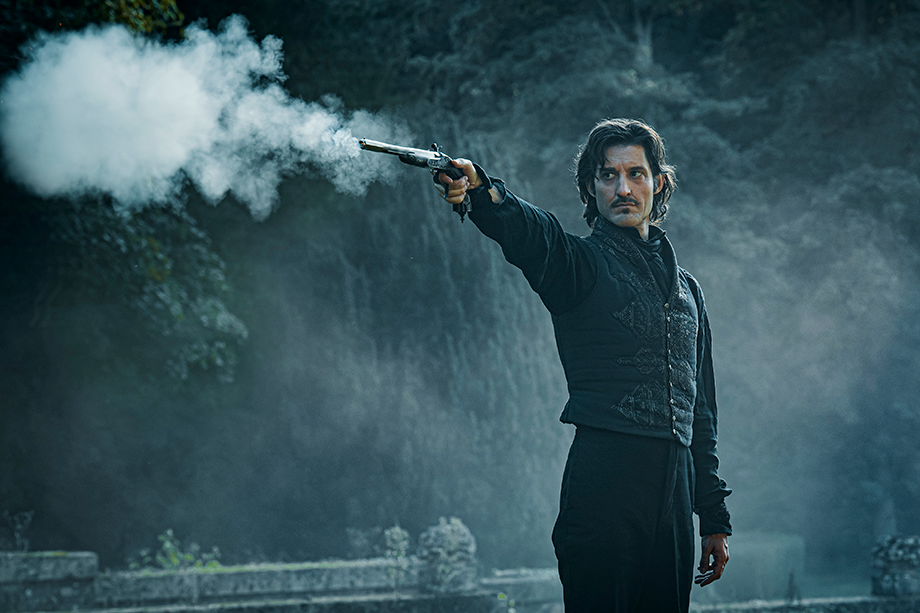
- Article Hero Image Caption: Pierre Niney as Edmond Dantès (courtesy of Palace Films)
- Production Company: Palace Films
In its latest cinematic incarnation, written and directed by Matthieu Delaporte and Alexandre de la Patellière, the French filmmakers seem to have come to a slightly different conclusion. They are not afraid of length or of playing with the passage of time. The film comes in at just under three hours, but it never lags: it is a deft balance of spectacle, suspense, elaborate intrigue, and emotional weight – a work that knows when to linger and when to condense.
In a way, the pair also manage to convey something fascinating that lies at the heart of The Count of Monte Cristo: it is a personal work. It might be an extravagant, exhilarating adventure of perfidy and long-term revenge, but it is also a tribute by the author to a father he barely knew. Dumas, born in France in 1802, was a wildly successful, ridiculously prolific writer whose historical fiction continues to be popular and influential: most notably, with The Three Musketeers and The Man in the Iron Mask as well as The Count of Monte Cristo.
Dumas was three years old when his father died, but he soon became aware of the extraordinary life he had led. Thomas-Alexandre, who called himself Alex, was born in 1762 in the French colony of Saint-Domingue (now Haiti), the son of an errant French marquis and a slave. He lost his mother at the age of twelve and had a difficult relationship with the marquis, who brought him to France then virtually disowned him. Alex enrolled in the army, rose from corporal to general in less than three years, and became one of France’s most successful generals, before Napoleon turned on him. He was thrown into prison on unknown charges, possibly poisoned with arsenic, and died a broken man.
In 1843, Dumas wrote a short novel, Georges, with a biracial title character, clearly based on his father’s life. A year later, he published the first of eighteen instalments in the serialised The Count of Monte Cristo. The connection with Alex’s legacy is less explicit, but it is evident nonetheless.
Delaporte and de la Patellière (whose father directed a 1979 television version of The Count of Monte Cristo) have been writing together since the 1990s, in television and theatre as well as cinema. They have worked in many different genres and collaborated on more than a score of screenplays. They adapted but did not direct Dumas’ The Three Musketeers, which was released in two parts in 2023. Monte Cristo is their third joint work as directors, and by far the most elaborate and expensive.
Their Monte Cristo, like their Three Musketeers, takes liberties with the original, but more successfully. They have streamlined a vast, sprawling narrative, eliminated several characters, and removed a significant poisoning subplot. Some characters have different motivations; others figure less significantly in the story. In one case, the betrayal is more fundamental. The ending is quite different in certain ways, but it also feels completely appropriate to the story.
The film begins with a sense of immediacy. An ominous score and a brisk title card set the scene. The film opens in 1815; Napoleon has been ousted, his partisans dream of his return, we are told, but ‘a new regime is rooting them out. Arrests, executions abound, in a climate rife with suspicion.’ This atmosphere is an important element of the world of the film, a place in which corruption flourishes, treachery is rewarded, and even the closest of relationships are sacrificed for advancement.
The first thing we observe, however, is an act of individual heroism: in a turbulent sea, a man swims through the waves to save a drowning woman. The rescuer, a sailor called Edmond Dantès (Pierre Niney) has disobeyed orders from the ship’s captain, Danglars (Patrick Mille), who punishes Edmond for his temerity, and will go on to do far worse.
 The Count of Monte Cristo (courtesy of Palace Films)
The story of The Count of Monte Cristo unfolds in three stages, each defined by an element of secrecy. There is the tale of the well-intentioned, naïve Edmond, whose secret is a relatively innocent one; he and his great love, Mercédès (Anaïs Demoustier), keep their relationship under wraps until he is more financially secure. Then, just when they are about to be married, everything is taken from him. For reasons he does not yet understand, Edmond is falsely accused of treason and thrown into jail. His life seems to be over.
In the second stage, Edmond is a number rather than a name, kept in solitary confinement in the Château d’If, an island fortress turned prison. This time, his secret is an escape plan initiated by a fellow prisoner, Abbé Faria (Pierfrancesco Favino). Over the years that they painstakingly dig a tunnel, the abbé also gives Edmond an education in everything from languages to history. Towards the end, he shares with him another secret: the location of an immense treasure.
In the third stage, years later, when Edmond realises exactly what he has lost during his incarceration, he decides to embark on systematic revenge. Here the film enters its final, more baroque phase. Dantès will return to Marseilles as the Count of Monte Cristo, a man with a vast fortune who embarks on an elaborately plotted campaign of vengeance against those who have betrayed him. He carries out his plan in person, but incognito. He brings with him two protégés, Haydée (Anamaria Vartolomei) and Andrea (Julien de Saint Jean), who are also not what they seem; they are part of the Count’s long game, but have their own scores to settle.
Delaporte and de la Patellière skilfully embrace the different aspects of the Monte Cristo story. Niney (Yves Saint Laurent, Frantz) is suitably convincing as both the innocent and the vengeful Edmond, and the supporting cast embrace their roles with relish and conviction. The film is fast-paced when necessary, leisurely at times. The escape from Château d’If is exciting; a crucial sword fight is fierce, full of grim fury and rage; a purported ghost story told at a dinner party becomes an extended, excruciating exploration of guilt and dawning recognition.
The payoffs are not straightforward, however. Though there is a satisfaction in seeing villainy exposed and routed, The Count of Monte Cristo also conveys, in melancholy terms, a sense of the collateral damage and self-destructive implications involved in an all-consuming project of revenge. And that, in its own way, is strangely satisfying, too.
The Count of Monte Cristo (Palace Films) is released nationally on 10 April 2025.