


- Free Article: No
- Contents Category: Music
- Custom Article Title: Freiburg Baroque Orchestra: Exhilarating Mozart from Siobhan Stagg
- Review Article: Yes
- Article Title: Freiburg Baroque Orchestra
- Article Subtitle: Exhilarating Mozart from Siobhan Stagg
- Online Only: No
- Custom Highlight Text:
The pairing of two Australian soloists – Siobhan Stagg (soprano) and Kristian Bezuidenhout (fortepiano) – in top form with one of the world’s finest period music ensembles, and in an all-Mozart program, was always likely to be a winning concert combination, and so it proved to be. This second of two Melbourne concerts by the Freiburg Baroque Orchestra during their current tour was delivered with consummate style to a delighted and near-capacity audience at the Melbourne Recital Hall.
- Article Hero Image (920px wide):
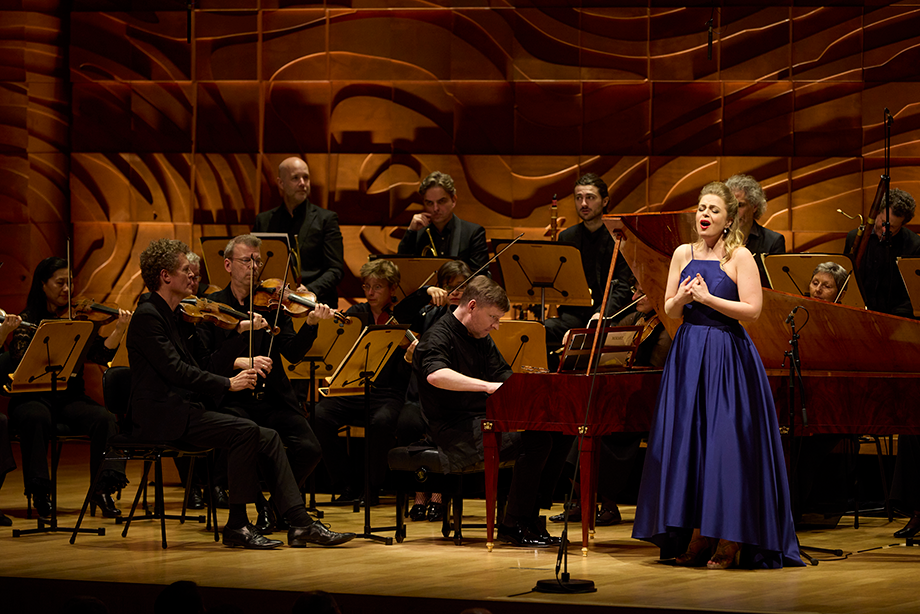
- Article Hero Image Caption: Freiburg Baroque Orchestra (photograph by Laura Manariti)
- Production Company: Melbourne Recital Centre
The curtain-raiser was a rare Australian concert outing for the overture to Mozart’s opera La finta giardiniera (‘The Pretend Garden Girl’) K196. Composed when Mozart was eighteen years old, the opera it introduced was the composer’s ninth! It is fair to say that it does not quite measure up to the standard of his later music for theatre. By the same token, it is also the kind of work that demonstrates how period music instruments and sensibilities can deliver significant musical dividends for contemporary audiences. Here the Freiburg Baroque Orchestra (FBO) gave such a stylish and spirited performance of the overture that any fear that this was merely high-class rococo background music was quickly banished. Evident too was the influence of the Empfindsamkeit Stil, that captivating style of heighted emotionality then being practised by Mozart’s more northern contemporaries, such as C.P.E. Bach.
The overture led nicely into the aesthetic world inhabited by the four concert arias that formed a significant part of the evening’s program. The first two, Chi sà, chi sà, qual sia (K582) and Vado, ma dove? (K583), were composed as substitution arias for Vicente Martín y Soler’s 1789 opera Il burbero di buon core (1789). They are much less well known than should be the case, victims of the success of Mozart’s own stage works (especially his three great operas with librettist Lorenzo Da Ponte) and the inevitably more dramatically purposeful music he wrote for them. Stagg nevertheless made a strong case for their musical significance, delivering both with technical and dramatic assurance, and aided by characterful and sensitive accompaniment from the orchestra.
The third concert aria, Ch’io mi scordi di te (K.505) is in a league of its own. Written as a farewell present to the soprano Anna Storace (with whom Mozart had a close professional and, some have alleged, romantic relationship), it is a kind of short double concerto for voice and piano. The mid-twentieth-century musicologist Alfred Einstein once speculated that in writing it Mozart may have wanted ‘both to preserve the memory of [Anna’s] voice and leave with her in the piano part a souvenir of the taste and depth of his playing, and of the depth of his feeling for her’. Whatever was the case, Einstein was right to draw our attention to just how brilliantly it combines expressions of heightened emotion with a masterful formal structure. We get, if you like, the double whammy of a work that has the intimacy of a love letter combined with the formal grandeur of a wedding procession.
The music is also significantly more demanding both technically and dramatically. Stagg demonstrated a greater variety of vocal colour and emotional dexterity. Ch’io mi scordi di te exploits the darker ‘chalumeau’ register of both the voice and the fortepiano, here sensitively performed by Bezuidenhout.
Bezuidenhout then took centre stage for a beautifully shaped and refined performance of the Piano Concerto No.23 in A K488. Another of Mozart’s later works, this was written for a series of subscription concerts in Vienna, and it stands as one of his finest. The softer timbre of the fortepiano reminded those of us who regard the soloist in a piano concerto as ‘pitted against’, or largely accompanied by, the orchestra that Mozart had instead conceived an almost ideal musical form through which he could balance the competing formal demands of the baroque instrumental concerto and the emerging classical symphony.
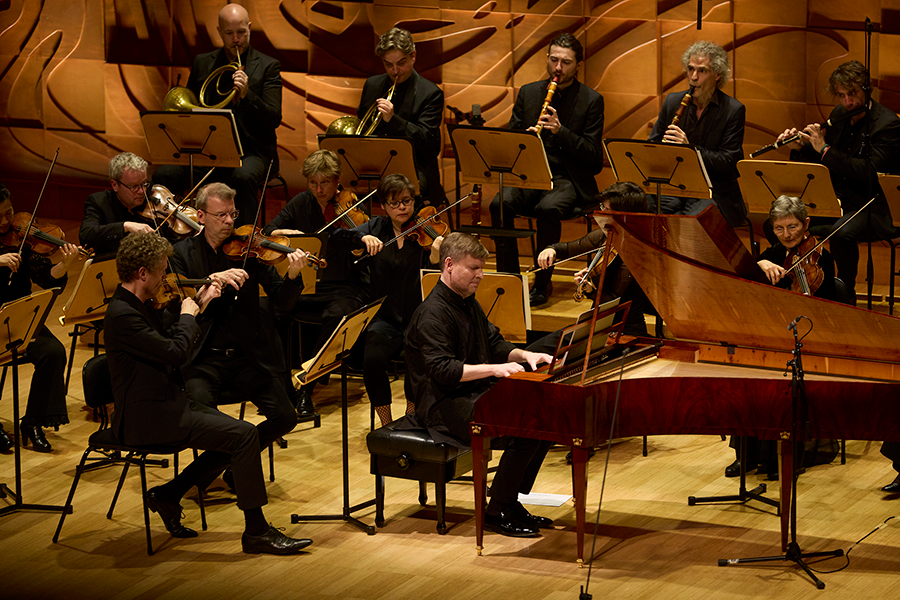 Freiburg Baroque Orchestra (photograph by Laura Manariti)
What results is music that also bears an affinity to those marvellous finales in his late comic operas, where a variety of disparate characters engage in close dialogue with one another. Here the ‘characters’ are the various themes that are first announced by the orchestra and then shared by soloist and instrumental groups alike. The famous middle movement, where the fortepiano takes a more central role, is an ‘aria without words’ in all but name, a siciliana with a tragic lilt that presages Mozart’s use of the same dance rhythm for a similar effect in ‘Ach, ich fühl’s’ from Die Zauberflöte. Bezuidenhout proved to be as strong at making the fortepiano speak to such deep effect in this movement as he did when delivering the sense of refined conversation and wit that characterises the two that surround it.
The second half of the program was dominated by a work composed around the same time as La finta giardiniera: Mozart’s Symphony No.29 in A K.201/186a (1774). From the outset (an energetic theme that almost instantly becomes the source of canonic imitation), there was little doubt that we were listening to a mature masterwork. The composer’s signature concern not just for beautiful and charming musical effects but also for formal symmetry and motivic unity (including across its four movements) is especially apparent when performed in such a deeply satisfying way. The third movement (a scherzo in all but name) was delivered with particular charm and good humour (as evidenced by the audience’s gentle laughter at its conclusion), as were the finale’s grandiloquent scalar flourishes.
To conclude, Stagg was joined by Bezuidenhout, albeit now providing light continuo support, to perform the concert aria Bella mia Fiamma K.528 (1787). Like Ch’io mi scordi di, it was also composed for a particular singer, Josepha Duschek (for whom Beethoven would later write ‘Ah! perfido’). Here the soprano soloist is required to give voice to the feelings of a male protagonist who is traversing waves of grief and anguish through music of notorious (and likely deliberate) difficulty. Nevertheless, Stagg made it all seem effortless, delivering the textural and musical artifice with compelling emotional sincerity.
As an encore, Stagg and Bezuidenhout performed Mozart’s delightful and dramatic setting of Antoine Houdar de la Motte’s ‘Dans un bois solitaire’ (In the solitary woods), one of only a few works he composed in French.
My only substantial criticism of the concert was that the program did not contain texts or translations, or any substantial program note, to help guide the audience, Nor were there surtitles on stage. Stagg did briefly introduce a couple of her arias, but it is no disrespect to her to suggest that it remains worthwhile for a concert promoter to give an audience (wherever possible) access to more substantial information about what is being sung (or played), and why. As this concert made abundantly clear, much of Mozart’s music may seem like winsome ‘easy listening’, but it also contains riches and depth that can be hard to appreciate at first if only because of the inevitable gulf that exists between the language, time, and/or era of its composition, and our own. Concert promoters and performers alike should take every opportunity to help audiences to reach across that gulf and to think and feel more deeply about the music.
The Freiburg Barque Orchestra will also be performing at The Neilson, ACO On The Pier on 28 March 2025. Performance attended: March 26.