


- Free Article: No
- Contents Category: Theatre
- Custom Article Title: Innocence
- Review Article: Yes
- Article Title: Innocence
- Article Subtitle: Kaija Saariaho opera in Adelaide
- Online Only: No
- Custom Highlight Text:
Ever since its beginnings in the late sixteenth century, opera has been preoccupied with death. Illness, murder, and suicide stalk countless libretti, from Mozart’s Don Giovanni and Puccini’s Tosca to Berg’s Wozzeck and Mazzoli’s Breaking the Waves. To the litany of horrific fates which have historically befallen the medium’s protagonists – stabbings, immolations, death by snake bite, poison and toxic mushroom, to say nothing of various wasting diseases and literal descents into hell – can now be added that most contemporary and shocking of demises: death by mass shooter.
- Article Hero Image (920px wide):
- Article Hero Image Caption: Innocence (photograph by Andrew Beveridge)
- Alt Tag (Article Hero Image): Innocence (photograph by Andrew Beveridge)
- Related Article Image (300px * 400px):
- Production Company: Adelaide Festival
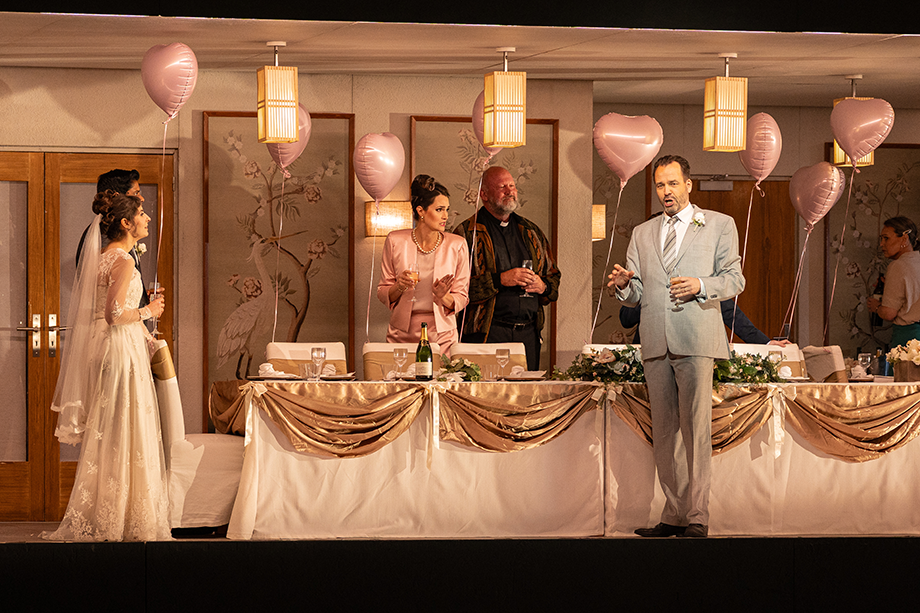
The connections between these events are gradually revealed, but it is not giving too much away to disclose that the groom, Tuomas, is the killer’s brother, and that Tereza, the restaurant’s Czech waitress, lost her daughter in the shooting. At the outset, none of this is known to Stela, the bride, whom Tuomas met while holidaying in Romania.
Given the medium’s relationship to melodrama, to the titanic struggles which define the course of human life (and death), such weighty subject matter seems ripe for opera. At the same time, Innocence transcends simple binaries – good and evil, love and hate – by casting the net of complicity wider than its ostensible villains. Its title is ironic, drawing our attention to the fraught idea of blamelessness when it comes to ‘inexplicable’ tragedy.
A priest recalls silently witnessing a young boy – who would later grow up to murder ten children and a schoolteacher – poison a bird and take pleasure in its suffering. The killer’s father tells us he taught his son ‘to shoot like a man’. Violent movies and video games are implicated as potential contributors to the tragedy. Even Tereza’s daughter, Markéta, described by her mother as an ‘angel’, is revealed in a flashback to have bullied the shooter by inventing mocking songs about him and calling him ‘frog boy’.
 Innocence (photograph by Andrew Beveridge)
Oksanen also paints a more conventional picture of the way collective trauma strips innocence – or, at least, delusions of such – from survivors and their loved ones. A schoolteacher paranoically reads her student’s papers for indications of mental illness like handwriting changes and ‘weird syntax’. The groom confesses to celebrating news of mass shootings as evidence that ‘monsters are bred in other families too’. Paradoxically, survivors speak of finding comfort in the dark, secretive places where such monsters are presumed to lurk.
Saariaho’s score, thoroughly modernist in its dissonance and novel textures, is as unsettling as you would expect. From its portentous, Ligeti-esque piano opening, the opera sustains an unbroken mood of dread across five acts and twenty-five scenes, with no intermission. Glissandos routinely shriek and pierce, strings swell to frightful crescendos, and woodblocks clack metronomically like old bones. Just as Tereza describes her life as having come to a standstill since the shooting, so too does the score have a quality of prolonged suspension, never quite resolving into full-blown melody or arioso.
Reflecting the international school’s multicultural setting, as well as Finland’s broader ethnic diversity, multiple languages, including English, French, Spanish, Swedish, German, and Greek, jostle, as do various vocal styles from conventional operatic singing to several speak-singing techniques. Most remarkable of all is the choice to locate the teenage Markéta’s style within the Finno-Ugric folk tradition of northern Finland, lending the role a limpid and deeply haunting quality.
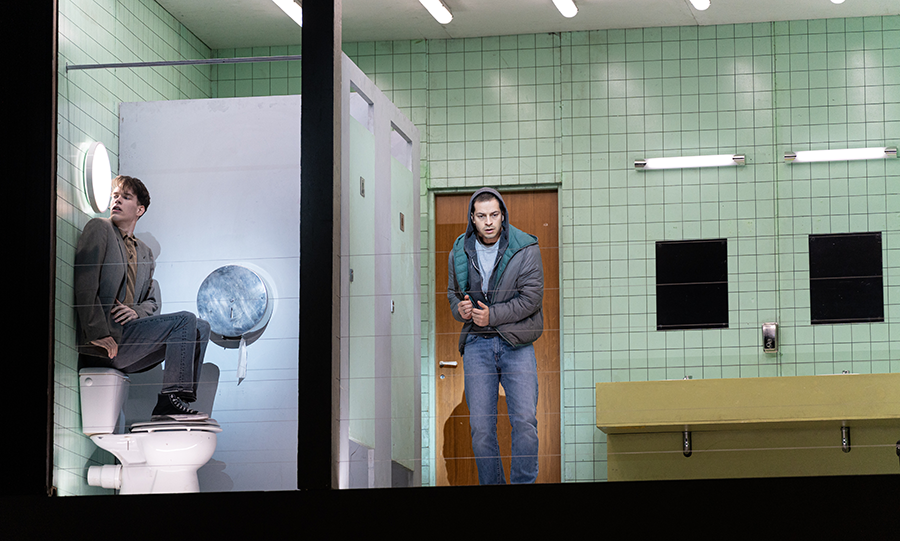
All these elements are methodically, though somewhat dispassionately, assembled by Australian expat Simon Stone, whose cinematic direction combines granular realism with more stylised, almost gestural flourishes by choreographer Arco Renz. Chloe Lamford’s revolving, multilevel set is a wonder of stagecraft, its multiple, intricately realised spaces –classrooms, kitchens, closets, and the like – swapped out for one another with astonishing efficiency. As the opera progresses and the rooms begin to empty out, their walls streaked with blood, James Farncombe’s lighting becomes increasingly sepulchral, the set beginning to reflect the psychological diminution of the survivors.
The thirteen-strong cast are without exception equal to the material. Finnish-Swedish mezzo-soprano Jenny Carlstedt is terrific as Tereza, the moral core of the opera. Brittle, resolute, and expressive, Carlstedt conveys the anguished mother’s inner turmoil with remarkable depth and a careful balancing of vulnerability and strength.
As the Bride and Groom, Faustine de Monès and Sean Panikkar exactingly chart their characters’ journeys from pained denial to devastated acceptance, while Teddy Tahu Rhodes and Lucy Shelton, as the Priest and the Teacher respectively, sing beautifully without shying away from their characters’ ethically compromised natures. As the Groom’s parents, Claire de Sévigné and Tuomas Pursio are effectively conscience-stricken.
The six students – played by Erika Hammarberg, Christina af Klinteberg Herresthal, Julie Hega, Rowan Kievits, Camilo Delgado Díaz, and Marina Dumont – are uniformly excellent, studies in various degrees of adolescent angst and Weltschmerz. Best of the lot is Hammarberg, whose Markéta seems at once to define and defy, by way of the actor’s transcendent singing voice and exquisitely spectral poise, everything going on around her. Rarely have I seen a character defined by their absence be imbued with quite so much presence. Hammarberg is extraordinary to watch.
Throughout, under the dynamic baton of young French conductor Clément Mao-Takacs, the Adelaide Symphony Orchestra, Adelaide Chamber Singers, and State Opera Chorus deliver performances of remarkable precision and intensity, sustaining the opera’s relentless tension for well over two hours.
Innocence is not a flawless opera, and this production is similarly imperfect. Oksanen’s levity- and irony-free libretto, combined with Saariaho’s unrelenting score, begins to risk feeling lumbering and unvaried. I was also faintly troubled by the casting of people of colour as both the killer’s brother and his accomplice, choices with uncomfortable resonances given the current surge of racist and anti-immigrant rhetoric in Europe.
Still, Innocence must rank among the most significant of the operas the twenty-first century has produced so far. In the end, it ominously circles back to the same note on which it began – a devastation almost as great as Tereza’s final, heartbreaking emancipation from the chains of the past.
Innocence continues at the Adelaide Festival until 5 March 2025. Performance attended: February 28.