


- Free Article: No
- Contents Category: Film
- Custom Article Title: Inside
- Review Article: Yes
- Article Title: Inside
- Article Subtitle: The battle for a boy’s soul
- Online Only: No
- Custom Highlight Text: Guy Pearce always seemed like the odd man out among the Australian actors who became Hollywood leading men at the turn of the century – slighter, less conventionally rugged than Hugh Jackman, Russell Crowe, or Eric Bana. Even Heath Ledger was initially typecast as the kind of swashbuckling rogue with the dimpled smile that Australians have been playing since Errol Flynn cast the mould. But there was never anything twinkle-eyed about Pearce. Hot off Memento, Disney offered him the title role in The Count of Monte Cristo. He turned it down – and asked to play the villain instead.
- Article Hero Image (920px wide):
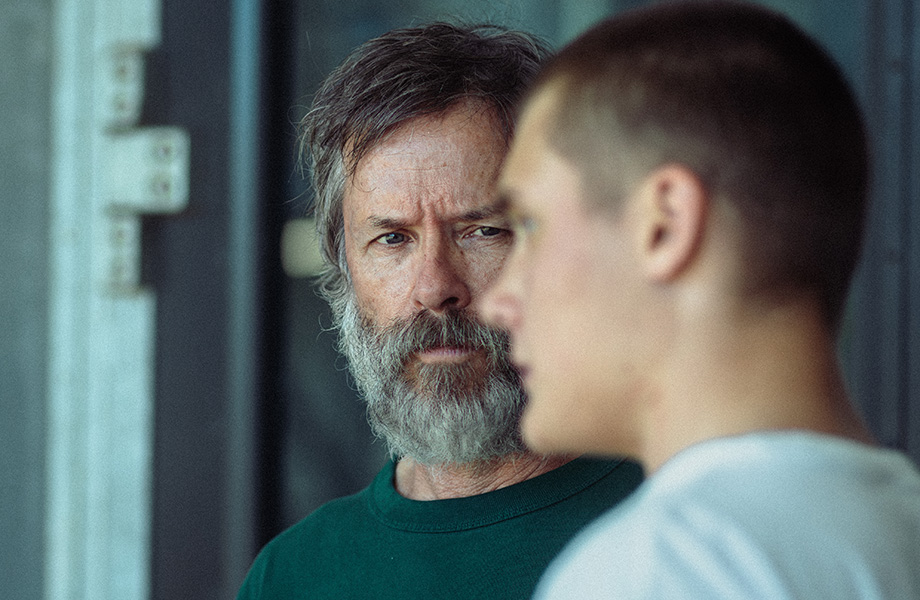
- Article Hero Image Caption: Guy Pearce as Warren and Vincent Miller as Mel
- Alt Tag (Article Hero Image): Guy Pearce as Warren and Vincent Miller as Mel
- Production Company: Bonsai Films
Pearce is Warren, a prisoner nearing parole after decades in which he has had no contact with his now-adult son. To grease his release, he agrees to keep an eye on a recent arrival from juvenile detention. But Warren is a dangerous custodian. Desperate to get his creditors off his back, he encourages the boy to carry out the murder of another prisoner, a notorious child killer with a price on his head. The wily old jailbird even demonstrates how to do the deed.
The character’s calculated self-interest recalls Ed Exley, but the lieutenant’s ramrod posture is a distant memory: Pearce slouches his way through Inside like a petulant teenager, and those cheekbones are concealed by a bushy beard. This is the kind of rough-hewn role that would be easy to oversell, but, though Pearce broadens his accent slightly, it never quite feels like he is doing working-class karaoke. Warren is a wonderfully supple creation, equally capable of violence and of warmth. He is loquacious and frequently funny, busting shibboleths about laid-back Australians and passing on homespun wisdom inherited from his old man.
It is notable that Warren has internalised his father’s aphorisms, even though he was a drunk (‘Pissheads have a lot of sayings. They think it makes them look smart’). The characters in Inside are all struggling to outrun the imprint of their childhoods. The teenage Mel (Vincent Miller) is tormented by flashbacks to a boyhood incident that we initially glimpse only in fragments, while Mark (Cosmo Jarvis) endured horrific sexual abuse as a boy. Both are serving time in adult prison for crimes they committed as minors, wrestling with feelings of guilt and shame. But Mark has been born again, presiding over prayer sessions in the prison chapel, where he tells the other inmates that they’re not responsible for their sins; that they can still be forgiven. Enlisted as a keyboardist during these services, young Mel finds himself wanting to believe it.
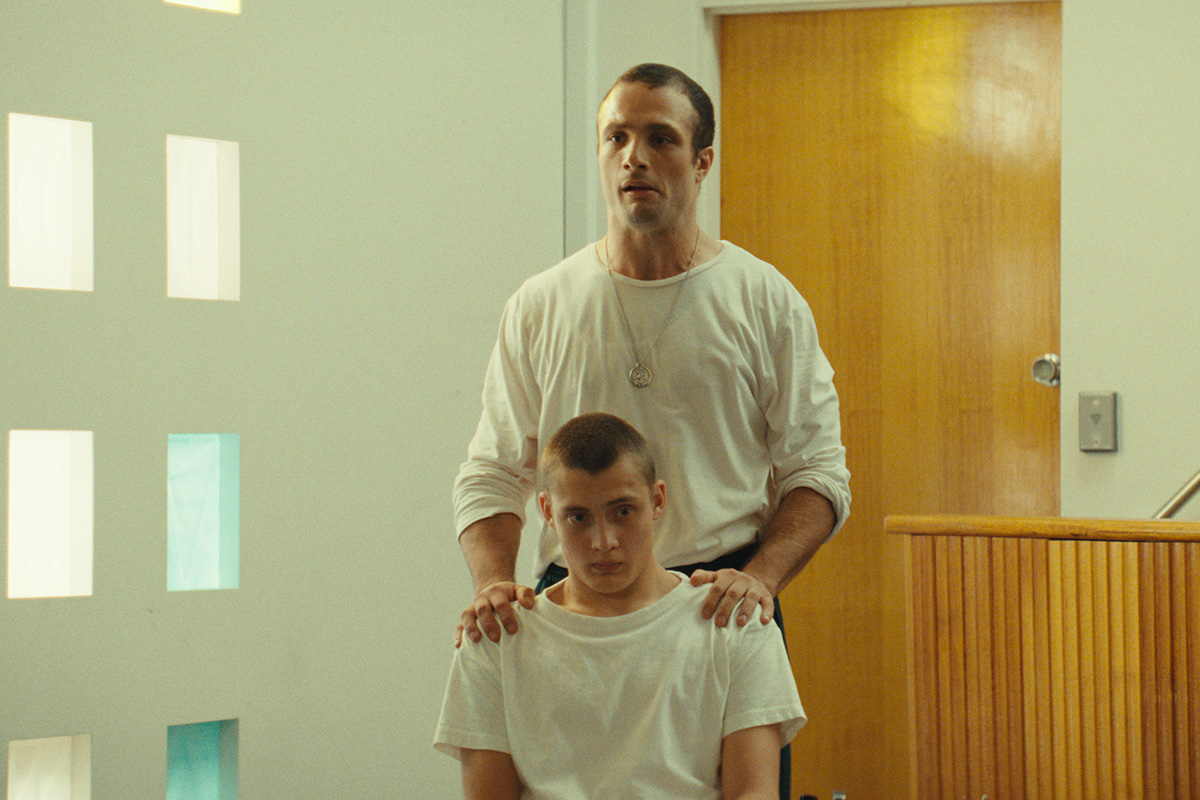 Cosmo Jarvis as Mark (standing) and Vincent Miller as Mel
The doe-eyed Miller was only fifteen when the shoot began, and he makes a watchful, reactive character far sweeter and more sympathetic than the equivalent naïf in, say, Animal Kingdom. English actor Jarvis (Calm with Horses) plays Mark as shy, shuffling, awkwardly formal, but with a powerful physical presence. He is sincere and solicitous, and his care for the younger man is no pretence. He is also deeply damaged – and not just psychologically. The edge of Mark’s mouth slopes downwards, as though he has suffered a stroke, and his fervent desire to remake himself has even led him to self-mutilate.
The uneasy dance between these three characters amounts to no less than a battle for a boy’s soul. As the deadline to carry out the hit draws nearer and Warren’s desperation ratchets up, writer-director Charles Williams unravels his story in a manner that feels messy rather than schematic. Part of what makes his début feature feel like a mature work is that the filmmaker leaves room for the audience to join the dots. Mel’s willingness to shiv Mark is unexplained, and narrative clarity about why characters are doing certain things is frequently deferred. The Hollywood narrative model of goal-oriented characters with clear motivations can be psychologically flattening, and the characters in Inside are multifarious and conflicted, mysteries even to themselves.
Williams made a very stylish short (All These Creatures, 2018) that put him on the map in 2018. Inside shares certain motifs with that film, but it largely dials back on the poetic slow motion. Shooting mostly hand-held and in close quarters, the director’s framing is unselfconscious, and there are few highly composed establishing shots (when we do cut to outside the state-of-the-art prison facility, it recalls both Ghosts … of the Civil Dead (1988) and places like Pine Gap, lights glittering at night on the empty plain). Cinematographer Andrew Commis started his career making documentaries, and his camera sometimes adopts a respectful distance, shooting through plexiglass or favouring mid-shots over close-ups. This is true even in the film’s final scene, which is nevertheless overwhelmingly emotional, aided enormously by the swelling of composer Chiara Costanza’s silvery theme.
The film was shot at a newly constructed prison in regional Victoria. The place is bright and airy, with an octagonal building ringing a large central courtyard. Natural light bisects antiseptic cells, haloing characters like Mark who are seeking redemption, or maybe just a little grace. Mel’s eventual confrontation with Mark is interrupted (perhaps conveniently) by a news broadcast on the wall-mounted television, but the final reckoning is both clear-eyed – not everyone can be saved – and hopeful. Faith is sustaining, even if it boils down to the belief that somebody else cares. Williams has the confidence to end on a laugh line, but it is one that breathes a whole future of fellow feeling transcending prison walls.
Harry Windsor is a critic for The Hollywood Reporter and the former editor of Inside Film Magazine.