


- Free Article: No
- Contents Category: Opera
- Custom Article Title: Die Meistersinger von Nürnberg
- Review Article: Yes
- Article Title: Die Meistersinger von Nürnberg
- Article Subtitle: Melbourne Opera’s magnificent production of Wagner’s comedy
- Online Only: No
- Custom Highlight Text: There is something inherently self-defeating in the famous quote about Richard Wagner’s Die Meistersinger von Nürnberg being ‘the longest single smile in the German language’. Certainly, in some productions I have seen over the years, that smile has curdled into a rictus of silent suffering that comes when something is taken too seriously, thereby depleting the opera’s natural musical and dramatic energy.
- Article Hero Image (920px wide):
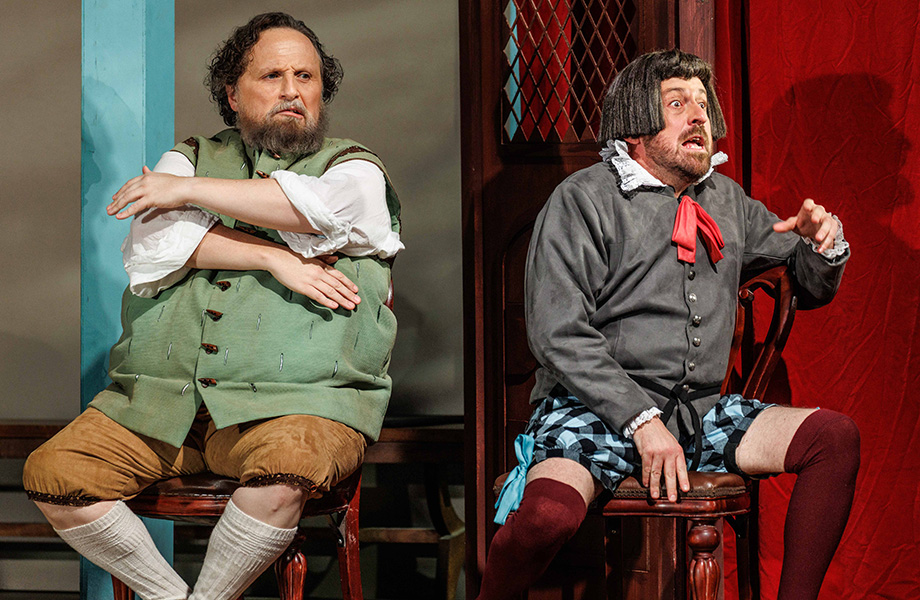
- Article Hero Image Caption: Warwick Fyfe as Hans Sachs and Christopher Hillier as Sixtus Beckmesser (courtesy of Melbourne Opera)
- Alt Tag (Article Hero Image): Warwick Fyfe as Hans Sachs and Christopher Hillier as Sixtus Beckmesser (courtesy of Melbourne Opera)
- Production Company: Melbourne Opera
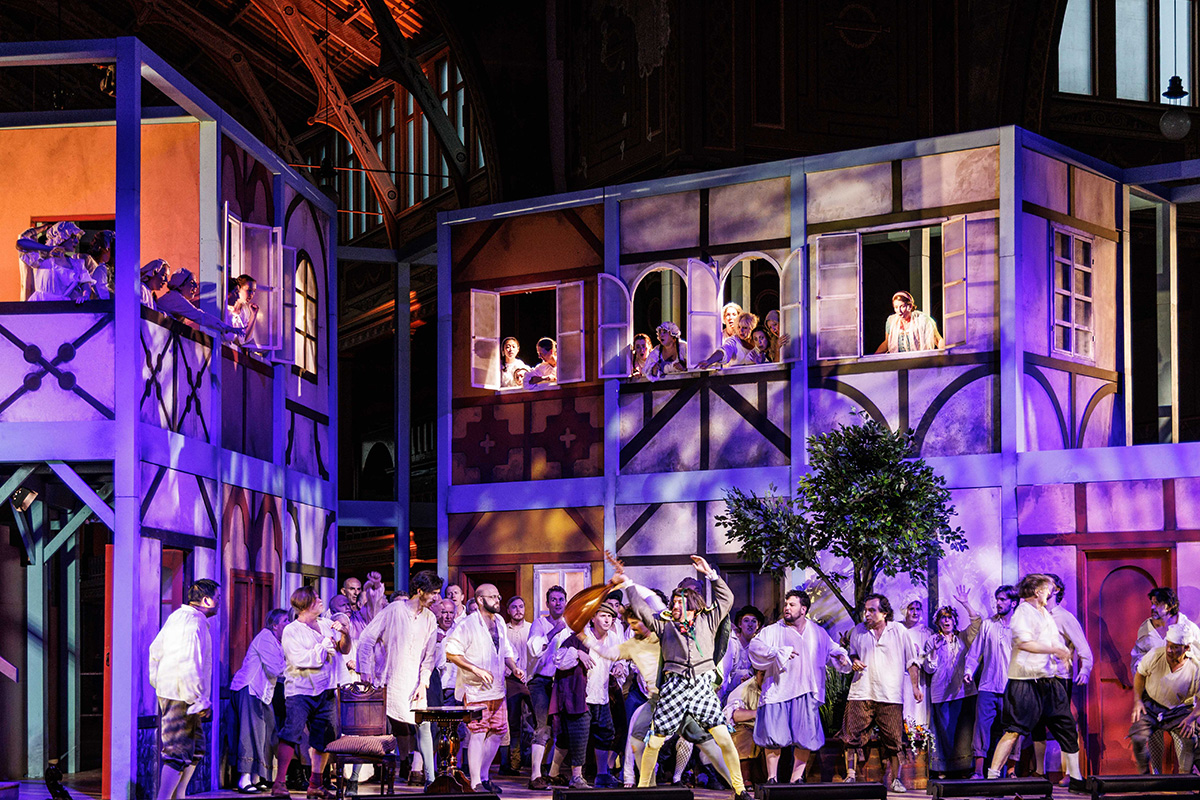 Die Meistersinger von Nürnberg at the Royal Exhibition Building (courtesy of Melbourne Opera)
The production’s other great ingredient, one which emerged into the world little more than a decade after Meistersinger was composed (but two years before Parsifal), was of course the Royal Exhibition Building. The Beckmessers among us, perhaps sceptical that this colossal venue could do Wagner visual or acoustical justice, have been confounded. There, underneath the arches of the towering dome, the wide stage and Andrew Bailey’s simple, suggestive, skeletal set became part of the building itself – an inspired idea that incorporated not only the loftiness of the central area, but the perspectives of the long vaulted roof, its vanishing point somewhere to the east, the balconies either side, and, the master stroke, the careful matching of costumes and sets with the building’s internal colours. The lighting, too, by Philip Lethlean, with assistance from God, was illuminating and transformational: from mid-afternoon, through twilight, and into the night, the combination of natural and man-made light subtly underlined the action of the opera. And who cares if the final Festwiese scene is nocturnal? It was dazzling, shining a beacon into that concluding blaze of C major optimism.
Any fears that the sound might be sucked up into the dome were quickly dispelled. There might have been some occasional blurs and smudges of orchestral sound, but, for the most part, the sound was clear, distinctive, and well balanced. For example, the riot at the end of Act II, so often shambolic, was positively antiphonal in its splendid raucousness.
Again, as they superbly proved in Melbourne Opera’s Ring in 2023, conductor Anthony Negus and director Suzanne Chaundy were the lynchpins of this Meistersinger. Negus, no ditherer here, conducted a vivid and persuasive account of the score, as swift flowing as the River Pegnitz, but also with swirling depths and unexpected eddies when required. The result was beauteous playing from the Melbourne Opera Orchestra (offstage instruments included), with some gloriously refulgent lower strings and excellent horns. Clearly, the benefits of a long rehearsal period ensured that this was no first-night-nervous performance, but something that sprang fully formed from the first chords of the prelude. A special word, too, for Negus’s conducting of the Act III prelude, which was numinous.
Chaundy’s production, to quote her program note, ‘is suggestive of the period but not a slave to it’. As it proved, to fine effect. Identities, particularly those of the Meistersingers and their respective trades, were quietly emphasised by their costumes (quirkily respectful, designed by Karine Larché). Chaundy also made good use of the multiple offstage areas. There always seemed to be something interesting going on – for example, deploying the side balconies for the St Katharine’s congregation in Act I, which also served as a useful patrol point for the Nightwatchman in Act II. Or, in the final scene of the opera, the procession that extends along the eastern corridor up on to the stage.
A key word mentioned by Chaundy is ‘camaraderie’: of cast, production teams, etc. In this respect, Melbourne Opera, now having staged almost all of Wagner’s mature operas (Parsifal to come, one hopes soon), has formed the country’s main Wagner repertory company. On Sunday, camaraderie applied in spades, and you could sense it at almost every turn.
The cast, which could not be faulted, was dominated by Warwick Fyfe’s Hans Sachs (his role début) and Christopher Hillier’s Beckmesser: cobbler and town clerk at their most crafty and vexatious, but also vocally strong and persuasive, as befits two of the more venerable master singers. Fyfe, who never tired, was the ideal Sachs, his creative poetic soul always sensed from a more rough-shod exterior. Were he an actual pair of shoes, they would be sturdy walkers rather than patent leather. Fyfe lent strength and dignity to his role, most of all in his Flieder and Wahn monologues, but also brought a touch of welcome vulnerability in his two lyrical encounters with Eva.
Hillier’s Beckmesser, in a Prince Valiant wig, sharply etched beard, and chequered bike shorts, looked the part even before he opened his mouth. When he did, he never forgot that his character, despite his inflated pride and pedantic peccadillos, is at heart still a sensitive, creative man.
Lee Abrahmsen, as Eva, adds another substantial Wagner role to her already admirable repertoire. Her voice coped easily and effortlessly with the vocal range, and she brought in as much sunlight as streamed through the east window. Deborah Humble brought wit and distinction to Magdalena, an often underplayed part, and I particularly admired her gritted-teeth expression, ‘Beckmesser’, in Act II.
Walther von Stolzing was sensitively sung by James Egglestone, who maintained the Franconian knight’s nobility and impetuousness in equal measure, and delivered his Prize Song with ardency and attention to the words. Likewise, Robert Macfarlane’s apprentice, David, delivered his Mastersinger lesson in Act I with precision, but also with enough sense of warning to Walther as to what lies ahead. It must be said that Macfarlane, Fyfe, Egglestone, Abrahmsen, and Humble were all magnificent in the Act III quintet.
Steven Gallop’s goldsmith Pogner was suitably stentorious, but never blustery; and Michael Lampard maintained excellent order as the baker Kothner. Praise, too, to the remaining Meistersingers: Henry Choo, Bradley Daley (imagine: an erstwhile Siegfried as the pewterer Zorn), Asher Reichman, Christopher Busietta, Darcy Carroll, Michael Honeyman, Peter Tregear, and Alex Pokryshevsky. Also, salutes to the forty-eight-strong MO Chorus, the eleven Apprentices, and that peripatetic Nightwatchman, Henry Shaw.
On Sunday, the Royal Exhibition Building was transformed into the Bayreuther Festspielhaus of the Great Southern Land. This Meistersinger, an opera about a song festival on Midsummer’s Day, was in itself an event well worthy of a festival. I would say it deserves to travel, but you would have to transplant the Exhibition Building as well. So, see it while you can. It’s something special, something wonderful.
Die Meistersinger von Nürnberg (Melbourne Opera) continues at the Royal Exhibition Building until 22 February 2025. Performance attended: February 16.