


- Free Article: No
- Contents Category: Music
- Custom Article Title: Follies
- Review Article: Yes
- Article Title: Follies
- Article Subtitle: Sondheim’s masterwork of musical theatre
- Online Only: No
- Custom Highlight Text: A year after their production of Bernstein’s Candide, Victorian Opera has made another winning foray into the masterworks of American musical theatre with this finely wrought and brilliantly executed new staging of Follies at the Palais Theatre in St Kilda.
- Article Hero Image (920px wide):
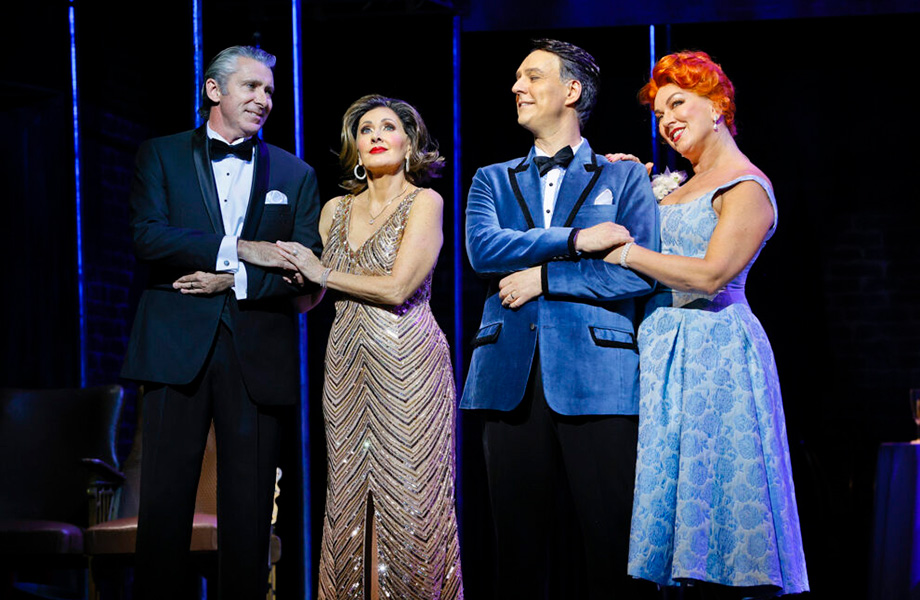
- Article Hero Image Caption: (L-R) Adam Murphy, Marina Prior, Alexander Lewis, Antoinette Halloran (photograph by Jeff Busby).
- Alt Tag (Article Hero Image): (L-R) Adam Murphy, Marina Prior, Alexander Lewis, Antoinette Halloran (photograph by Jeff Busby).
- Production Company: Victorian Opera
This contrast of both era and mood is played out on stage principally through two couples, Sally and Buddy Plummer (Antoinette Halloran and Alexander Lewis). and Phyllis and Ben Stone (Marina Prior and Adam Murphy). Sally and Phyllis are both alumnae of the ‘Weismann Follies’, and Buddy and Ben are their respective former lovers, now husbands. All have been invited by the impresario Dmitri Weismann (Grant Piro) to a party on the stage of their old theatre because it is soon to be demolished to make way for a parking lot (a sly nod to Jodi Mitchel’s 1970 hit song ‘Big Yellow Taxi’ perhaps?)
The party will be, as Weismann declares from the stage, an occasion where all can ‘glamorise the old days, stumble through a song or two, and lie about ourselves’. It sets off a series of dramatic collages in which the couples encounter not just each other but also the gatecrashing ghosts of their younger selves (here Taao Buchanan as Young Phyllis, Mia Simonette as Young Sally, Jack Van Staveren as Young Bob, and Jacob Steen as Young Buddy). They thus come to be painfully reminded of all the hopeful enthusiasms and dreams they had forgone in the intervening three decades.
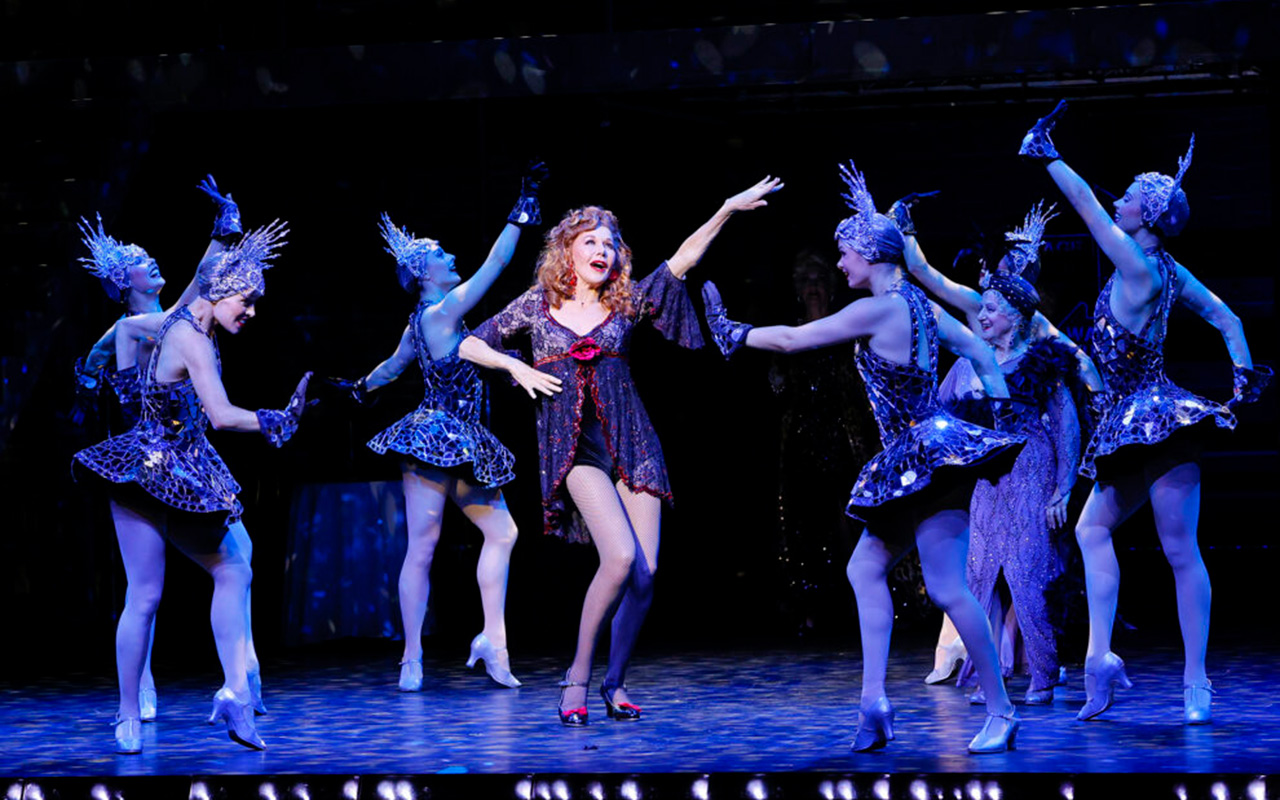 Rhonda Burchmore and Ensemble in Follies (photograph by Jeff Busby).
Also at the party are several of their colleagues from earlier generations of Weismann girls: Carlotta Campion (Anne Wood), Stella Deems (Rhonda Burchmore), Emily Whitman (Colette Mann), Hattie Walker (Geraldene Morrow), and Solange La Fitte (Evelyn Krape). They provide the dramatic excuse for a series of show-stopping cameos – here perhaps Follies is at its most ‘meta’ as art and life conspicuously, and rather deliciously, merge. In the roles of Roscoe and Max Deems, and Theodore Whitman respectively, Stephen Smith and Tom Blair also excel during similarly brief centre-stage appearances.
Through this virtuosic blending of layers of the past and present, Follies reveals itself to be one of the first ‘concept musicals’. Goldman and Sondheim were likely drawing on broader influences of the time such as the French ‘New Wave’ film movement which had already started to deconstruct and reconfigure forms of American popular entertainment. The stage and cinematic musical are also interrogated, for instance, in Jacques Demy’s superb The Umbrellas of Cherbourg (1964). And it too is concerned with the melancholic realisation of life paths not taken, and of loves lost.
Like Demy’s film, Follies remains a powerful and thought-provoking drama today, especially when, as is the case here under Stuart Maunder, the direction is consistently sharp and efficient. The strong characterisations across this genuine ensemble cast are also brilliantly supported by Gavan Swift’s clever lighting design, Roger Kirk’s spectacular set and lavish costuming, and Yvette Lee’s efficient and attractive choreography. The pairings of older and younger couples, which include not just the four main characters, but also that of another singer by the name of Heidi Schiller (performed with obvious relish by Merlyn Quaife and Nina Korbe respectively) are especially effective (and thus also especially affective). All give masterful ‘duo’ performances. The physical resemblance between the old and young Benjamin Stone bordered on the uncanny. Here was a triumph of casting, directing, and acting, in equal measure.
While not without some minor technical issues and an occasional slight overuse of reverb (this is, however, a technically very complex show), Samuel Moxham’s sound design generally worked well to support Phoebe Brigg’s clear direction of a superb ensemble of members and guest musicians from Orchestra Victoria. Right from the arresting timpani roll that opens the show, their delivery of Sondheim’s clever and refined score was stylish and first rate.
As he later freely acknowledged, Sondheim in his score set out to imitate the style of some of the great American music theatre composers of the past, such as Irving Berlin (Sondheim’s ‘Beautiful Girls’), DeSylva, Brown and Henderson (‘Broadway Baby’), Jerome Kern (‘Loveland’), Rudolf Friml and Sigmund Romberg (‘One More Kiss’), George Gershwin and Dorothy Fields (‘Losing My Mind’), Cole Porter (‘The Story of Jessie and Lucy’), and Lorenz Hart or Frank Loesser (‘The God-Why-Don’t-You-Love-Me Blues’). This all adds considerably to the work’s capacity to convey a sense of nostalgic pathos. After all, it is not just the characters (and the theatre in which they once performed), that are, by 1971, forced to face the ravages of time: the genre of the grand American musical itself was starting to stare into the abyss of its own obsolescence. This was also the year that saw the première of Tim Rice and Andrew Lloyd Webber’s rock musical Jesus Christ Superstar, and the dance clubs of New York were already starting to reverberate to altogether different dance rhythms.
While I was watching the show, I could not help but think of those marvellous lines in Barry Manilow, Jack Feldman, and Bruce Sussman’s hit song ‘Copacabana’, which has something of the same ambience as Follies: ‘… they used to have a show / Now it’s a disco’ and where the showgirl is ‘still in dress she used to wear / Faded feathers in her hair’. The lyrics of that song also draw our attention more explicitly than Follies to some of the darker aspects of show-girl culture (as does Billy Wilder’s film Sunset Boulevard [1950], which could stand as a bleaker West-coast companion to Follies). To be sure, we are left in no doubt that the mental anguish that lies behind Sally’s great ballad ‘Losing My Mind’ is largely the result of the bad behaviour of the powerful men around her. But Follies also ultimately avoids proffering the kinds of broader social or political critique of American culture that either Goldman seems first to have envisioned, or that can be found in several of Sondheim’s later musicals, such as Sweeney Todd (1979) and Assassins (1990).
Then again, maybe it is enough simply to be reminded that when any of us choose to love, a good measure of hurt and self-deceit, and the certainty of loss, will follow. Either way, Victorian Opera has produced a consistently engaging and thoughtful production of a significant piece of modern theatre.
Follies (Victorian Opera) continues at the Palais Theatre in St Kilda until 6 February 2025. Performance attended: February 1.