


- Free Article: No
- Contents Category: Music
- Custom Article Title: Beethoven Festival
- Review Article: Yes
- Article Title: Beethoven Festival
- Article Subtitle: The first six symphonies
- Online Only: No
- Custom Highlight Text: A dominant seventh of F resolving onto an F major chord (a perfect cadence); a dominant seventh of C resolving onto an A minor chord (an interrupted cadence); a dominant seventh of G resolving onto a G major chord (another perfect cadence): thus begins Beethoven’s Symphony No. 1 in C major.
- Article Hero Image (920px wide):
.jpg)
- Article Hero Image Caption: Jaime Martín conducts the Melbourne Symphony Orchestra (photograph by Laura Manariti)
- Alt Tag (Article Hero Image): Jaime Martín conducts the Melbourne Symphony Orchestra (photograph by Laura Manariti)
- Production Company: Melbourne Symphony Orchestra
Beethoven was twenty-nine years old, so he had taken his time to enter the symphonic world. (For comparison, Mozart had written his first symphony at the age of nine and had completed thirty-seven of them before reaching the age of twenty-nine.) Happily, although his symphonic output would remain numerically meagre in comparison with that of Haydn or Mozart, Beethoven had discovered a medium in which he would make a monumental contribution.
The nine symphonies have long been a mainstay of the repertoire of most symphony orchestras, and typically a couple of them are programmed annually. To be served all nine within a period of ten days is indeed a feast for the ears, the mind, and the soul. The concerts have strayed a little from chronology, presumably in order to pair less popular works with rather more popular ones. The First, Second, and Fourth have been paired with the Third, Fifth, and Sixth respectively. The exact make-up of the orchestra has varied a little from work to work, and the First and Second Symphonies were performed with slightly reduced numbers in the string section, which was historically appropriate.
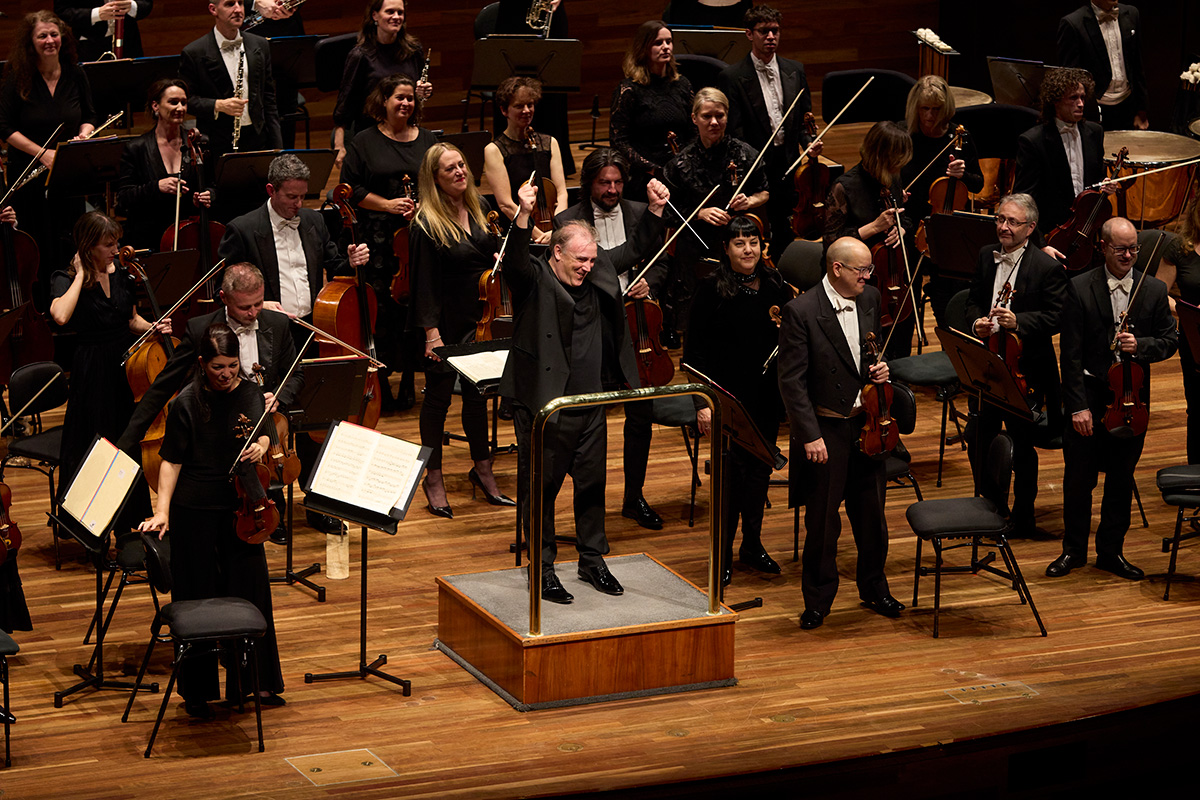 Jaime Martín and the Melbourne Symphony Orchestra (photograph by Laura Manariti)
Jaime Martín, the orchestra’s Chief Conductor since 2022, has clearly established an excellent rapport with his players. While his conducting technique is anything but traditional at times, it is always full of gesture and highly communicative. He uses his baton most of the time, but occasionally discards it; the whole of the First was conducted without baton. Martín’s tempi are close to those of Beethoven (as communicated by his metronome marks), and he maintains the composer’s orchestration. This last point may seem obvious enough: why would anyone change the orchestration? The fact is that Beethoven’s symphonies have long been performed with added brass parts, so that the instruments can contribute more continuously to tutti passages rather than playing only the notes available on the valveless instruments of the time. Indeed, not so long ago one despaired of ever hearing the second subject of the recapitulation of the first movement of the Fifth played by the bassoons (as Beethoven wrote it) rather than by horns (as editors or conductors regularly changed it, to agree with what occurs in the exposition of the movement).
There has been very little amiss in the performances of the first six symphonies. After a superb First, the Eroica contained some minor untidiness, hardly enough to detract from a strong performance, but the kind of small details that would need to be redone for a recording. Was the opening tempo just a little too fast? Things were not quite together and poised for the first dozen bars. And later there were a couple of split notes and an occasional loss of synchronicity.
The Second Symphony was particularly poetic. But while the Fifth was nearly flawless, it was often breathless – especially the first movement. The idea of holding the fermatas/pauses (or bars 2, 5, etc.) through to the next barline is contrary to the sign’s origin as a place for breath – there may be room for some rethinking along historical lines here. And the oboe’s little cadenza might have been just that bit more poetic if left unconducted (and with time for reflection before going on). The slow movement would also have benefited from a little more rhetoric at times, and Beethoven’s playful insertion of a variation on the traditional La Folia toward the end of the movement deserved more playful treatment – but was it even recognised?
The only thing that disturbed in the Fourth was some loss of synchronicity in the strings in the finale – very minor. As for the Pastoral, the performance was throughout richly radiant. And the fermata in bar 4 was given plenty of breathing space.
Beethoven Festival (Melbourne Symphony Orchestra) was performed at Hamer Hall, Arts Centre Melbourne on 19, 21, and 23 November 2024. The festival continues with Seventh and Eight Symphonies on November 25, and three performances of the Choral Symphony on November 28, 29, and 30.