


- Free Article: No
- Contents Category: Film
- Custom Article Title: Blitz
- Review Article: Yes
- Article Title: Blitz
- Article Subtitle: A tonally uncertain war film from Steve McQueen
- Online Only: No
- Custom Highlight Text: The opening frames of Steve McQueen’s Blitz situate us in the midst of all the horror and chaos of Hitler’s lightning war – his blitzkrieg – on Britain in 1940-41. Bombs rain down on the densely populated streets of London’s East End, while firefighters and air raid patrol (ARP) wardens rush to counter the raging flames, dragging bodies, alive or dead, from the rubble.
- Article Hero Image (920px wide):
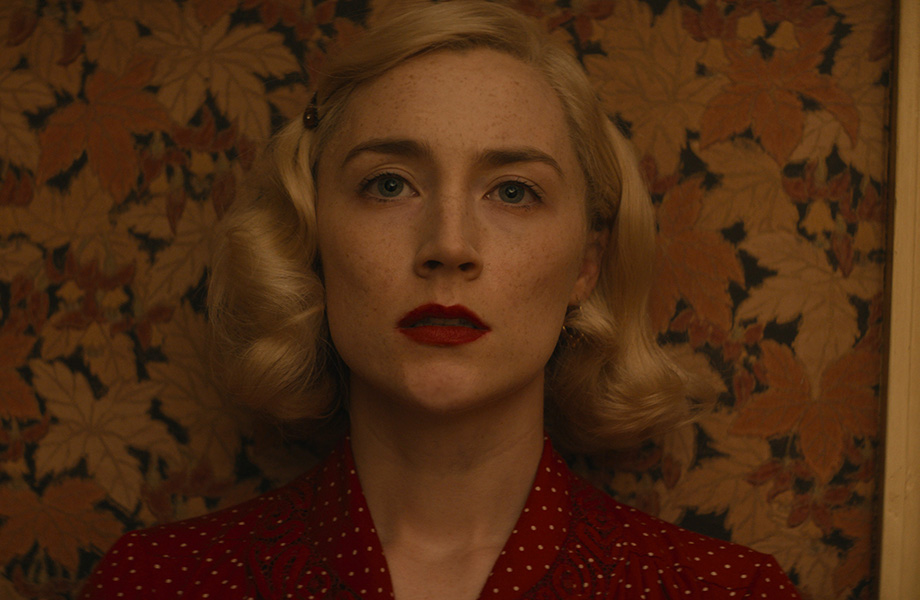
- Article Hero Image Caption: Saoirse Ronan as Rita (courtesy of Palace)
- Alt Tag (Article Hero Image): Saoirse Ronan as Rita (courtesy of Palace)
- Production Company: Palace Films
In The Splendid and the Vile (2020) – a study of Winston Churchill’s vital role in nurturing the phlegmatic spirit of the British in the wake of Adolf Hitler’s resolution to erase the cities of England, demoralising the kingdom by attacking the monuments and institutions by which it defined itself – Erik Larson quotes from the diary of a Londoner who experienced the Blitz. ‘My heart misses a beat whenever a car changes gear-up,’ they wrote, ‘or when someone runs or walks very quickly, or suddenly stands still … So taken all round my heart seems to miss more beats than it ticks.’ This sense of brittle anticipation, of calm that is little more than skin-deep, is precisely what Blitz lacks. For all its visually breathtaking moments, there is a dramatic sluggishness that the film never quite overcomes.
The film’s narrative centres on a family from London’s East End. Rita (a strangely subdued Saoirse Ronan) and her young son, George (Elliott Heffernan in an assured and moving debut), live with Rita’s father, Gerald (a credible performance from ex-Jam frontman, Paul Weller). George is mixed-race and there is no immediate sign of his father, but he and his mother share a close bond, playing silly games together, singing with Gerald at the family piano. Theirs is a cosy if frugal home, brimful of memories, music, and implicit love.
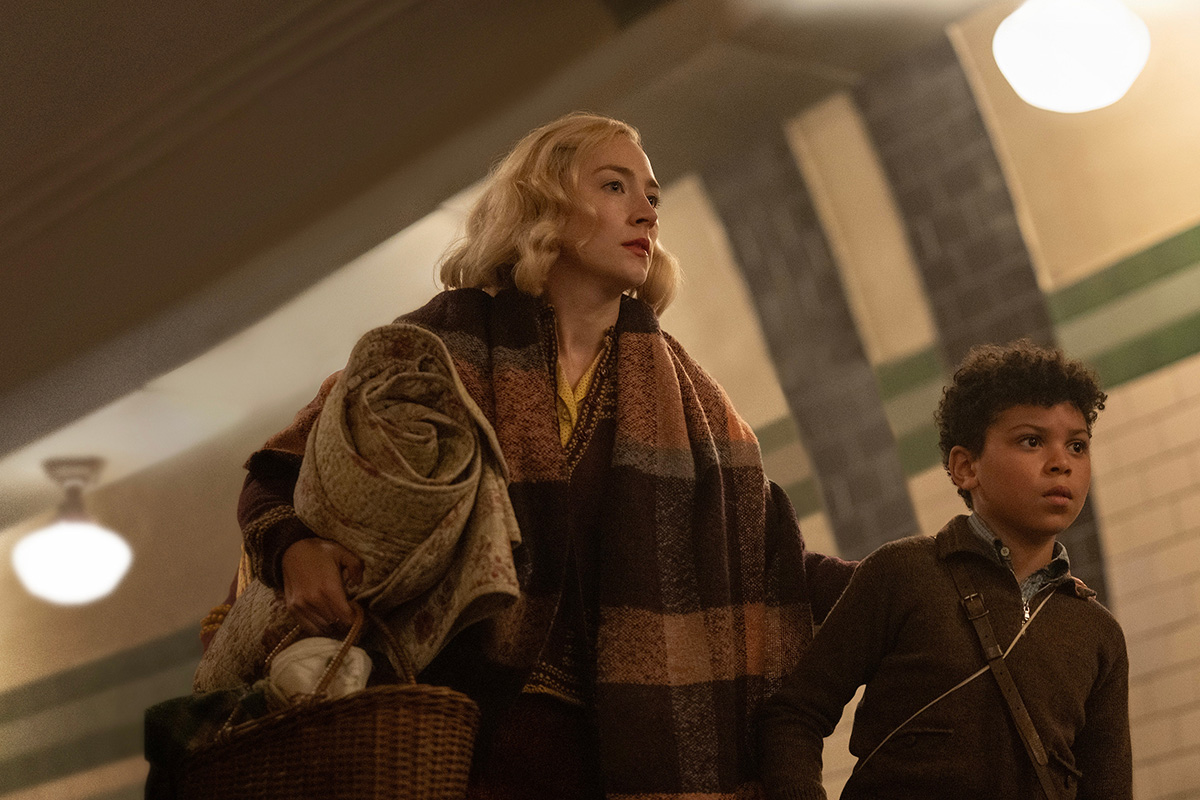 Saoirse Ronan as Rita and Elliott Heffernan as George (courtesy of Palace)
One night, at the sound of sirens, the family rushes with hundreds of others to the nearby tube station, only to find the entrance blocked by officers upholding government directives that only certain parts of the underground are to be made available to those seeking shelter. When they are told to shelter at home as best they can, the crowds force the hand of the officer-in-charge. The overwhelming crush of those pressing against the gates of the station, and the fear of the bombs overhead, are enough to convince Rita that George needs to be evacuated to the countryside with the thousands of other children who are being sent away for their own safety. George resists; he refuses to acknowledge his mother when he is forced onto the train, telling her he hates her. An hour out of London, he takes his chance and jumps from the train, his first step on a meandering odyssey back to his family.
Here the narrative splits. One half follows Rita, who, for much of the film, is not even aware that George is missing. She continues with her job at a munitions factory (if we are meant to find a parallel between the bombs Rita and her colleagues are making and those that plummet out of German aircraft, McQueen doesn’t labour the point), being jollied out of her despondency by best friends Doris (Erin Kellyman) and Tilda (Hayley Squires), and singing on one of the BBC broadcasts designed to boost morale. In flashbacks we also learn about her relationship with George’s father, a black man from Grenada who, in the aftermath of being racially abused, was accused of having initiated the affray. He is arrested and subsequently disappears from Rita’s life, her only memento of him a Saint Christopher medal that she, in turn, gives to George.
Despite – or perhaps because of – the relatively understated nature of her performance, Ronan manages to convey the abiding sense of loss that Rita experiences in the absence of George’s father. You can feel something of the deep bruise hidden below her amiable, occasionally perky demeanour, a wound echoed in the blood-red of the jacket she wears when she is away from the factory. By and large, Ronan’s Rita is given precious little to do, her narrative seeming to merely bide its time, waiting for the climactic moment when Rita’s and George’s paths will again intersect.
More fascinating is George’s trek from the countryside beyond London into the dark heart of the city. You can’t help but wonder how much more compelling Blitz might have been had McQueen chosen to focus the film entirely on George; on the perspective of a child wandering lost through a city under such sustained and devastating attack. His is not just a journey towards home, but a pilgrimage which brings him face to face with the best and the worst of Britain’s ‘keep calm and carry on’ mantra. In this, McQueen transposes a quintessentially Dickensian storyline to 1940s London, George’s travails with bullying children, dastardly criminals and unexpected benefactors echoing the tales of any number of Dickens’s boy-heroes from Oliver Twist to David Copperfield to Great Expectations.
While the Dickensian resonances add dramatic interest to Blitz, McQueen is unable to modulate the shifts from satire to tragedy to redemption. The result is a film whose overall tone is uncertain. While, for example, there is poignancy in the time George spends with Ife (Benjamin Clémentine), a black ARP Warden, it is difficult to know what to make of the criminal gang who force George to squeeze through the tiny apertures of bombed-out buildings to steal watches and jewellery. Gang leaders Albert (Stephen Graham) and Beryl (Kathy Burke, in lurid pantomime make-up) sit somewhere on the scale of credibility between Fagin and the Thénardiers (in the musical rather than the novel of Les Misérables). Suddenly, we are taken out of the reality of wartime London and into some grotesque parallel universe.
Blitz is never entirely its own film, seeming instead a (conscious or unconscious) patchwork of other war films. There are intimations of the climax of Joe Wright’s Atonement (2007) in the flooding of a tube station where George is sheltering and of Stephen Spielberg’s Empire of the Sun (1987) as George scurries for shelter in the wake of a German aerial bombardment. But there is also the reverberation of British war movies from the 1940s, whether in the overhead angle from which McQueen captures the bombs falling onto London, the jazz clubs with their black immigrant performers, and the crowded shelters, streets and pubs peopled with stereotypical Londoners, from the stoical old women waiting their turns in a queue to the sassy, good-time girls pencilling seams onto their bare legs and letting their hair down while their men are at the front.
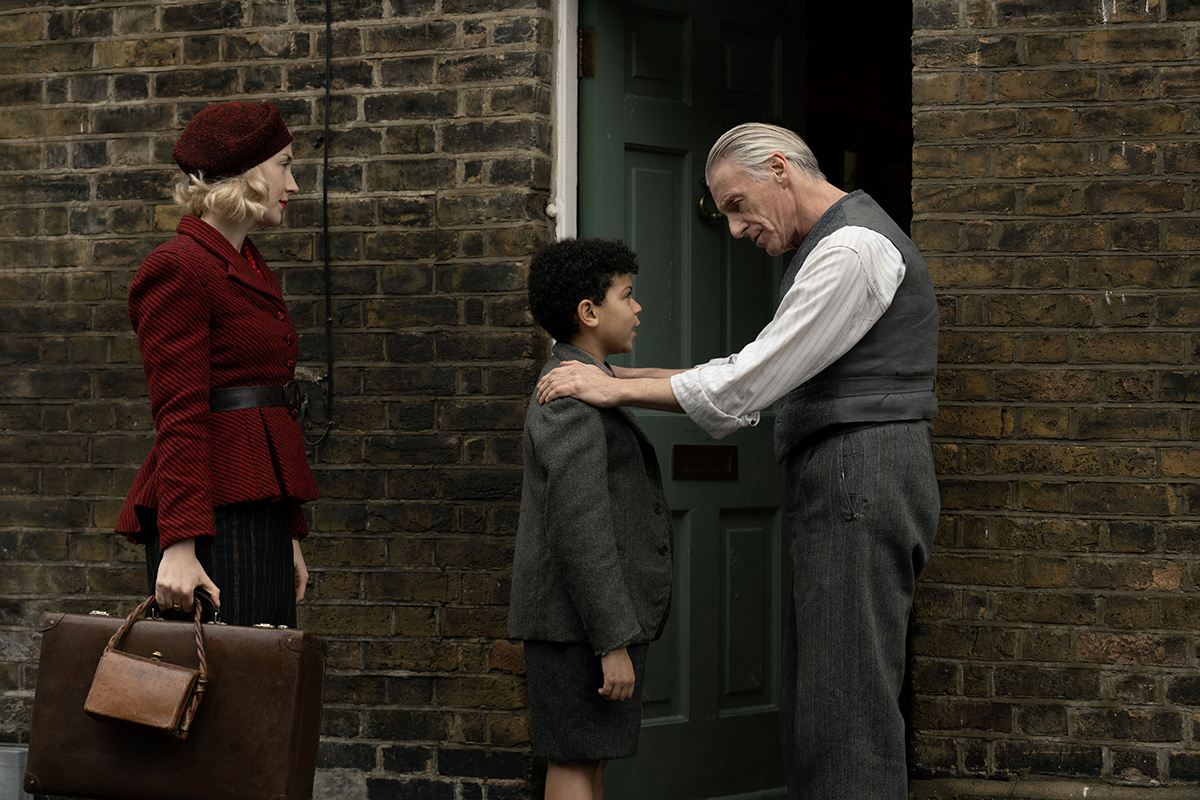 Saoirse Ronan as Rita, Elliott Heffernan as George, and Paul Weller as Gerald (courtesy of Palace)
Despite all this, McQueen does endeavour to say something original. In particular, he seems to want to puncture the fiction that Britain was defended, and Hitler defeated, by a population which was, essentially, noble and white. That this same myth has been appropriated in our own times by those who wish to return Britain to some mythological golden age of empire (think White Nationalists, Nigel Farage’s Reform UK Party, and the right-wing of the Britain’s Conservative Party) underlines the importance of McQueen’s demonstrating the crucial role played by all classes and races in holding the line against the Germans.
McQueen’s subversion of the received narrative of England and the Blitz is, however, attenuated. Critical moments in George’s journey of self-discovery (for example, the denouement of his relationship with Ife and his battle to save himself from the flooded tube station) either occur far too early in the film or are played off-screen, dampening the drama. Potentially powerful notes – such as George wandering through the Empire Arcade, witnessing the legacy of slavery upon which much of the British Empire was built, and thereby bringing into question what exactly is being fought for – are subsumed by a narrative that can’t sustain them. In previous films, McQueen has worked with established writers such as Abi Morgan (Shame, 2012) and Enda Walsh (Hunger, 2008). For Blitz, McQueen wrote his own screenplay. Just as his background as a visual artist is evident in some of the soaring shots of an obliterated London, so too his lack of writing experience is evident in the film’s narrative structure.
The Blitz McQueen gives us is not Churchill’s war. Churchill’s absence, and the absence of the ruling and political classes (save for a handful of petty bureaucrats), is glaring. There are none of the rousing speeches, no re-enactment of the royal family clambering through the debris of real people’s lives, no St Paul’s Cathedral towering intact above the ruins. Rather, this is the people’s war, this is their fight. If Blitz has a symbol, it comes in the figure of George, a brave, resilient, and determined mixed-race child who has the courage to risk himself to save others and whose most courageous feat is to embrace the fact that he is black, despite all his instincts telling him that he should, for his own survival, pretend otherwise.
Blitz (Palace Films) continues as part of the British Film Festival until 8 December 2024.