


- Free Article: No
- Contents Category: Music
- Custom Article Title: Angela Hewitt in Recital
- Review Article: Yes
- Article Title: Angela Hewitt in Recital
- Article Subtitle: The British pianist begins her Australian tour
- Online Only: No
- Custom Highlight Text:
In a deftly pitched introduction to the evening’s program of Mozart, Bach, Handel, and Brahms, Angela Hewitt mentioned in passing that her first visit to Adelaide had been back in 1991. A packed and responsive Elder Hall audience was quick throughout the evening to show their support and enthusiasm for the artist, her choice of works, and her individual performances.
- Article Hero Image (920px wide):

- Article Hero Image Caption: Angela Hewitt
- Related Article Image (300px * 400px):

- Featured Image (400px * 250px):

- Alt Tag (Featured Image): ‘Angela Hewitt in Recital: The British pianist begins her Australian tour’ by Michael Morley
Opening with the arresting flourish of the tonic across the staves, and moving to the hushed, progressively quieter answering figures, Hewitt demonstrated how her approach to both the Fantasie and the Sonata was constructed round the combination of passion and poetry. Easy to spell out, but rather more demanding to bring together in a coherent form. The Fantasie’s juxtaposition of drama with carefully chosen dynamics held the attention throughout, giving the lie to Busoni’s claim that Mozart lacked das Dämonische (a term not quite translatable as ‘demonic’, since it does not convey anything diabolical, but rather a quality of dark, psychological intensity). And Hewitt demonstrated, through her handling of tone and phrasing, just precisely how essential the intensity is to Mozart’s darker works. To take but one example: her shaping of the subdued passages leading up to the recapitulation of the first movement of the Sonata was both dramatic and quietly poised. And her shaping of the close to the second movement was perfectly gauged. Throughout the third movement, her flexible handling of dynamics and tempi never distracted from the essential character of the music – what Brendel describes as the composer painting a shocking picture of no way out combined with panic.
Where the Mozart Fantasie offered a dramatic combination of darkness with moments of relief, Hewitt’s approach to Bach’s Chromatic Fantasia was both freer and more flexible. In its outline, and her overall approach to the passages of semiquavers both rounded out and suspended, it reminded at least this listener of an interpretation – by Keith Jarrett, say – of sections close to jazz improvisation. Not that Hewitt ignored the work’s structure: throughout, one was always aware of where this music was leading, for all the occasional freedom and individual outlines of the extended phrases. And Hewitt’s use of arresting, organ-like figuration in the Fugue reinforced admirably the theatrical aspects of Bach’s writing.
While the first half closed with the quasi-organ-like tones of the Bach Fugue, the second half opened with a lightly and clearly articulated statement of the theme of Handel’s Chaconne in G, HWV.435. So markedly different in tone and style was this opening that one could have been pardoned for thinking a different instrument had taken the place of the first-half Steinway. What the listener was hearing was just how Hewitt’s understanding and realisation of the respective individual qualities of Bach and Handel were communicated to the listener.
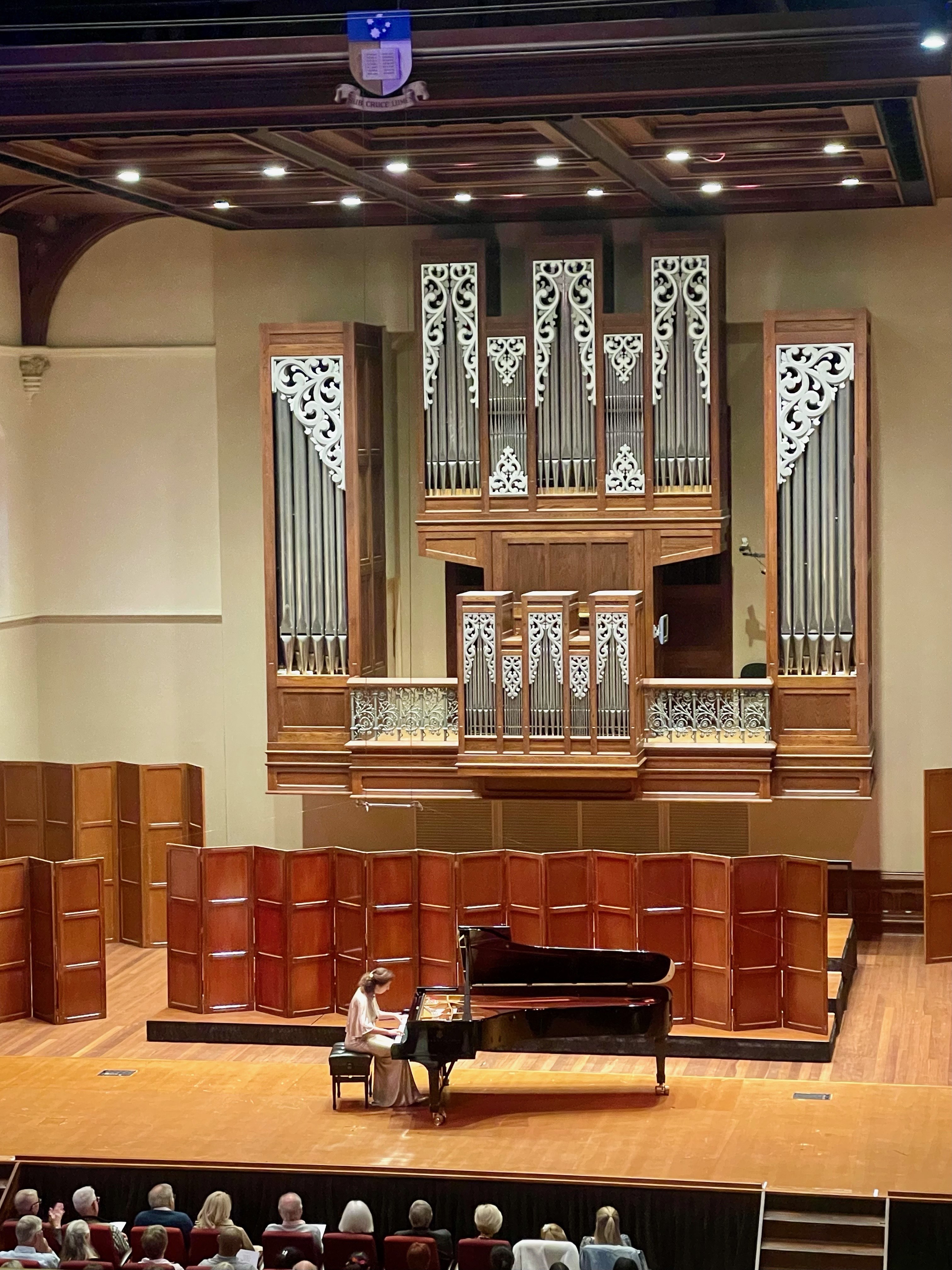
Opening the second half with the Chaconne was a smart touch, with Hewitt’s programming reminding the listener that Brahms was not just a re-worker of Handel, but also something of a music librarian, in that he collected scores of, among others, Bach and Handel. And this Chaconne deserves to be more widely known. (There is, in fact, a YouTube recording of it with a young Emil Gilels, which is simply electrifying in its handling of some of the semiquaver Variations: in the case of at least one of these, it is hard to credit the speed at which he takes it.) Hewitt’s view of the work is slightly more relaxed, though still up to speed (though with some blurring of detail) when required.
And so the evening reached its musical highpoint, in the choice of a work that Donald Tovey describes as ‘among the half-dozen greatest sets of variations ever written’. In the course of his Variations and Fugue on a Theme of Handel, Op. 24, the young Brahms (only twenty-eight when he wrote it) takes the listener on an exhilarating journey, which encompasses experiments in both form (canon, fugue, Siciliano, even variations of variations) and musical style (echoes of Hungarian funeral marches, fiery clarion calls, and imitations of earlier composers, including Couperin, Mozart, Beethoven, and Schumann). But they never sound clichéd or academic: always the musical personality of their creator comes to the fore.
From the outset, Hewitt’s approach embraced the essential overall structure of the theme with variations: the performer must be aware of the need for the dramatic arc(s) as well as the distinctive nature of each vignette. And always the transformative task and need to maintain momentum must be to the fore. (It is some way from the original piano version of the work, but a dance reviewer for The New York Times once came up with a perhaps somewhat hyperbolic characterisation of the opening of the orchestral version of the work, married to Twyla Tharp’s choreography: ‘Imagine watching a society of splendid teetotallers who collectively imbibe their first martini.’ With the substitution, perhaps, of Kirsch Royale, one might come close to the swirling, surging qualities of the early Variations.
Hewitt’s alertness to shifts in metre and rhythm meant that the music was never merely meandering or extravagantly marching: always there was the sense of the form of the individual Variation and its place and function in the whole work. While Variation 25 and the final Fugue could have benefited from a touch more dramatic majesty and magisterial display, Hewitt’s sense of form was clearly in tune with what Wagner had to say of the composer on the occasion of their only meeting: ‘One sees what can still be accomplished with old forms when someone comes along who knows what to do with them.’
How to follow the excitement and theatricality of the Brahms? Angela Hewitt had the ideal solution with a perfectly gauged reading of Mendelssohn’s Song Without Words No. 1. Perhaps when she has completed her Mozart project, Mendelssohn might be worth exploring?
Angela Hewitt in Recital continues in Melbourne (October 12), Bendigo (October 13), and Sydney (October 15). Performance attended in Adelaide: 9 October 2024.