


- Free Article: No
- Contents Category: Theatre
- Custom Article Title: Bad Boy
- Review Article: Yes
- Article Title: Bad Boy
- Article Subtitle: A further collaboration between Patricia Cornelius and Susie Dee
- Online Only: No
- Custom Highlight Text: Bad Boy is the second work in a series of what playwright Patricia Cornelius and director Susie Dee have called ‘visceral dramatic monologues’. The first, RUNT (2021), centred on the unnamed homunculus of the play’s title, portrayed with memorable physical intensity and dexterity by Nicci Wilks.
- Article Hero Image (920px wide):
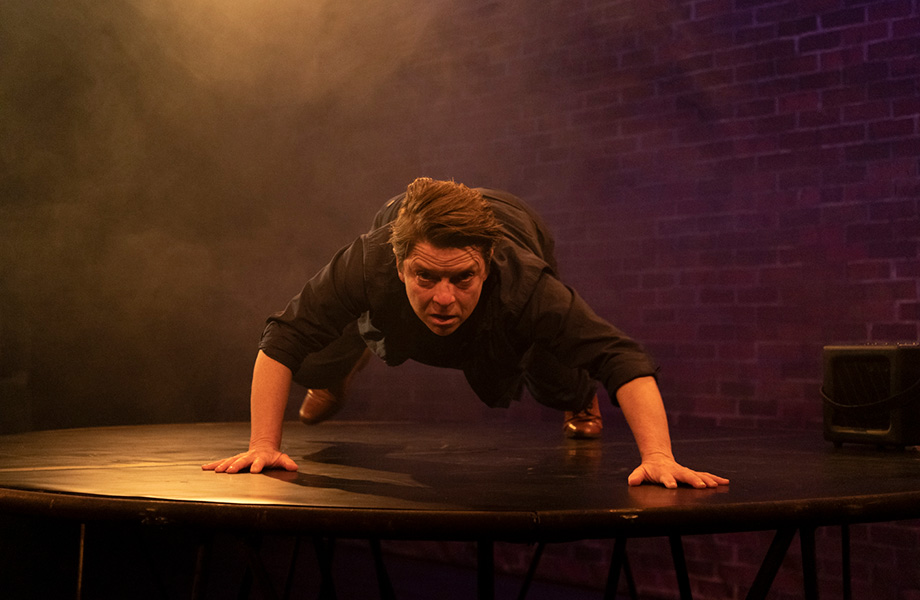
- Article Hero Image Caption: Nicci Wilks as Will (photograph by George Jefford)
- Alt Tag (Article Hero Image): Nicci Wilks as Will (photograph by George Jefford)
- Production Company: fortyfivedownstairs
When their domestic life inevitably frays, Will becomes violent and controlling, stalking Lisa when she tries to leave him. Wheedling apologies follow and the cycle repeats, both parties dragged down into a vortex of shame, recrimination, and emotional blackmail. It is a story whose beats play out every day in the media, and whose last, grimly predictable act all too often results in yet another woman slain at the hands of a current or former partner.
Cornelius’s text, with its fragmentary, sketch-like dramaturgy, is lean but lyrical, almost akin to rap in its use of choppy rhythms and simple rhymes. Wilks, hair short and jutting, and costumed in dark slacks, shirt, and casual jacket, gets inside it with seeming ease, hammering at its hard consonants, bellowing and guffawing, all the while matily ingratiating herself with us. Her impressive physicality – wiry, muscular, and cocksure – is at times parodic, its half-John Wayne, half-Tony Abbott gait a pastiche of performative hypermasculinity (one is reminded of Ian Warden’s observation that ‘to see Tony Abbott’s walk is to know that one cannot and must not ever vote for him’). The only prop is a boombox, and Wilks jabs at it like a boxer, punching techno beats and metronomic blips out of it.
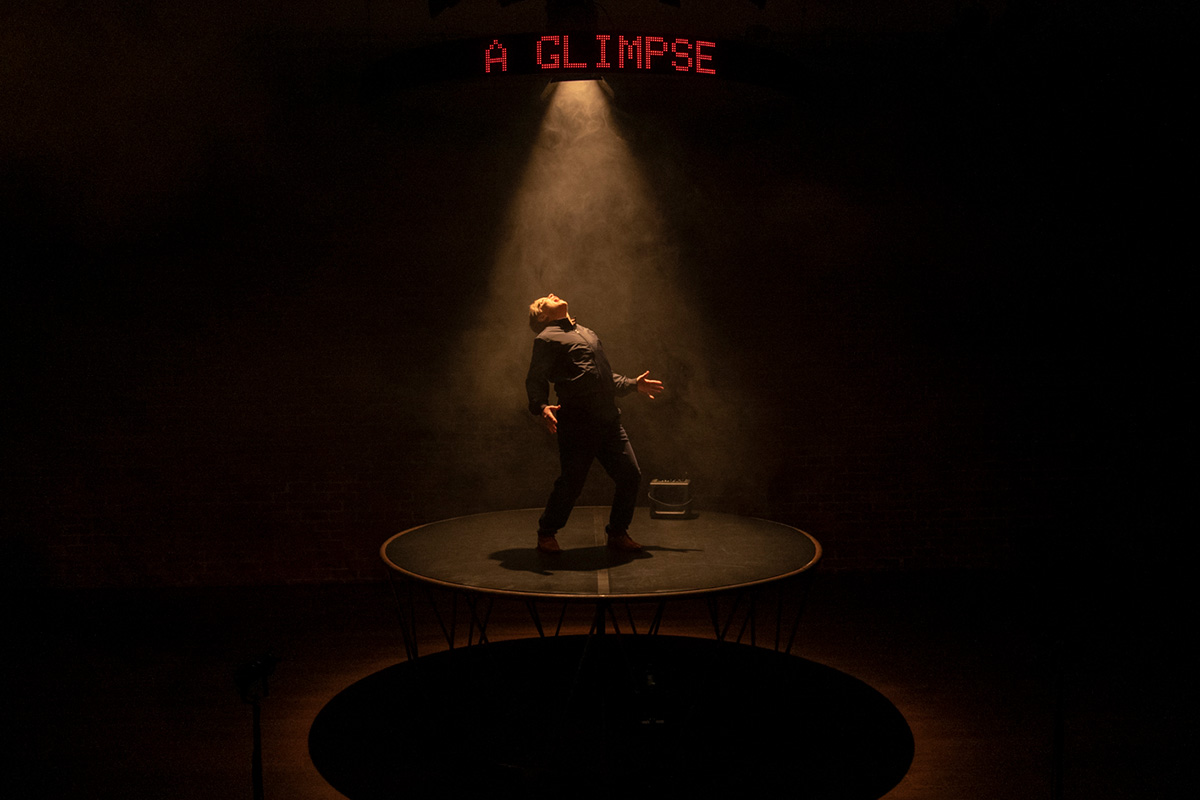 Nicci Wilks as Will (photograph by George Jefford)
There is vulnerability in Wilks’s performance, too. A times there is an unexpected softening, her eyes glazing over with emotion or her body contorting in on itself as though seeking re-entry to the haven of the womb. By casting a woman in the role, Cornelius and Dee invite us to see into these cracks in Will’s armour plating with less condemnation than a male performer might have garnered. In their program note, Cornelius and Dee write that this gender inversion ‘heightens the examination into male behaviour to create a more disturbing, more clarifying and fascinating take’. It mitigates against a more reductive reading of the work, and asks us to consider how abusive men use charm as well as cruelty to achieve their ends.
Yet Bad Boy feels like something of a missed opportunity. When the lights rise on Romanie Harper’s set – a raised, circular platform above which the titles of scenes scroll on a ring-shaped LED display – and Wilks is revealed in drag-king moustache and make-up, I hoped we were in for something more theatrical, a lively deconstruction of gender perhaps filtered through Judith Butler’s concept of performativity. As it is, Bad Boy seems to be suspended between competing sensibilities, neither detailed enough to convince us of its naturalism, nor expressionistic enough to reach beyond its well-worn immediacies. There are glimpses of a broader, cross-class critique of hypermasculinity, such as when Will reels off lists of both blue- and white-collar professions, but I wish the play had made more of a simple but neglected fact: that victims and perpetrators of intimate partner violence are found at every socio-economic level.
Still, Cornelius remains one of our most singular playwrights, and while Bad Boy falls short of the high watermark set by many of her previous collaborations with Dee, her work is never less than bracing. The sixty minutes of Bad Boy’s running time pass at a gallop, and Wilks is appropriately beguiling, bringing the determined, sinewy presence of a prize-fighter or carnival barker to the role. It is notable, too, that Cornelius’s class consciousness – a rarity on Australian stages still dominated by largely unexamined middle-class perspectives – remains unerring. While Cornelius’s characteristically hard, raw voice sometimes feels out of step with contemporary Australia, redolent as it is of the country’s ocker past, it nevertheless seethes and fizzes, giving life to an underclass more often than not occluded from our theatre. It is lifted here, too, by the production’s unity of purpose, held together by Dee’s deeply simpatico direction. Ryall’s score is effectively driving and ominous, while Hector’s lighting, utilising a half-circle of waist-high spots, works to render Will both mundane and larger than life, a tenebrous figure of often monstrously multiplied shadows.
In the past, Cornelius has said that her work is grounded in a desire to make audiences form relationships with unlikeable characters. However leavened by the casting of a woman in the role, Will is certainly this, a detestable encapsulation of all that is wrong with toxic masculinity: abusive and tyrannical, a misogynist whose hatred of women both arises from and enforces traditional gender roles. Yet like the infamously creepy lyrics to The Police’s ‘Every Breath You Take’, which are woven throughout Bad Boy, Will’s malignancy hides in plain sight, wrapped up in a tune all too easy to hum along with.
Bad Boy continues at fortyfivedownstairs until 13 October 2024. Performance attended: 27 September.