


- Free Article: No
- Contents Category: Theatre
- Custom Article Title: Uncle Vanya
- Review Article: Yes
- Article Title: Uncle Vanya
- Article Subtitle: An uneven production of Chekhov’s classic
- Online Only: No
- Custom Highlight Text:
Straddling broad comedy and genuine pathos, Uncle Vanya, first produced in 1899, is a very tricky play indeed. The main characters are mostly puffed up with delusion and fuelled by romantic fantasy. They use mordant self-deprecation alongside flights of fancy to express their dissatisfaction with their lot. The play encourages the audience to laugh at the evident gap between these characters’ vaulting sense of how special their lives ought to be relative to their actual lives of middling privilege, conducted in middling places.
- Article Hero Image (920px wide):
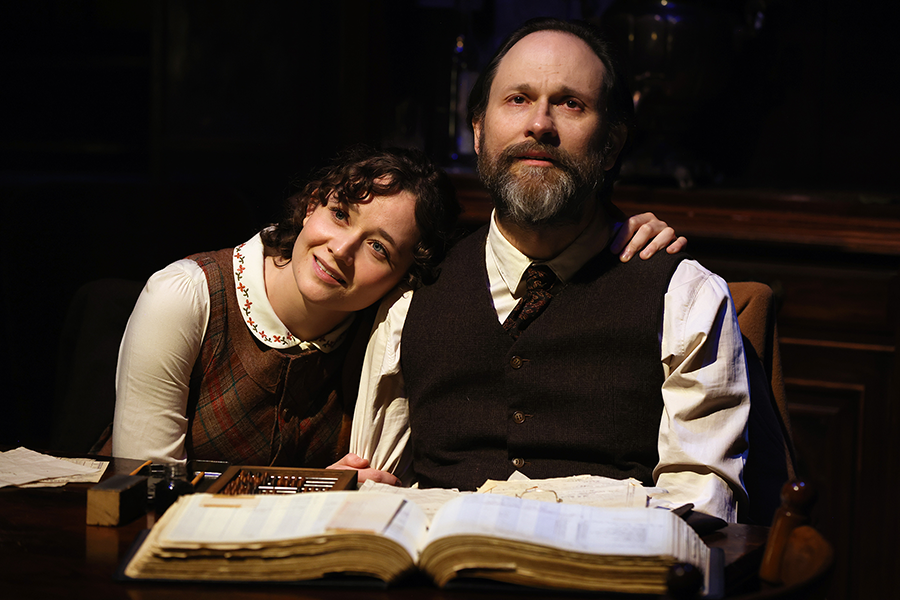
- Article Hero Image Caption: Abbey Morgan as Sonya and Yalin Ozucelik as Vanya (photograph by Prudence Upton)
- Alt Tag (Article Hero Image): Abbey Morgan as Sonya and Yalin Ozucelik as Vanya (photograph by Prudence Upton)
- Production Company: Ensemble Theatre
Ensemble Theatre’s production of Uncle Vanya provides vigorous comedy. In its quieter moments, the production offers a restive sense of bleak but stoic contemplation. But the elements do not fuse, and with Anton Chekhov it is in the fusion that the magic happens. There are some wonderful performances, some side-splitting laughs, and some moments of acute tenderness in this production. All too often, however, I felt that I was watching two different plays on stage without knowing how to find unity in the tonal diversity.
It is the main characters that provide the farce and the satire. Vanya, played by Yalin Ocuzelik, manages the country estate that belonged to his deceased sister. He lives with his sister’s daughter Sonya (Abbey Morgan), his mother Maryia (Vanessa Downing), and an elderly servant Nanny (also Vanessa Downing). Vanya offers tiresome and regular, as gauged by the response of his household, complaints about his rural life and the loss of his youthful potential. His partner in provincial whingeing is the doctor Astrov (Tim Walker), who manages his own disappointment with vodka. Vanya and Astrov’s routine of impotent kvetching is interrupted by the arrival of Serebryakov (David Lynch), the ex-husband of Vanya’s sister and Sonya’s father. Serebryakov is a pompous, urbane intellectual with a desirable and much younger wife, Yelena (Chantelle Jamieson). Their arrival arouses desire and jealousy on the part of Vanya and Astrov, as they both resent the smug indifference of Serebryakov, while at the same time angling after the affections of Yelena. Chaos, as you might imagine, ensues between this ménage à quatre. The four actors that make up this central quartet offer excellent comic timing as well as energetic physicality. Their interactions were often riotous and were received with the likewise riotous chuckles of the audience.
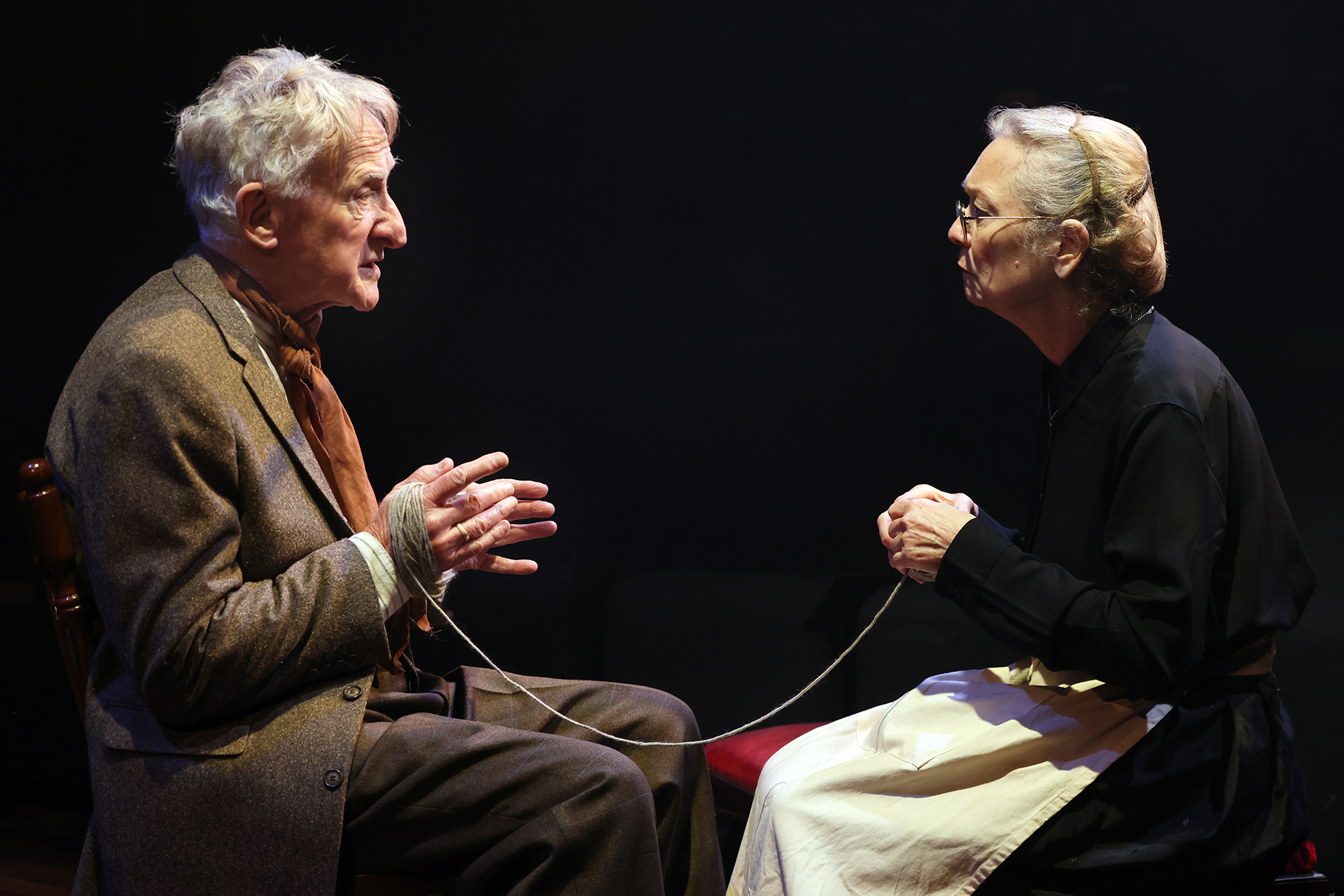 John Gaden as Telyeghin and Vanessa Downing as Nanny (photograph by Prudence Upton)
The play has been adapted by Joanna Murray-Smith, who was able to modernise and vernacularise Chekhov’s language without depriving it of a sense of context and historicity. Her deployment of Australian colloquialism was deft and never gimmicky, always providing a translational bridge to the world of Chekhov. Her writing shines most brightly, I think, in the scenes that centre the play’s ostensibly secondary characters: Sonya, Nanny and the neighbour Telyeghin (John Gaden). Sonya holds a torch for Astrov, and Abbey Morgan conveys beautifully the timidity and excitement of her girlish passion, alongside her rigorous sense of duty to her work and her family. Vanessa Downey’s Nanny, while also claiming many comedic moments, offers the gravitational pull of wisdom and acceptance of one’s situation. And, unsurprisingly, even in his small role, Gaden stole the show. His woebegone neighbour elevated every scene he was in; he can do more with a raised eyebrow than most actors can do with their entire body. Combined, the performances of Morgan, Downey and Gaden supplied a foil to the antic physicality of the show’s leads, somehow generating space for reflection and contemplation within the turmoil. Unfortunately, however, I found that the excellence of these performances overshadowed the ludic dramatics of the leads. It was hard to work out how to hold it all together.
This is a challenging review to write because I would thoroughly recommend this production to audiences, inasmuch as it was highly entertaining, dextrously humorous, and bravely ambitious in its commissioning of an excellent new adaptation. I am not sure, however, that the production illuminates the most startling and profound aspects of Chekhov’s work. Chekhov dwells in the ordinary and holds to a limited scale, and yet his plays and short stories are universalising in their account of the feeling-ness and subtleties that vibrate in all spaces, however little or privileged or dull. The scale may be modest, but the best executions of Chekhov produce the broadest of psychic horizons. By that measure, this production fell short. Although I felt the absence of expanded horizons, Ensemble Theatre’s Uncle Vanya offers a delightful array of elements to its audience; there are scenes of hilarity, dark comedy, and sadness that are wonderful to behold. And when remembering the wistful performance of Abbey Morgan, I have a hunch that a star may have been born. With all this talk of horizons, the birth of a star is surely alone worth the price of admission.
Uncle Vanya (Ensemble Theatre) continues until 31 August 2024. Performance attended: 31 July.