


- Free Article: No
- Contents Category: Music
- Custom Article Title: The Choir of King’s College, Cambridge
- Review Article: Yes
- Article Title: The Choir of King’s College, Cambridge
- Article Subtitle: A highly expressive Australian program
- Online Only: No
- Custom Highlight Text: The Choir of King’s College, Cambridge, arguably the world’s most famous choir, is undertaking another Australian tour. It is travelling with two programs, both of which include a variety of music from the late Renaissance to the present day, and is performing in all mainland state capitals, as well as the national capital.
- Article Hero Image (920px wide):
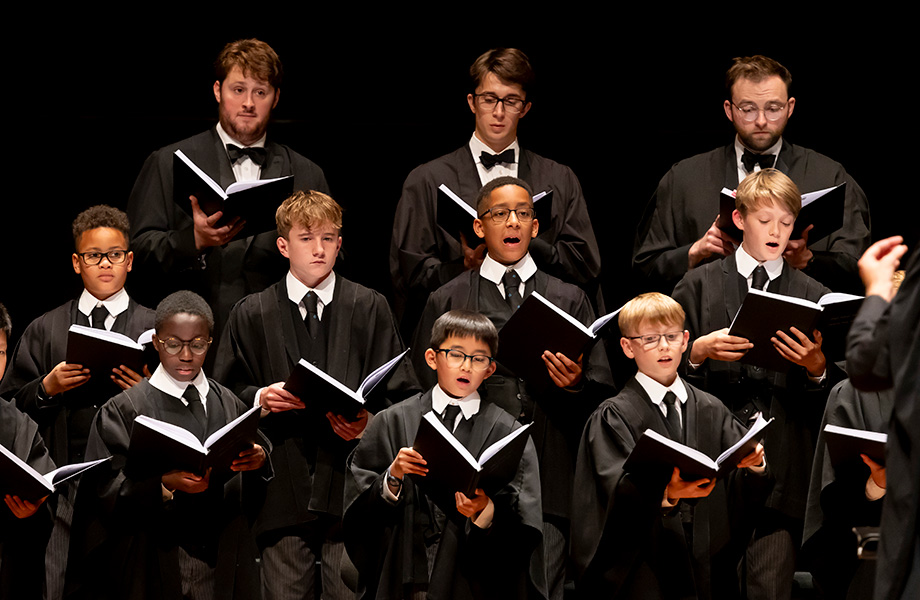
- Article Hero Image Caption: King's College Choir (photograph by James Grant)
- Alt Tag (Article Hero Image): King's College Choir (photograph by James Grant)
- Production Company: Musica Viva
Common to both programs is Australian composer Damian Barbeler’s Charlotte, whose words are from Judith Nangala Crispin’s poem ‘On Finding Charlotte in the Anthropological Record’. This eight-minute piece, commissioned in response to Director of Music Daniel Hyde’s intention that the tour should have a social impact on the choristers as well as on Australian audiences, is clearly structured and makes challenging and effective use of the skilled vocal resources of the thirty-two choristers. The choir recorded the piece just a few weeks ago in preparation for the tour, so it received a polished performance.
 Daniel Hyde, Judith Nangala Crispin, Damian Barbeler with the King's College Choir (photograph by James Grant)
Charlotte was placed just before Interval, a good time to allow audience members to discuss their experiences of the piece. Immediately before this we were treated to Maurice Duruflé’s Four Motets on Gregorian Themes – beautifully crafted miniatures, expressively delivered, and indeed our first chance to hear the choir sing a cappella.
The program opened with Giovanni Gabrieli’s double-choir Christmas motet O magnum mysterium, in which the voices were supplemented by three trombones and chamber organ. Those of us who have known the choir over some decades were immediately struck by the differences in choral sound and interpretation from what we had experienced under David Willcocks, Philip Ledger, or Stephen Cleobury, each of whom had put his own stamp on the King’s College sound. The new sound was warm and veiled, not as robust as one might have anticipated, but also highly expressive. All of this fitted perfectly with the unfathomable mystery of the text.
The next item was John Bull’s Epiphany anthem Almighty God, which by the leading of a star (commonly referred to as ‘The Star Anthem’), whose original accompaniment of five viols was entrusted to the chamber organ. This is often done when viols are not available, but on this occasion the contrapuntal lines of the single eight-foot stop were no match for the dynamic levels of the vocal lines.
Continuing the theme of the greater Christmas period was Thomas Tallis’s superb six-voice motet Videte miraculum, composed for the Feast of Candlemas. This substantial work, of some twelve minutes’ duration, is usually performed unaccompanied, but was here supported by the organ. While this is historically a possibility, it was an unnecessary appendage on this occasion. But it allowed one to enjoy the glorious plainchant interludes (without organ) all the more.
The remaining piece in the first half of the program was Alessandro Grandi’s brief Christmas motet Hodie nobis de caelo, effectively performed by two solo tenors and organ.
After Interval, the featured work was Stravinsky’s Mass, for which the choir was joined by ten of Australia’s finest double reed and brass players. The work was composed in the 1940s, and in his final years Stravinsky was still hopeful that it would be performed liturgically. This may not have occurred during his lifetime, but there have been a number of liturgical performances over the past half century. On this occasion, the Mass received a strong realisation from vocalists and instrumentalists alike, a particularly noteworthy detail of which was the impeccable synchronisation of the Gloria’s duets for solo soprano and solo alto, despite the considerable physical distance between the two singers.
The Mass was preceded by an instrumental rendition of Morten Lauridsen’s motet O magnum mysterium. Given that Lauridsen’s music is so closely wedded to its text, much was lost and nothing gained in this purely instrumental version of the piece, though the performance itself was polished.
The remaining pieces were four choral works by Master of the King’s Music, Judith Weir, one of which (a setting of Psalm 148) was accompanied by a solo trombone, while the others (three settings of poems by George Herbert) were unaccompanied. These pieces were interspersed between the movements of the Stravinsky Mass.
As an encore, the choir sang the Nunc dimittis from Orlando Gibbons’s Short Service. This was a highly expressive rendition, with a rallentando that commenced so long before the end that we had no doubt that the evening was being brought to an end.
If I may be permitted a brief trip down memory lane …
This same Nunc dimittis was sung on the first occasion I heard the choir, in April 1968, a very different interpretation of the piece under David Willcocks, whom I met shortly afterwards. I subsequently wrote to him asking whether there was any chance that the choir could do an Australian tour. He replied: ‘I regret that it would almost certainly be impossible for The King’s College Choir to visit Australia, but it is good to know that there would be a welcome for us there.’ Of course, the choir didn’t tour Australia under David’s direction, but the current tour is its ninth.
The Choir of King’s College, Cambridge (Musica Viva) tours nationally until 5 August 2024. Performance attended: 23 July.