


- Free Article: No
- Contents Category: Theatre
- Custom Article Title: Blackout Songs
- Review Article: Yes
- Article Title: Blackout Songs
- Article Subtitle: Circling in and out of love and addiction
- Online Only: No
- Custom Highlight Text:
Addiction is the third wheel in many a stage relationship. Plays such as Eugene O’Neill’s Long Day’s Journey Into Night (1956), J.P. Miller’s Days of Wine and Roses (1958), and Edward Albee’s Who’s Afraid of Virginia Woolf? (1962) examine the ways in which addiction – whether to alcohol, morphine, or even love – offers a heady sense of ‘something’ where once there seemed to be nothing at all.
- Article Hero Image (920px wide):
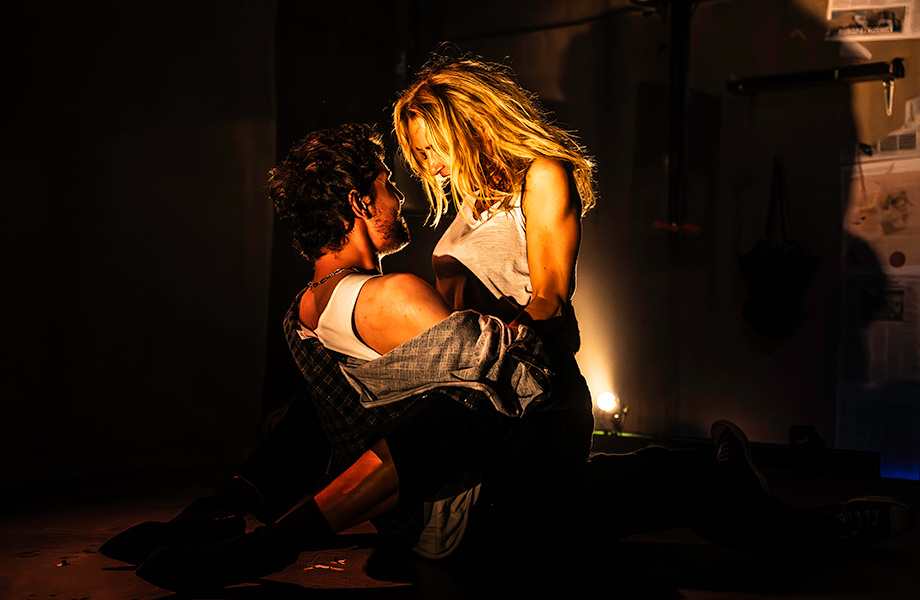
- Article Hero Image Caption: Jack Twelvetree as He and Sarah Sutherland as She (photograph by James Reiser)
- Alt Tag (Article Hero Image): Jack Twelvetree as He and Sarah Sutherland as She (photograph by James Reiser)
- Production Company: Red Stitch Actors' Theatre
What should be a chamber piece – one that balances screaming pain with an angst that is barely audible – is, in this Red Stitch production, played as though every line is marked sforzato. The urgency with which one scene bleeds into another might mirror the blurring of its central characters’ days, but ultimately it blunts the plays edges. The central idea of Blackout Songs – that addiction simultaneously shatters and mends our sense of who we are and where we belong – is thereby robbed of its necessary clarity.
Him and Her first connect at an AA meeting. He (Jack Twelvetree) is wearing a neck-brace and stuttering. She (Sarah Sutherland) is all nervous energy, disdainful of the coffee and the other alcoholics, who have come to share their stories. Recognising in his clamminess and shakes the symptoms of someone trying to go ‘cold turkey’, she coaxes him away, advising him to take a medicinal sip or two of alcohol to ease him more gradually towards sobriety. It’s a mode of self-healing that recurs throughout the play, each attempt failing, each attempt bearing more crushing consequences.
Blackout Songs is built around a series of half-remembered encounters, all of them fuelled by a combination of alcohol, ardour, and desperation. For Her, drinking is a way of life. There is a suggestion that she has money (and no indication of her holding down any sort of job) and that it is she who keeps the rivers of alcohol flowing. Her father was an alcoholic, and her relationship with him is the obvious chip on her shoulder. ‘That man,’ she says, ‘that unseen, obscene man, at the very edge of your life.’
He (Him) lives in a squat and paints, a vocation that is meant to be either ‘desperately romantic’ or edgy (given the sorts of paintings he produces), but that, in this context, screams cliché. His creativity – rather predictably – is stifled by abstinence.
A poem she wrote about her father was published years ago, and he encourages her to write again, to immortalise their love on the page, as he will immortalise them on canvas. He is more prone than her to the grand delusions of intoxication. In Sutherland’s portrayal of Her, there is the feeling that she has been there, done that; that she has dreamed these dreams and knows their falseness. Even so, delusions are preferable to clear-eyed sobriety.
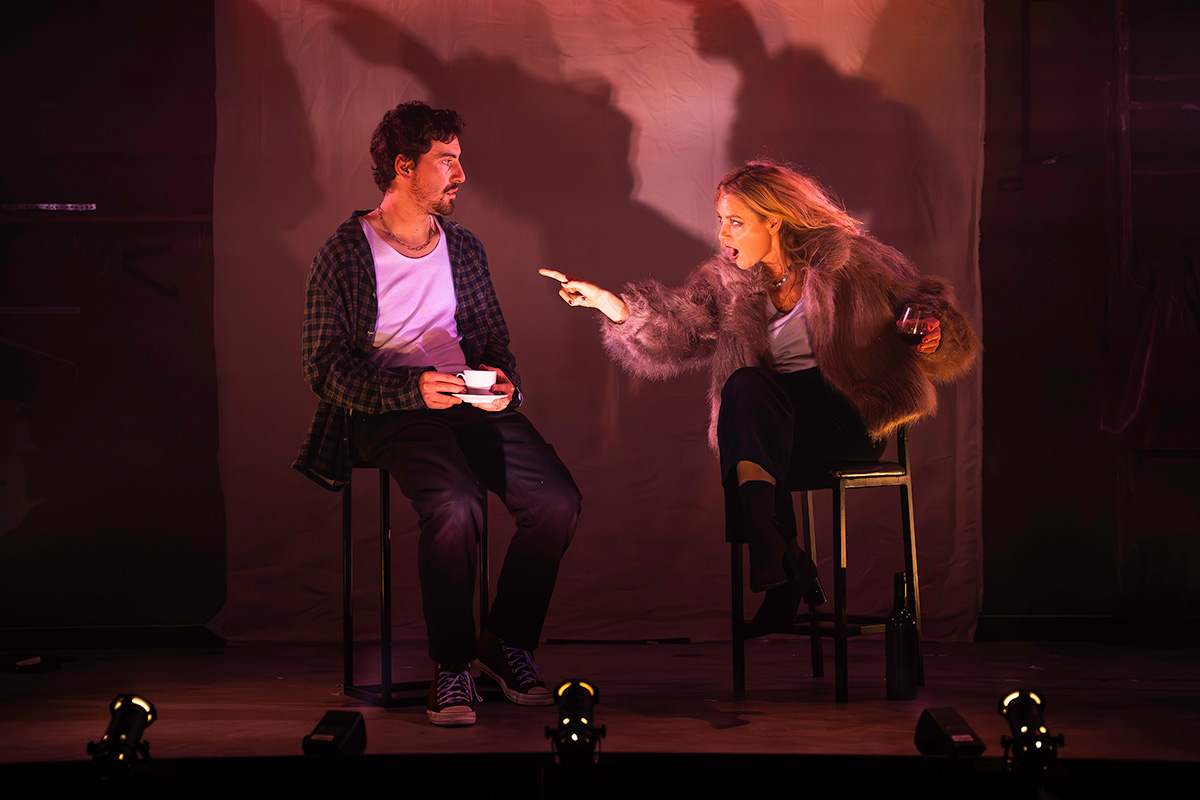 Jack Twelvetree as He and Sarah Sutherland as She (photograph by James Reiser)
What just about lifts Blackout Songs from being a somewhat ordinary ‘will they, won’t they’ play are the ‘blackouts’ of the title. Within these cycles of meeting, conjoining, and falling apart, White levers open the gaps in memory – the gaps in self – that alcohol abuse scars on a person’s being. The ‘blackout songs’ are the stories and misprisions by which these scars are hidden. Half-baked narratives fuse the broken memories and attempt to bring coherence to the chaos.
When she is persuaded to pull out his cracked tooth with a pair of pliers, she conjures the tale of the first time they met, an imagined life replete with horses, huts, and plague. When they meet again after a long time apart – he is now sober – she situates herself in a fable where she has drunk a river dry and been hospitalised for as long as it took for the river to be drained from her. Even when she announces at AA that she is an alcoholic, naming herself for the first time as Alice, we might wonder whether this, at last, is something real or just another of her stories.
Sutherland’s Her is acerbic and restless, as though there is a reserve of barely repressed hysteria constantly leaking out of her. As Him, Twelvetree is all crash or crash-through, a storm of inner demons over which he has meagre control. What both performances are missing, however, is a palpable sense of the inescapable spectre – whether it be love or addiction – around which their relationship revolves.
In his notes to the playscript, White makes the point that Him and Her ‘should never be played drunk, but when alcohol is in their system that should oscillate at a higher frequency’, a directive the production fails to accommodate satisfactorily. There is plenty of the higher-frequency (which seems to have been interpreted as not only higher-speed but constant fidgeting and clamour), but little by way of oscillation. If the audience is unable to discern the difference between these characters when they are drunk and sober, the play has lost much of its point.
Director Tom Healey emphasises the adversarial elements of the relationship, but underplays opportunities for stillness and contemplation. When the actors are given the space to stop shouting at each other and fleetingly expose the ghosts that haunt them – the ghosts that are there in the script waiting to be found – something intense, even significant, is allowed to reveal itself. But such moments are too few.
The coarseness in the tone of the production – its lack of variation and subtlety – is reflected in the play’s design (Tom Healey, Chiara Wenban, and Natalia Velasco Moreno). The drably set stage – a space that looks like the back-end of a derelict alley – offers nothing by way of context, swallowing the action rather than foregrounding it. The lighting only exacerbates the problem, the actors often so overwhelmed by shadows that they become little more than belligerent ciphers. Such gloom might reflect the downward trajectory of their lives when they are together, but swamping them in so much darkness only further distances audiences from the characters’ more muted emotions and, crucially, from what their lives might signify.
If you had to identify the defining note of Healey’s interpretation of Blackout Songs, you might name it as commotion. It is a reading of the play that not only exposes the essential fragility of the play’s text but that also leaves the anchor points of the play’s meaning – inflections of absence and wholeness, of incompleteness and reincarnation – flailing in the turmoil.
Blackout Songs continues at the Red Stitch Actors Theatre until 30 June 2024. Performance attended: 5 June.