


- Free Article: No
- Contents Category: Television
- Custom Article Title: The Test, Season Three
- Review Article: Yes
- Article Title: The Test, Season Three
- Article Subtitle: The human comedy of Ashes cricket
- Online Only: No
- Custom Highlight Text:
The cricket-lover knows that a Test match – let alone a Test series – lasts long enough for the full sweep of human comedy to be on show. Ambition; petulance; perfection all too fleeting; horrible failure; hilarious pratfalls; selflessness and honour: it’s all in a day – or in five day’s play.
- Article Hero Image (920px wide):
.jpg)
- Article Hero Image Caption: Australian Cricket Team (Amazon Prime)
- Alt Tag (Article Hero Image): Australian Cricket Team (Amazon Prime)
- Production Company: Amazon Prime
The Test first aired in 2020. If you have ever wondered what Test cricket would look like if edited to the conventions of a Hollywood thriller, with liberal use of slow motion, cutaway shots, tense music cues and all the slow hours dispensed with, The Test will show you. It is mildly ridiculous, yet entertaining: who knew that cricket could look cool? The Test’s first season began with the appointment of Justin Langer and Tim Paine as head coach and captain, respectively, of the Australian men’s Test team, in the wake of the 2018 ball-tampering scandal in South Africa that marked the nadir of Australian cricket’s international reputation. The second season also dealt in upheaval, with the shock resignation of Tim Paine only weeks before the 2021-22 Ashes series began in Brisbane.
Happily for the makers of The Test, Paine’s replacement as captain was Pat Cummins, who combines old-fashioned, matinee-idol charisma with a commitment to progressive values. The Murdoch press loathes him, younger fans love him, and he also happens to be a fiercely talented fast bowler – Australia’s first fast-bowling captain since Ray Lindwall skippered one Test against India in 1956. Cummins led Australia to a 4-0 series win in the 2021-22 Ashes at home, which was covered in The Test’s second season. He has since gone on to greater feats, including winning an unlikely trophy for the men’s one-day team during the 2023 World Cup in India.
The third season of The Test does not include that seven-week World Cup campaign, unfortunately. Instead, it spends the bulk of its three (hour-long) episodes on last year’s competitive, controversial, and ultimately drawn Ashes series in England. Australia, the standard bearers for fast-paced and aggressive cricket twenty years ago, was last year cast in an unfamiliar role – that of stylistic conservatives. England, meanwhile, revelled in ‘Bazball’, which basically entails scoring at five runs an over. It’s not a new idea in cricket, though England acted as if it were, and the ensuing clash of attitudes, both on and off the field, not to mention a stumping that set prime ministers bickering, meant that the 2023 Ashes was enthralling, even for casual cricket fans. Directors Adrian Brown and Sheldon Wynne can’t have lacked for material, but this season somehow fizzes rather than sparks.
I never thought I’d say this, but I miss Justin Langer. His blend of motivational business talk with unblinking patriotism was hard to stomach in real life – season two records his departure as Australia’s coach, in spite of the team’s successes – but it made for weirdly compulsive viewing. He was the perfect figurehead for a documentary series that strives to make cricket look action-packed, yet simultaneously captures the fact that professional sport is now a carefully managed arena of data analysts, team psychologists and PowerPoint presentations. ‘Elite mateship’ was one of Langer’s slideshow mottoes, and it still makes me laugh. Elite mateship! The sheer quackery of it.
The absence of Langer’s inadvertent satire is one problem that Brown and Wynne face as directors. The other, larger problem is that The Test has always had to balance two ultimately irreconcilable goals: one, to be a candid documentary about a high-pressure sporting contest; and two, to provide a quasi-official record of events, complete with after-the-fact interviews, from the Australian team’s perspective. The Test’s makers have close access to the Australian players, tailing them off the field and into pavilions, across hotel lobbies and onto tour buses. But the viewer feels the strings attached to that access. This is especially the case when events during the Second Test at Lord’s – specifically, Australian wicket-keeper Alex Carey stumping England’s Jonny Bairstow – lead to scenes of incredible rancour between the English crowd and the visiting team.
Unless you count the sight of Cummins tucking into a plate of lasagna while chuckling at the outrage he has caused, The Test doesn’t reveal anything more than we already knew about that Lord’s match and its fallout, thanks to endless media coverage. It does emphasise something routinely overlooked at the time: the stumping was Cummins’s idea, not Carey’s. Carey himself proves a reticent interviewee, all nervous smiles and deferrals. That’s understandable: no sports psychologist could prepare you for a mauling by the English tabloid press. By every credible account Carey is a good-natured man; he must have wondered what ladder he walked under to end up as the folk devil of England. Reluctant to probe the Australian players or to venture wider than their circle, The Test misses an opportunity to consider sporting controversy in the light of our networked era, where some ‘fans’ think nothing of issuing death threats to athletes online, and where a 24/7 news cycle means there’s always one more headline, one more specious angle, to be run.
It is also the case that in focusing so loyally on the Australian team, we miss half – or more than half – of last year’s Ashes story, which was all about the zeal of England, self-declared twenty-first-century saviours of Test cricket. What I wouldn’t give for a Langer-style scene involving England’s evangelist coach, Baz McCullum, or their captain, Ben Stokes, a superhuman cricketer on his best days but also prone to carrying on as if the current England team were the Eighth Wonder of the World. The Ashes almost always manages to touch the third rail of colonial mistrust between Australia and England. It can and does bring out the worst in both nations. Even so, last year’s hostilities felt unusually livid. My pet theory involves Brexit: this was the first Ashes to take place in England since the United Kingdom finally withdrew from the European Union. So many years of promises preceded Brexit; so little benefit has followed its actualisation. When a visiting Australian cricket team played by the laws but not, according to the English, by the ‘spirit’ of the game, a deep sense of betrayal, displaced from a more deserving target, was unleashed.
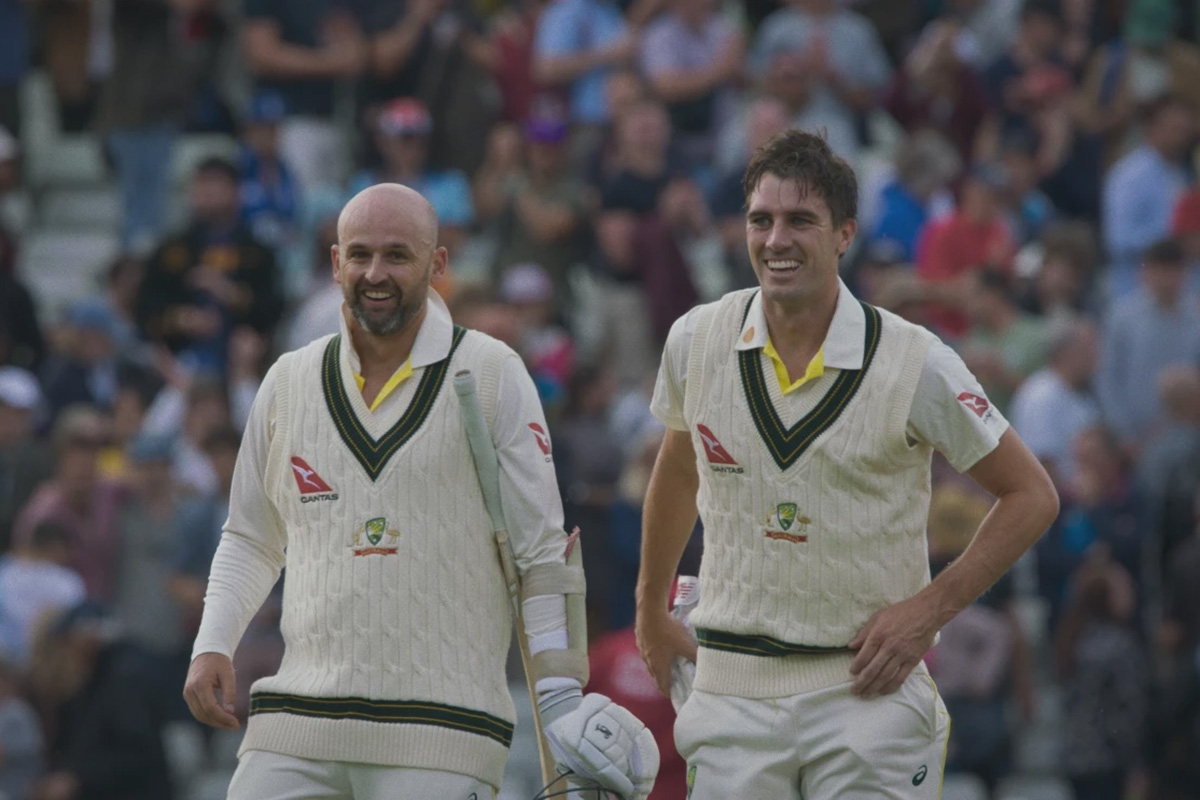 Nathan Lyon and Patrick Cummins (Amazon Prime)
Still, they were good. England was really good, and several times quite magnificent. The most effective episode of The Test this season is the first one, which begins with Australia winning the World Test Championship against India on neutral ground at The Oval, in London, and then focuses on the Edgbaston Test, before the Ashes had soured. This was sporting rivalry at its best, and a Test match full of intriguing plot lines. An emboldened Ben Stokes declares on 393/8 in the first innings. An embattled Usman Khawaja, who frankly admits that England is for him a place of ‘bad memories’, counters with his first century on English soil. Needing fifty-four runs to win in the dying hours of the fifth day, and with only two wickets in hand, Cummins and a wretchedly nervous Nathan Lyon form a batting partnership that no one in their team believes can succeed.
Ensuing scenes are proof of sport’s cathartic qualities, as men who otherwise seem to communicate only in tentative pats on the shoulder lift each other off their feet in jubilation. All those hours, all those days, down to the wire, and it finally pays off. Then the next Test match comes along, and the human comedy begins again.
Season Three of The Test is available on Amazon Prime Video.