


- Free Article: No
- Contents Category: Opera
- Custom Article Title: Lucia di Lammermoor
- Review Article: Yes
- Article Title: Lucia di Lammermoor
- Article Subtitle: Melbourne Opera tackles Donizetti’s masterwork
- Online Only: No
- Custom Highlight Text:
There was a real sense of occasion on Thursday evening before the opening performance of Melbourne Opera’s new production of Gaetano Donizetti’s Lucia di Lammermoor, first performed in 1835, with a libretto by Salvatore Cammarano, based on Sir Walter Scott’s novel The Bride of Lammermoor (1819). Bagpipes summoned us along Collins Street. Inside, the Athenaeum Theatre seemed close to full.
- Article Hero Image (920px wide):
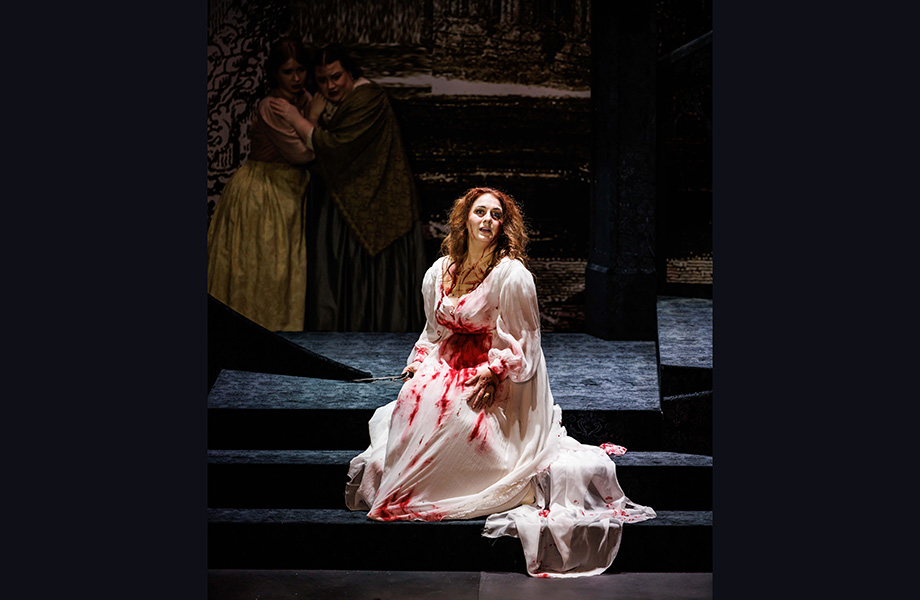
- Article Hero Image Caption: Elena Xanthoudakis as Lucia (photograph by Robin Halls)
- Alt Tag (Article Hero Image): Elena Xanthoudakis as Lucia (photograph by Robin Halls)
- Production Company: Melbourne Opera
Much has happened since 2003 – about sixty productions for a start, all without funding from the state or federal government. What loyalty and affection this enterprising company attracts, doubtless intensified by the lavishly subsidised national company’s lengthy absences in Melbourne.
Given Melbourne Opera’s deep roots in bel canto opera, it is surprising that this is the first time it has presented Lucia, possibly Donizetti’s finest work and certainly one of his most popular operas.
Clearly, Suzanne Chaundy’s production is a labour of love, as she attests in her Director’s Note. She has moved the production forward to 1850, eighty years after the setting of Scott’s novel, when the Acts of Union finally united old rivals England and Scotland into Great Britain. ‘Family is at the centre of the work,’ Chaundy states. With Dale Ferguson (set design) and Harriet Oxley (costumes), she has turned for inspiration to the daguerreotype photograph which became popular in the 1850s. ‘The “moment” captured in many of these portraits and preserved for posterity seem [sic] to barely disguise a deep dysfunctionality.’ Chaundy’s Lucia, despite the Gothic setting, is modern in conception: she has no ‘agency’ and may be suffering from ‘a dissociative disorder arising from trauma and preceded by depression’. She has lost her mother, and the father is not mentioned. ‘She is worn down to acceptance, weakened and almost an automaton by the time the wedding ceremony commences,’ Chaundy writes.
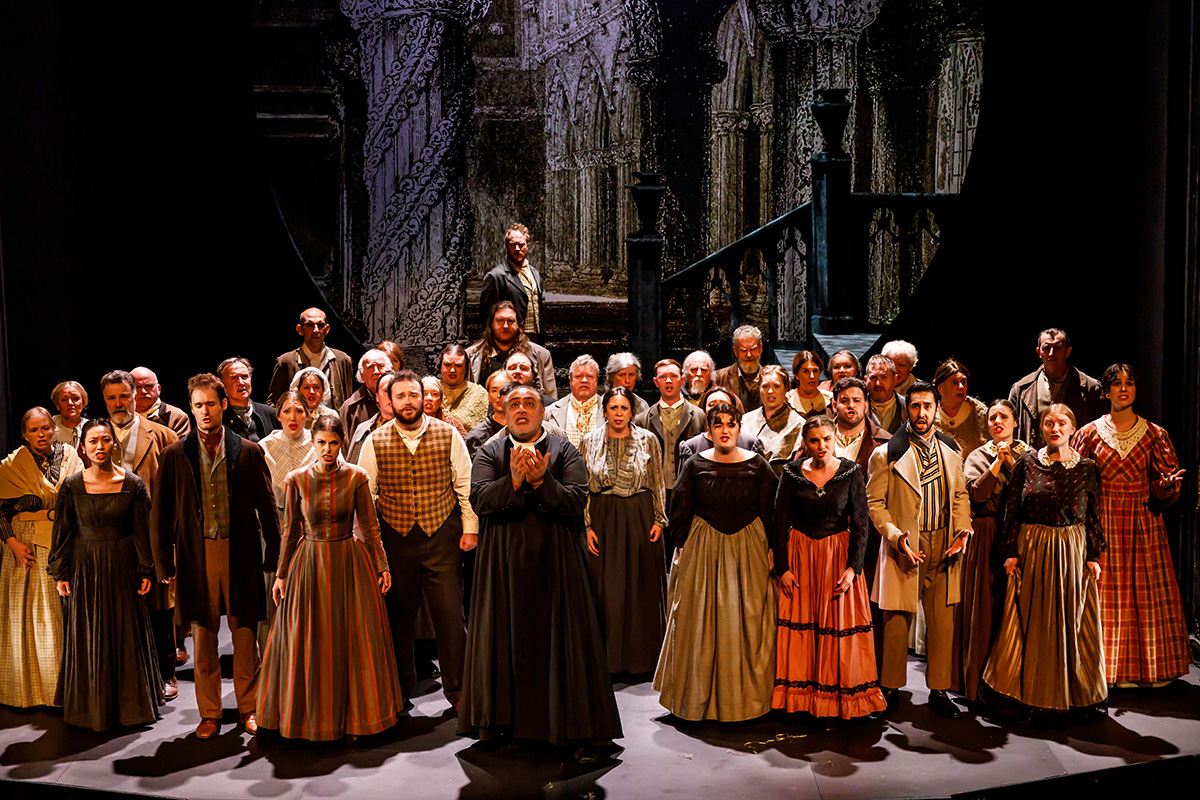 Eddie Muliaumaseali'i as Raimondo and Ensemble (photograph by Robin Halls)
The Athenaeum’s stage is tiny – even smaller than that of the Joan Sutherland Theatre, if that is architecturally possible. Chaundy – with Dale Ferguson – has the measure of it by now. Mostly the new production works, though the great hall of Lammermoor Castle, where the guests celebrate the wedding of Lucia to Arturo, was conspicuously pinched. Compensating for the exiguousness of the stage is the unusual intimacy this atmospheric old theatre affords between singers, players, and audience.
Elena Xanthoudakis – who has sung Anna Bolena, Maria Stuarda, and Desdemona (in the Rossini Otello) for the company – returns in the title role, famously assumed by Maria Callas and Joan Sutherland. Xanthoudakis lacks their amplitude and finish, but then, who doesn’t? She looked the part: neurotic and haunted at first, in the fountain scene, as Lucia recalls an ancestress who was stabbed to death by her lover and has returned as a ghost, which Lucia believes she has seen; ardent and unworldly when joined by Edgardo; then credulous as her brother deceives her about Edgardo’s intentions. Throughout, Xanthoudakis mastered the relentless coloratura. She sang with agility and an assured trill. The long, tremulous Mad Scene was admirable, if not especially affecting.
Henry Choo brought his high, refined tenor to the role of Edgardo, with its difficult tessitura. Choo was at his best in the long Act I scene with Lucia, one the finest love duets in Italian opera. Pleasingly, the Wolf’s Crag scene – Edgardo being joined by the wrathful Enrico – did not fall victim to thrift or timing. Choo was expressive here. In the long scene that ends the opera, when Edgardo laments Lucia’s betrayal before learning of her demise and promptly stabbing himself. Choo sang with customary daring, pushing himself to breaking point in the despairing ‘Tu che a dio spiegasti l’ali’.
Enrico, the diabolical brother, is wonderfully twisted and full of dramatic promise. Simon Meadows – a notable Alberich in recent years (both in Melbourne and Bendigo) – sang forcefully, with possibly too much volume for this tiny theatre, with its close acoustic. Meadows seemed oddly mechanical, two-dimensional, unsure perhaps how to modulate this pathological brute, whose terrorisation of his sister surely hints at abusive chapters in the past.
Eddie Muliaumaseali’i – a veteran of the company – has never been more persuasive than he was in the small, pivotal role of Raimondo. Rigid, yet compassionate, the Chaplain suits Muliaumaseali’i, who was gravely sympathetic in the Act II scene when he persuades Lucia to marry Arturo, despite her vow to Edgardo, and in the Act III scene when he informs the wedding guests that Lucia has slaughtered the groom (‘Dalle stanze ove Lucia’).
Alisa, companion to Lucia, has some stout, admonitory music in the fountain scene that introduces Lucia in Act I, and later in the famous sextet. Sara Sweeting, such a fine Fricka in Melbourne Opera’s recent Ring cycle, sang well and moved and acted exquisitely. (In a deft touch, Chaundy has Alisa, full of dread, escorting Lucia to the threshold of Enrico’s apartment, where she will learn her fate.)
Robert Macfarlane, in good voice, was a suitably ingenuous Arturo, that dismal dupe who, despite all the warning signs, marries the lugubrious Lucia. Boyd Owen was equally effective as Normanno.
The Melbourne Opera Chorus has never sounded better. It was in excellent from right from the start, when Enrico’s huntsmen indulge his homicidal loathing of Edgardo, and later when the full chorus laments the news before the Mad Scene. It’s not often that a chorus threatens to steal Lucia.
Finally, but by no means least, Raymond Lawrence conducted with his usual brio, drawing bright playing from the orchestra (flute, horns, principal cello all prominent at times) and offering mobile, attentive support to principals and chorus alike.
Lucia di Lammermoor (Melbourne Opera) continues at the Athenaeum Theatre on May 14, 16, and 18. Performance attended: May 8.