


- Free Article: No
- Contents Category: Music
- Custom Article Title: Mahler’s Song of the Earth
- Review Article: Yes
- Article Title: Mahler’s Song of the Earth
- Article Subtitle: A chamber reduction of Mahler’s monolithic song cycle
- Online Only: No
- Custom Highlight Text: Despite what it packs into barely an hour, Gustav Mahler’s Das Lied von der Erde (hereafter, Erde) is insufficiently long to fill a subscription concert. Hence, the Australian Chamber Orchestra’s brief first half, which featured two suitably complementary works.
- Article Hero Image (920px wide):
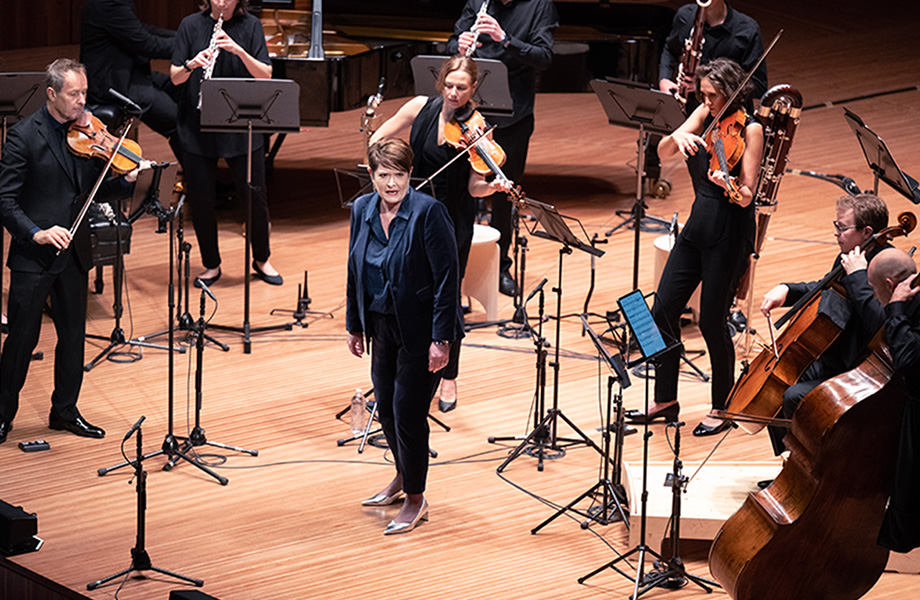
- Article Hero Image Caption: Catherine Carby and the Australian Chamber Orchestra (photograph by Nic Walker)
- Alt Tag (Article Hero Image): Catherine Carby and the Australian Chamber Orchestra (photograph by Nic Walker)
- Production Company: Australian Chamber Orchestra
Three early short songs by Alma Mahler-Werfel, wife of Mahler, followed, in a chamber-orchestra arrangement especially commissioned by the ACO from David Matthews. The thirteen-piece orchestra, led by Richard Tognetti, and soloist, mezzo-soprano Catherine Carby, were nicely balanced and pursued their varied inflections in support of the work’s short love story. For Carby, with strength across the range and effortless control of tone and vibrato, it was a welcome warm-up for greater tests to come after interval.
Mahler’s A Song of the Earth (1908-9) is an incredible work that absorbs three decades of his experience with song cycles into a large-scale and profound development of his symphonic conception, by then expressed in eight monumental symphonies. Erde’s first five songs, with texts adapted from traditional Chinese poems that resonated with Mahler’s own social and ecological values, might pass as part of a song cycle. But not his last movement, ‘Der Abschied’ (‘Farewell’). There, his use of voice and of instruments transcends anything hitherto in his symphonic output. Even Mahler’s Ninth and incomplete Tenth symphonies are unable to rival the symphonic profundity of Erde’s half hour of farewell.
How then does a chamber ensemble of fewer than twenty players, including two voices, grapple with such a monolith, composed by a master conductor for a large, late-Romantic orchestra? Fortunately, master orchestrator Arnold Schoenberg had attempted a chamber setting in 1921, which was completed in 1983 by Rainer Riehn. With many players doubling on instruments, especially woodwinds, and skilful use of three keyboard instruments, an amazing facsimile of Mahler’s Erde is possible. This arrangement maintains the original tenor and alto vocal parts, and has Mahler to thank for his highly soloistic featuring of instruments, particularly wind and brass, in the full-orchestra original. It is, however, the reduction of the strings from some fifty orchestral to just five chamber players that poses an irresolvable challenge in terms of emulating Mahler’s original balance and sheer tonal sheen. In this chamber arrangement, the strings, and especially the two violins, will often struggle to be heard. With one of those violins being music director, and occasional conductor, the challenge is heightened. On the other hand, the voices and other instruments are better heard, bringing into higher relief detail that is sometimes aurally submerged in Mahler’s ‘big sea’ of sound.
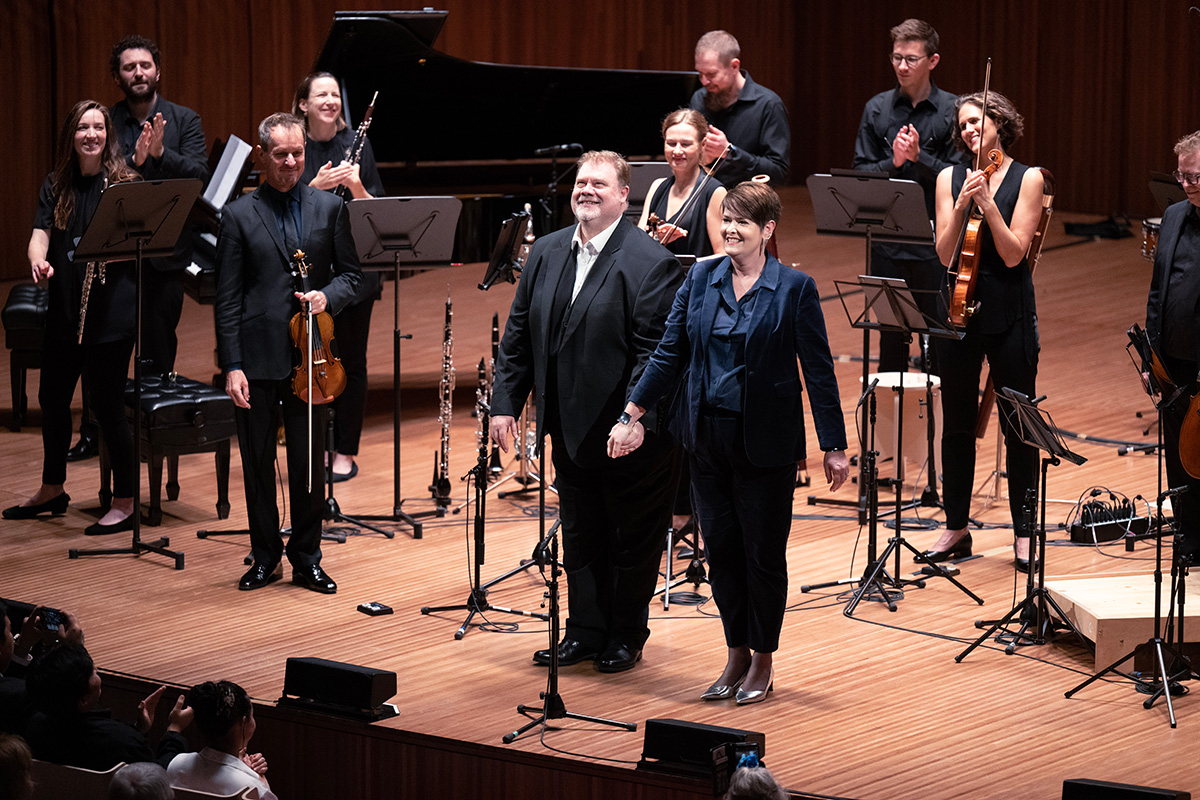 Stuart Skelton, Catherine Carby, and the Australian Chamber Orchestra (photograph by Nic Walker)
Stuart Skelton, with a truly Helden pedigree, excellent diction, and stylistic sympathy, was ideally cast as the alternating soloist across Erde’s six songs with Carby’s mezzo-soprano voice. He artfully rendered the very high writing for the tenor part in his first Drinking Song, and fluently dovetailed with talented members of the woodwind quartet (Sally Walker, Shefali Pryor, Olli Leppäniemi, and Todd Gibson-Cornish) in their solos celebrating ‘Youth’. Yet Skelton seemed to be out of puff by the time we reached ‘The Drunkard in Spring’. Or was this a case of acting the part? His final lines are, after all: ‘What do I care about spring? Let me be drunk!’
Carby was, throughout, in top form. In her three featured movements, she delved into the darker, deeper depths that had caused Mahler to designate this an alto (also, allowing a baritone) role. Counterpointing with the cello (Timo-Veikko Valve) in ‘The Lonely One in Autumn’, she revealed her full expressive range, while later, in ‘Farewell’, she demonstrated the chilling expressionlessness that Mahler demands of the role, almost causing time to stand still. Her middle movement, ‘Of Beauty’, evidenced her skills of diction and projection in the gabbling account of a horse in full flight, where many a soloist has come to grief.
It is, however, in this final long ‘Farewell’, with its extensive instrument-only developments, that Erde reaches its apogee. The voice becomes just another instrument in a magnificent exploration of the wanderings of the ‘lonely heart’, and leaving of the ‘world’, before the final lines of hope for the ‘earth’: the greening brought by spring, and the shiny, bright, and blue horizons of hope, forever. The ACO’s rendition of this ending, with Carby, showed their excellent individual musicianship. But it was too cautious. This work needed the ultimate dictating of a non-playing conductor to wind it finally down to infinity.
Mahler’s Song of the Earth (Australian Chamber Orchestra) continues in Melbourne (13, 22, and 26 May), Brisbane (20 May), Canberra (24 May), and Sydney (Angel Place, 15, 17, and 18 May). Performance attended: 12 May 2024.