


- Free Article: No
- Contents Category: Music
- Custom Article Title: Víkingur Ólafsson & Consortium
- Review Article: Yes
- Article Title: Víkingur Ólafsson & Consortium
- Article Subtitle: Astounding pianism that departs from Bach’s towering work
- Online Only: No
- Custom Highlight Text:
Monday evening saw a curious pairing of repertoire and performers at the Melbourne Recital Centre. Part One was a program of English consort music of the sixteenth and seventeenth centuries played by the local viol ensemble Consortium, while Part Two featured Icelandic pianist Víkingur Ólafsson playing Bach’s Goldberg Variations.
- Article Hero Image (920px wide):
.png)
- Article Hero Image Caption: Víkingur Ólafsson (photograph by Laura Manariti)
- Alt Tag (Article Hero Image): Víkingur Ólafsson (photograph by Laura Manariti)
- Production Company: Melbourne Recital Centre
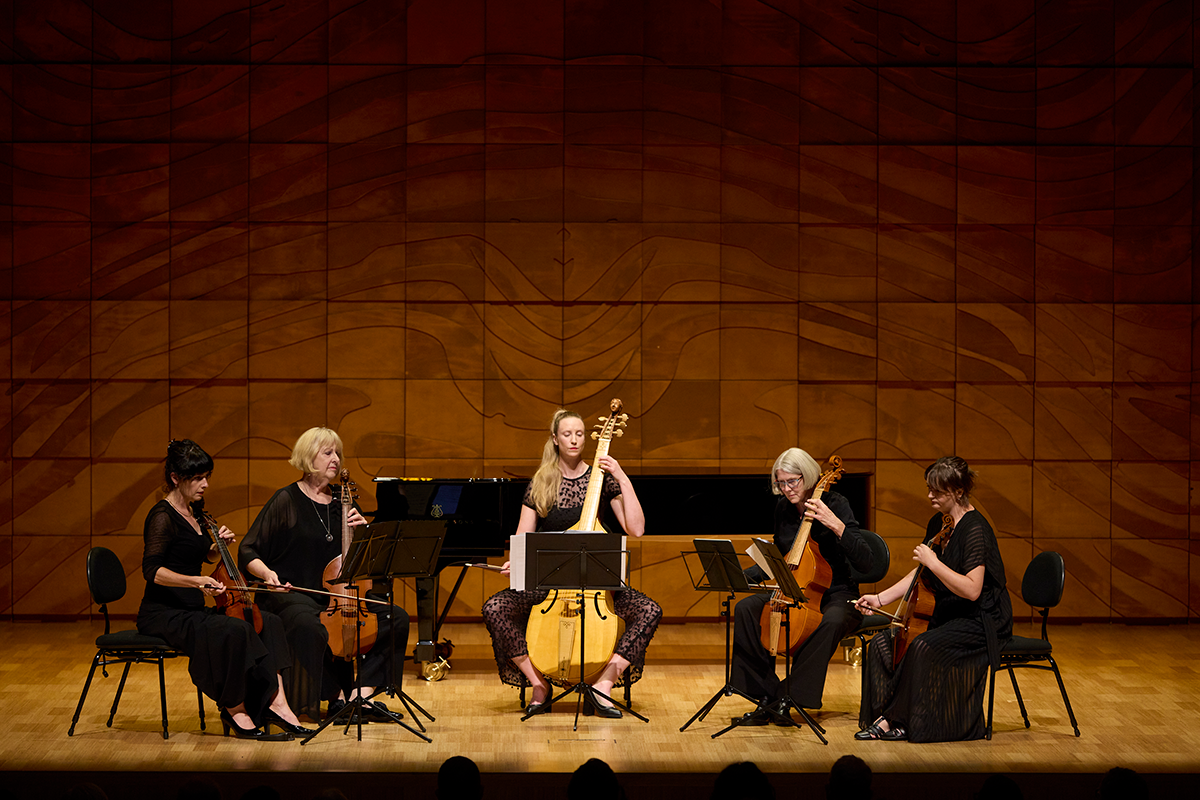 Consortium (photograph by Laura Manariti)
Part Two brought us to the featured artist of the evening. Ólafsson has built a strong reputation as a solo pianist and recording artist over the past decade and a half, including performances with European and North American orchestras, and recordings with Deutsche Grammophon. His current world tour is devoted solely to performances of the Goldbergs, which he recorded in 2023.
Let it be said immediately that Ólafsson is in possession of an admirable, indeed astounding, finger technique. As a demonstration of pianism, the performance earned the standing ovation that it received. A voice near me said, ‘He certainly tamed that piano’, and indeed he did.
But where was Bach?
Ólafsson is on record as saying that we know nothing about how Bach played – we couldn’t even imagine it. Well, yes, if we fail to observe Bach’s notation and his ornaments table, and don’t study the writings of his son Carl Philipp Emanual Bach; or of his student Johann Philipp Kirnberger; or of his contemporaries, Johann Mattheson and Johann Joachim Quantz (among others), we will find ourselves quite bereft of information on how he played.
But happily a wealth of information on how Bach played is available to those who seek it. Bar 2 of the Goldberg theme, for example, contains two appoggiaturas, of which Ólafsson’s performance was innocent. It would have been much simpler for the composer to have written what Ólafsson played, but his less convenient notation gives the performer details of rhythm, articulation, and accent, all of which were missing on this occasion. Throughout the performance the pianist repeatedly ignored or contradicted the composer’s own teachings (and those of his son) about how his ornaments were to be interpreted.
Variation 1 was played at what may well have been a record speed. But the movement is a Polonaise, perhaps given pride of place by the composer owing to his position as ‘Polish Royal Composer’, this title immediately following his name on the front page. The Polonaise character is instantly evident in the movement’s rhythmic make-up, and while the dance was a lively one, it was not a race. Many other variations were also played at speeds more appropriate to the Grand Prix than Bach’s music, so much detail lost to the listener in the process.
Variation 7, on the contrary, was taken by Ólafsson at a leisurely pace, despite the fact that the composer added the indication ‘al tempo di giga’ by hand in his personal copy of the print – perhaps to ensure against its interpretation as a Siciliana, as indeed it was often played before the discovery of Bach’s Handexemplar half a century ago, and again on this occasion. Similarly, in Variation 15 Bach’s ‘andante’ was simply ignored in favour of an ultra-slow tempo, which would have required at least an ‘adagio’ marking, if not ‘adagissimo’. On the other hand, Variation 25, so slow on his recording that it lasts almost ten minutes (described as ‘obnoxious’ by American reviewer Dave Hurwitz), on this occasion came in around the eight-minute mark, still a very slow ‘adagio’, but much more palatable, and indeed expressively played, despite the substitution of some of his own ornaments for Bach’s. And the next movement, Variation 26, was unique among the dazzlingly fast movements in maintaining clarity of texture throughout.
A complete list of Ólafsson’s departures from Bach’s text would take several times the space available here. Let it simply be said that the overriding impression throughout was that he should do whatever was in his power to override Bach’s notation and contradict the performance conventions of the day.
In a recent interview Ólafsson admitted that he had toyed with the idea of changing the order of the variations, but he eventually had to concede that he couldn’t improve on Bach’s order. Perhaps in time he will acknowledge Bach’s superiority in other details of this towering work. The moderation of the tempo of Variation 25 might be seen as a first step.
Víkingur Ólafsson & Consortium (Melbourne Recital Centre) was performed on 25 March 2024.