


- Free Article: Yes
- Contents Category: Film
- Custom Article Title: Alliance Française French Film Festival 2024 Highlights
- Review Article: Yes
- Article Title: Alliance Française French Film Festival 2024
- Article Subtitle: An eclectic mix of French films
- Online Only: No
- Custom Highlight Text:
The Alliance Française French Film Festival, the world’s largest showcase of French cinema outside of France, returns in 2024 for its thirty-fifth edition, with its usual eclectic mix of films from arthouse to mainstream cinema. Francophiles and cinephiles alike can see films from a range of genres, including drama, romantic comedy, social comedy, thriller, and historical biopic – from renowned directors like Marcel Carné and Olivier Nakache and Éric Toledano, to newcomers like Marie Amachoukeli. This year’s festival features the usual big names in French cinema – Catherine Deneuve, Isabelle Huppert, Daniel Auteuil, Laure Calamy, and Mathieu Almaric – alongside some excellent début performances. Here are some of the highlights.
- Article Hero Image (920px wide):

- Article Hero Image Caption: The Animal Kingdom (Courtesy of Studio Canal)
- Alt Tag (Article Hero Image): Alliance Française French Film Festival 2024 Highlights
Marie Amachoukeli’s tender, delicate, and inventive film tells the story of hypersensitive and precocious six-year-old Cléo (Louise Mauroy-Panzani), a mop of curls and oversized glasses, and her much-adored nanny, Gloria (Ilça Moreno Zego), who has raised her since birth. When Gloria is obliged to return to her native Cape Verde and her own children, Cléo’s world is turned upside down. To placate her, Gloria invites Cléo to spend one last summer on the island with her family.
Àma Gloria was inspired in part by Amachoukeli’s own childhood, the melodramas of Douglas Sirk, and the quintessential nanny film Mary Poppins (especially in its inclusion of animation and exploration of a strong and loving non-parental bond between caregiver and child). Told from the child’s point of view, Amachoukeli’s film is a sensorial and tactile cinema: Cléo sees but also listens and touches. Above all, she feels. The film also mixes live action with animation, the latter providing direct access to Cléo’s inner world. Conflating the gaze of the camera and that of the child is always a powerful conduit of affect. As French philosopher Jacques Rancière said of the ‘child-director’: ‘The common fable of a child’s naked stare on the adult world allows an art form to face up to its own potential.’ Captivating and heartrending performances by non-professional actors Ilça Moreno Zego and the young Mauroy-Panzani.
The Animal Kingdom (★★★★ ½)
The Animal Kingdom (directed by Thomas Cailley) belongs to a growing corpus of films which deal with the human-animal distinction and the relationship between human and non-human animals. In this intriguing fable, a curious phenomenon is causing part of the human population to metamorphose into various non-human animals. Among these mutants (or ‘critters’, as they are referred to in the film), is Lana, the wife of François (Romain Duris) and mother of Émile (Paul Kircher). François does all he can to help his wife, including reluctantly committing her to a treatment centre. When Émile, too, starts showing symptoms of transformation, François begins to realise that his struggle is not against the mutation itself but against the prejudice which it arouses in the human population.
Described as an ‘arthouse blockbuster’ and an ‘intimate epic’, The Animal Kingdom is a film as hybrid as the critters it depicts; at once coming-of-age tale, melodrama, and science-fiction fantasy. Moreover, it shifts register from thriller to comedy to horror to drama. Special effects and sound design make the scenario believable and affecting. No explanation is offered for the mutation, a strength of the film, which is never heavy-handed in delivering its message. Instead, Cailley makes the judicious choice to explore the consequences of becoming ‘other’, putting human beings literally into the skin of animals, with a range of reactions explored including horror, fascination, disgust, disdain, and, above all, empathy. There is even a nod to the much-maligned pangolin, said to have passed the coronavirus from bats to humans, which prompted the French response ‘Je suis un pangolin’. The film is also haunted by France’s collaborationist past. Ultimately, however, it is a film about adaptation and how we as a species need to rethink our own place in the animal kingdom. Powerful and moving performances from Duris, Kircher, and Tom Mercier as the eagle-human hybrid ‘Fix’ anchor this ambitious and visionary film.
Bonnard, Pierre and Marthe (★★★)
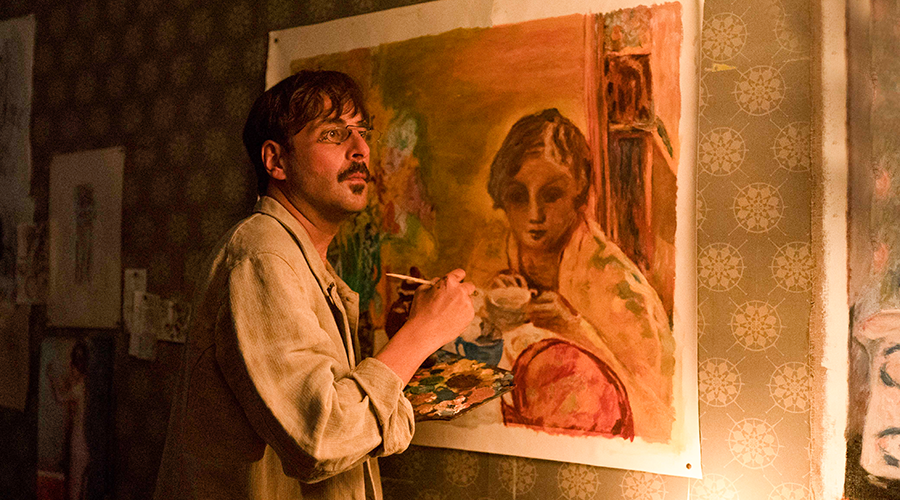 Vincent Macaigne as Pierre Bonnard (Courtesy of Palace Cinemas)
Pierre Bonnard’s quotidian subjects have earned him the labels ‘painter of happiness’ and ‘bourgeois intimist’. It is no surprise, then, that Martin Provost’s Bonnard is an example of the peculiarly French intimist drama punctuated with moments of pure happiness such as frolicking through fields, bucolic picnics, and lazy afternoons by the river. However, in the intimist tradition it also delves deeper into this happiness to approach the human drama beneath the colourful canvases. The central story is the fifty-year relationship between Bonnard (Vincent Macaigne) and his lifelong muse, Marthe de Méligny (Cécile de France). Their insulated world is upended when Bonnard introduces into their lives Renée Monchaty (Stacy Martin), who quickly becomes his new muse and mistress. The focus of the film, however, is Marthe, whose stoicism and inner strength is conveyed remarkably by France. Temporally abandoned by Bonnard, she herself turns to art, producing works admired by Claude Monet and, eventually, Bonnard himself.
Like other painter biopics, Bonnard is infused with the artist’s personal style, and it is certainly visually pleasing. Luminous and sensual in tone, an elegant eroticism runs through the film, recalling Bonnard’s nudes.
A Difficult Year (★★★★)
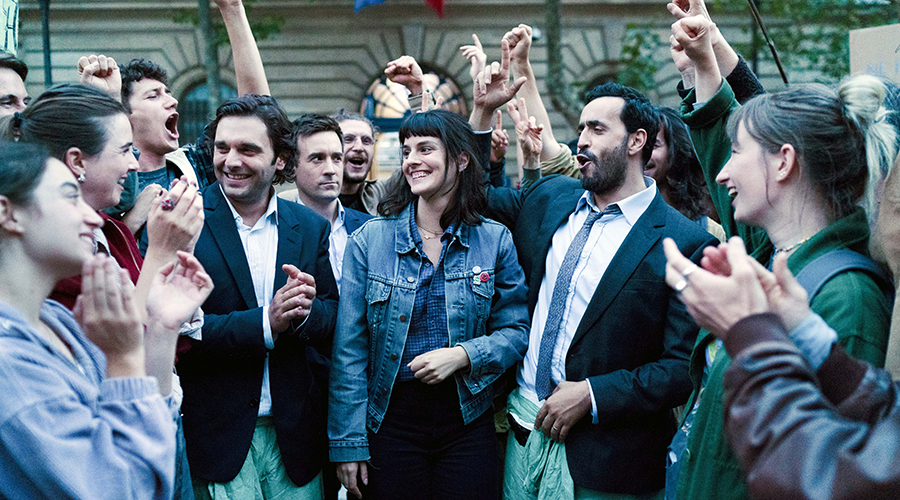 A still from A Difficult Year (Courtesy of Palace Cinemas)
Possibly Éric Nakache and Olivier Toledano’s best film, this impeccably crafted social comedy (a genre they have made their own) approaches the serious issues of climate change, eco-anxiety, hyper-consumption, and spiralling personal debt with a light-handedness which in no way denigrates or downplays these issues. The film follows a group of radical climate activists (many of them real activists who agreed to appear in the film) who are infiltrated by two opportunistic and unlikely ‘buddies’, Albert (Pio Marmaï) and Bruno (Jonathan Cohen), both down on their luck. They first attend the group’s meetings for the free food and beer, but when Albert develops a fascination with one of the group’s leaders, known only as ‘Cactus’ (Noémie Merlant), their involvement in the activists’ cause deepens.
Nakache and Toledano have a talent for staging set pieces which evoke a range of emotions. These include an opening sequence of the Black Friday Sales riots set to the music of Jacques Brel and a denouement on a runway in which activists halt a jumbo jet. These are powerful scenes which leave the directors’ sympathies in little doubt. The film also features a poetic coda which shows us another possible world and another possible way of living. Performances are excellent. Marmaï and Cohen tread a fine line between cynicism and enthusiasm, while Merlant’s nuanced Cactus is never reduceable to a stereotype. Mathieu Almalric also appears in a hilarious tragicomic turn as a debt counsellor with a gambling addiction.
Out of Season (★★★★)
Stéphane Brizé’s comedy/drama follows an actor in the throes of a mid-life crisis (Guillaume Canet), who checks into a thermal spa in an unnamed Breton town. By chance he meets up with a past love, Alice (Alba Rohrwacher), and the two begin a liaison which is not the rekindling of an old flame but rather the closure their failed relationship lacked. The morbid calmness of the health resort and the seaside town in the off season with its empty streets and palette of greys, steely blues, whites, and beiges are both the blank canvas for the couple’s internal recollections and introspections, and the expression of the characters’ psyches.
A sense of stasis pervades the film, the aesthetics of which are complemented by Vincent Delerm’s evocative score, which Brizé described as ‘a landscape of melancholic smiles’. Brizé pieces together his film from diverse influences like Jacques Tati, Jacques Demy, and Ingmar Bergman to create a tone both comic and tragic, best captured in Canet’s sad-clown face and at times slapstick performance. Brizé also exploits all the comic possibilities presented by a modern-day health spa, with Mathieu resignedly undergoing massages, seaweed wraps, and compression treatments while simultaneously being bombarded with requests for selfies from adoring staff. There is a fine synergy between Canet and Rohrwacher, whose sympathetic portrayals make their story convincing and makes you actually care about their lives.
The 35th Alliance Française French Film Festival shows across Australia until 21 April 2024.